Showing posts with label Anthony Robbins. Show all posts

Wednesday, February 26, 2025

Self-RECORDING


 Chapter 9


Self-RECORDING


Construction Stage 1.5   Planning and Scheduling

SAL Model Stage 1.5   Self-Recording


"If your life is worth living, it's worth recording."

Anthony Robbins


JOURNALING is one of the most important
practical skills a self-action leader
can practice on a regular basis.
Self-recording refers to the art and science of calendaring, and more especially to JOURNALING.

It is metaphorically analogous to planning, scheduling, and tending to other logistical details involved in constructing a skyscraper. Just as a building company must coordinate numerous particulars in the execution of a construction project, YOU must likewise plan, schedule, and coordinate the daily minutia involved in leading, managing, and constructing your life and career.  

Self-recording activities empower you to work out and refine your ideas, make them more concrete and detailed, conceptualize plans of action, and then draw it all up in an organized manner. 

It also affords you the opportunity to become a self-historian and gain the insights and other benefits of self-awareness derivable through deep introspection. 

In addition to aiding your recall of past events and details, self-recording is also useful for reviewing and analyzing your ongoing progress as well. 

JOURNALING is great
for your MEMORY
Journaling is also marvelous for your MEMORY.

To wit: Folks sometimes comment on my own accurate and prodigious memory, and I have my prolific journaling habit to thank for it—at least in part.   

If you were a diarist or journaler before diving into this Life Leadership textbook, that is great! If, on the other hand, your first foray into regular journaling was in your SAL journal, that's okay! If you still have not started a personal diary, journal, and/or SAL Journal, I invite—and strongly urge you—to begin one today. 

Some people (like me) like to save their journals in word processing and spreadsheet files, or online as a web document or blog. Others prefer to write it out the old-fashioned way by putting pen to paper in a notebook or leather-bound journal. Some prefer scrapbooking, photo albums, audio recordings, videography, or some other modern tool and technique for self-recording. 

How you do it is of secondary importance.

The important thing is that you DO IT!

We at Freedom Focused encourage you, of course, to record your SAL Journal right here inside this Life Leadership textbook, where a lot of blank space has been reserved for this very purpose. However, if you are an extra dedicated and enthusiastic diarist, you may want to make this text just one of several places in which you engage in self-recording activities.  

Composing a diary or journal deepens and improves your introspective processes, self-awareness, self-analysis and examination, personal planning, and writing skills. 

It also helps you gain a greater sense of your life's meaning and purpose.  

Every self-action leader's planning system will be unique.
In addition to these many benefits, Journaling provides therapeutic benefits to your emotions, psyche, and soul. This is because it is an ideal place and medium where you can safely vent and otherwise process angry, frustrated, or hurt feelings in a low-risk environment. Ample anecdotal evidence exists to suggest that journaling contributes to higher levels of emotional intelligence, mental hygiene, and Existential Growth.

Calendaring and day planning—electronically or via paper—are also key components of self-recording. If you plan something and write it down, you are more likely to remember and then keep your commitments. And like journaling, how you choose to proceed with the process itself (e.g. computer, paper, smart phone, etc.) is of secondary importance to just doing it. 

So...

Put together a system of tools that works well for you, and then, as the old saying goes:

Plan your work; and work your plan!


In Your Journal

  • Now that YOU are at this stage of the SAL Textbook and Master Challenge, and have gained some experience writing in your SAL Journal, reflect on what your journaling experience has been like so far. 
  • Have you noticed any benefits or blessings that have accompanied your journaling efforts to date? If so, what are they, and what further favors and fortunes do you believe might follow your future journal writing efforts?  


SAL Master Challenge

EXERCISE  #9


Self-action leaders ORGANIZE, PLAN, and JOURNAL


1.  If you don't already have a system for calendaring and planning, organize and prepare a system that works for you and then start using it TODAY.  

2. If you haven't already done so, begin a new journal—separate from your SAL journal—in the medium of your choice by composing a fresh entry for TODAY. 

3. Determine how often you plan to write and then maintain your writing momentum by meeting your regularity goal. 

REMEMBER: Your personal SAL Journal is private. You are therefore FREE to write openly and honestly about your anxieties, fears, thoughts, feelings, hopes, dreams, goals, et cetera.

For Example:

  • Daily task (to-do) list
  • Daily record of events
  • Thoughts
  • Feelings
  • Fears
  • Frustrations
  • Ideas
  • Inspiration
  • Hopes
  • Dreams
  • Loves
  • Joys
  • Challenges and obstacles
  • Pains and struggles
  • Pet peeves
  • Epiphanies
  • Breakthroughs
  • Values
  • Vision
  • Goals
  • Standards
  • Etc.

I have completed the SAL Master Challenge EXERCISE #9


Your initials:__________         AP initials:__________


Dr. JJ

Wednesday, February 26, 2025
Palm Beach Gardens, Florida, USA


Author's Note: This is the 435th Blog Post Published by Freedom Focused LLC since November 2013 and the 241st consecutive weekly blog published since August 31, 2020.   

Click HERE for a compete listing of the other 434 FF Blog Articles 

Click HERE for a complete listing of Freedom Focused SAL QUOTES  

Click HERE for a complete listing of Freedom Focused SAL POEMS   

Click HERE to access the FULL TEXT of Dr. JJ's Psalms of Life: A Poetry Collection

Click HERE for a complete listing of Self-Action Leadership Articles

Click HERE for a complete listing of Fitness, Heath, & Wellness Articles

Click HERE for a complete listing of Biographical & Historical Articles


Click HERE for a complete listing of Dr. JJ's Autobiographical Articles

.........................

Tune in NEXT Wednesday for another article on a Self-Action Leadership related topic.  

If you liked this blog post, please share it with your family, friends, colleagues, and students—and encourage them to bookmark this blog to access a new FREE article every Wednesday.


Click HERE to buy the SAL Textbooks


Chapter 9 Notes

Wednesday, January 15, 2025

Seeds of Self-Help


 Chapter 2


Seeds of Self-Help 


This chapter tells the story of my introductions to and experiences with the self-help and personal development fields. It chronicles a journey that began when I was just a boy and would eventually lead to the development of the SAL Theory and Model and the creation of this Life Leadership textbook.  

I was 14 years old when Warner Books published my Uncle Hyrum's book, The 10 Natural Laws of Successful Time and Life Management, which would eventually sell over a million copies and complement the massive success Hyrum was already enjoying with the Franklin Day Planning system.

During the summer of that same year (1994), I worked as a lowly field hand on Hyrum and Gail's sprawling ranch in Gunlock, Utah, and environs. 

A ranch hand's work is physically strenuous and low-paying. I earned $4.25 per hour for my labors that summer, which was the minimum wage in 1994. Summer days in southwestern Utah were hot, dry, dusty, and long. Temperatures often exceeding 100-degrees Fahrenheit (38 degrees Celsius) and rain was rare. Our daily commute usually included a ride in the back of a white Ford pickup truck. 

One week, we were assigned to build a fence up in the mountains, many miles away from the bunkhouse where we ate and slept. Facing a long, bumpy ride to work each day that week, I decided to take along a book to read. I had brought several books from home to read and study that summer. The book I chose on this particular occasion was: The Magic of Thinking Big, by David J. Schwartz.

Once I started reading, it was hard to stop, and not just because I enjoyed reading more than digging post holes in the rocky desert soil; but because the seeds of hope, possibility, and vision that the book planted in my mind and heart. I enjoyed that book so much that I would sometimes read at lunchtime and after work was over. I kept reading until I had read, marked, and annotated the entire volume. 

As I read, studied, and pondered Schwartz's hopeful and positive message, his words sunk deep into my soul, spawning rich daydreams about my personal and professional potential. I grew increasingly motivated by the realization that I didn't have to be a ranch hand for the rest of my life. I was further inspired by the idea that I could actually design my life largely according to my own desires if I was willing to pay the price. 

When I read the words: when you believe, your mind finds ways to do, (1) I was inspired by the personal power and capacity I possessed to accomplish difficult and meaningful achievements in my life and career despite any obstacles that might stand in the way. 

This was the point in my life when a nascent conceptualization of the SAL philosophy gradually began to form in my mind and heart. 

Over the next several years—throughout my teenage and young adult life—I increasingly took advantage of opportunities to read and study books and listen to audio tapes and CDs in the self-help and personal development fields.

Hyrum W. Smith
1943-2019
The books and/or authors from whom I supped included:

  • Dale Carnegie
  • Norman Vincent Peale
  • Napoleon Hill
  • Og Mandino
  • M. Scott Peck, M.D. 
  • Hyrum W. Smith
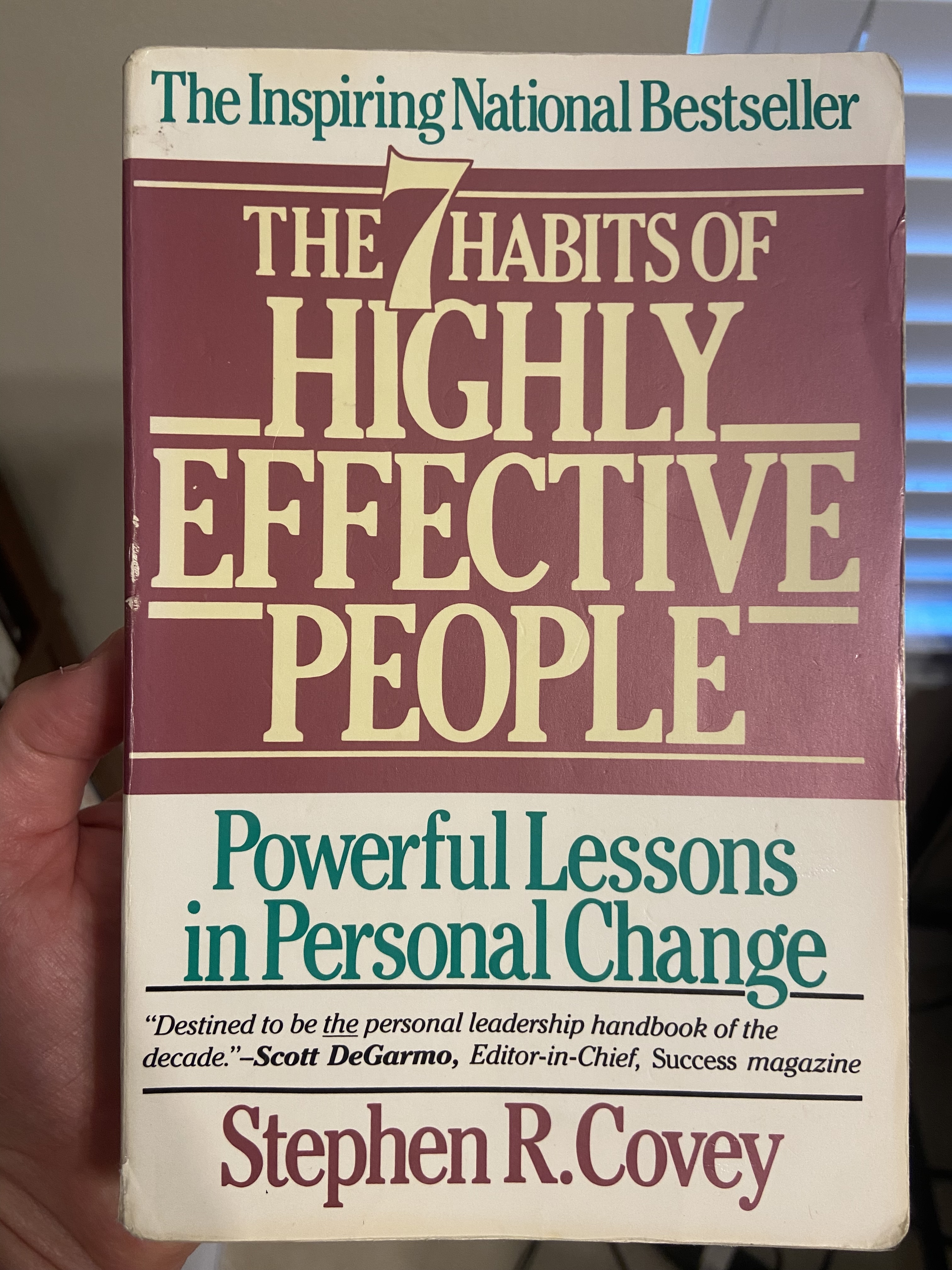
  • Stephen R. Covey
  • Anthony Robbins
  • Brian Tracy
  • Zig Ziglar
  • Et al. 


I'll always cherish my dad's personal copy of Dale Carnegie's How to Win Friends and Influence People. He had purchased the book in England in the mid-1960s while serving as a young missionary and it had that wonderful "old book" smell. 

When I was in eighth grade, my mom started buying Gary Smalley's relationship videos. Smalley's trainings focused on family relationships, and more particularly on marital unions. Though it would be years before I would start looking seriously at exclusive dating or marriage myself, I enjoyed watching these programs with my mom and learned a great deal about personality differences, communication skills, and successfully cultivating healthy and successful relationships.  

When I was a junior in high school, my oldest brother, Paul—a successful salesman and manager who shared my passion for personal development and self-help—sent me a videotape training by Jim Rohn, a famous business philosopher of the late twentieth and early twenty-first century.

Rohn had some GREAT stuff! 

A half-decade later, as a direct salesman myself, I was reintroduced to Rohn's work. While I ultimately found little aptitude for or interest in sales and marketing, Rohn's timeless talk on CD, entitled: Building Your Network Marketing Company, was filled with general truisms about long-term success that enormously influenced my thought processes as I set out to build Freedom Focused, develop the SAL Theory and Model, and compose iterations of this Life Leadership textbook.

To this day, I hear Rohn's voice in my head more than most others because of how concise, incisive, and memorable of his personality and teaching style.    

In high school, I attended a couple of Peter Lowe-organized day-long success seminars, where I had the chance to hear an impressive collection of high-profile speakers address personal development topics related to self-improvement, health and wellness, and success.

These speakers included:

  • President Gerald Ford
  • General Colin Powell
  • Zig Ziglar
  • Karl Malone
  • Et al. 
My personal copy of The 7 Habits
Annexed from my parent's home library
Shortly after graduating from high school, I read my Uncle Hyrum's book, The 10 Natural Laws of Successful Time and Life Management, wherein I made a commitment to be more conscious about planning my days moving forward. 

Later on, in college, I took a course in leadership from Brigham Young University (BYU) as a visiting student and a course in organizational behavior from Utah Valley University (UVU). 

These classes reintroduced me to Carnegie's How to Win Friends and Influence People and led me to carefully study Stephen R. Covey's bestselling book, The 7 Habits of Highly Effective People. I voraciously consumed Covey's classic work, which planted a potent and plentiful patch of additional SAL seeds in in my mind, heart, and soul. 

More than any other personal leadership-oriented or self-help book I had ever read, the 7 Habits left a deep and lasting impression on me. After reading the book, I obtained the same material on CD—taught by Covey himself—and listened intently to the entire program. The more familiar I became with the material, the more convinced I became that I didn't want to just practice what Stephen Covey had taught me; I wanted to become the Stephen R. Covey of my generation. 

My personal copy of Og Mandino's
The Greatest Secret in the World
In addition to carefully studying Covey's work during my college years, I also read books by Og Mandino. In particular, I carefully studied and completed Mandino's 45-week challenge outlined in his book: The Greatest Secret in the World, which invites a reader to not just read the Success Scrolls from his classic: The Greatest Salesman in the World, but challenges him or her to apply those scrolls in a concrete, dedicated, and systematic manner over the course of nearly a full year. 

This particular self-help exercise was, by far, the most ambitious and labor/time intensive personal development project I had ever undertaken—before or since. Og himself stated in his book that the probability of someone actually completing his ambitious challenge was about one-in-75. (2) I was absolutely determined to prove to myselfand others, including Og, even though he died nearly a decade before I undertook his challenge—that I would be one of the 1.3 percent of people who would actually finish the entire program. 

Forty-five (45) weeks after I started, I succeeded in this, my objective—an accomplishment that provides me with a residual source of personal confidence, esteem, and inner security to this day

William James
1842-1910
Suffice it to say, over an extended process of association, the nascent seeds of SAL were planted deeply in my mind, heart, and soul. Over time, as I continued to cultivate, fertilize, water, and otherwise nurture those seeds, they began to grow up in the form of the SAL Philosophy.  


"Sow a thought, reap an action; sow an action, reap a habit;
sow a habit, reap a character; sow a character, reap a destiny."

William James


Thus, over a long period of time, I gradually developed and refined my own thoughts and ideas about personal leadership—notions that would, in-time, develop and evolve into the SAL Theory and Model. I recorded many of these thoughts in little black-and-white, pocket-sized "Marble Memo" notebooks.

During my early-to-mid-twenties, I filled over 20 of these books with ideas and inspiration—as it came, piecemeal, one entry at a time. My mind was exploding with ideas during this time and it was not uncommon for me to have an idea strike my brain at all times of the day, including when going to sleep at night or driving my car. At such times I was conscientious about getting out of bed, turning on the light, pulling out the little Marble Memo notebook I was filling at the time, and recording the thought—or, if I was driving, I would pull my car over to the side of the road and record the inspiration in my little notebook before proceeding on my journey.

Over a long period of time—20-plus years and counting now—I gradually developed, refined, and revised all my thoughts and ideas that would become the SAL Philosophy.

At age 25, I began constructing the SAL Theory and Model. At age 26, I self-published my first book: I Am Sovereign: The Power of Personal Leadership. It was a personal leadership guide for teenagers and contained the first version of the SAL Model, as well as early vestiges of the SAL Theory.

It was my first attempt at writing a book and contained many markings of an amateur. 

But it was a solid initial effort that would eventually go through SIX additional iterations over the course of the following two decades.

The third of these seven iterations came in the form of my doctoral research, where I further honed the SAL Model and introduced a full version of the SAL Theory for the first time. The Life Leadership textbook you now hold in your hands is four (4) iterations removed from my dissertation, published in 2013. It is the result of 40 years of informal research, 24 years of formal research, organizing, writing, editing, revising, and continually polishing. 

It is a project literally tens of thousands of hours in the making.

It is my magnum opus as a thinker, writer, organizer, and leader. 

Indeed, I do not foresee, nor do I intend, to write or create anything more important or significant in my lifetime than this single, comprehensive work. Suffice it to say, it has been an incredible adventure and an exhilarating journey—a journey that is, in many ways, still just beginning.  


In Your Journal

  • Prior to being introduced to SAL, what self-help media (books, tapes, podcasts, etc.) positively influenced your life, actions, and Existential Growth? 

  • Which of these tools did you enjoy the most?  

  • Which of these tools did you find to be the most inspiring and/or helpful?

  • Which of these tools would you most highly recommend to others?

  • Which of these tools most closely resembles the message contained in the SAL Philosophy? 


Dr. JJ

Wednesday, January 15, 2025
Palm Beach Gardens, Florida, USA


Author's Note: This is the 427th Blog Post Published by Freedom Focused LLC since November 2013 and the 235th consecutive weekly blog published since August 31, 2020.   

Click HERE for a compete listing of the other 426 FF Blog Articles 

Click HERE for a complete listing of Freedom Focused SAL QUOTES  

Click HERE for a complete listing of Freedom Focused SAL POEMS   

Click HERE to access the FULL TEXT of Dr. JJ's Psalms of Life: A Poetry Collection

Click HERE for a complete listing of Self-Action Leadership Articles

Click HERE for a complete listing of Fitness, Heath, & Wellness Articles

Click HERE for a complete listing of Biographical & Historical Articles


Click HERE for a complete listing of Dr. JJ's Autobiographical Articles

.........................

Tune in NEXT Wednesday for another article on a Self-Action Leadership related topic.  

If you liked this blog post, please share it with your family, friends, colleagues, and students—and encourage them to bookmark this blog to access a new FREE article every Wednesday.


Click HERE to buy the SAL Textbooks  


Chapter 2 Notes

1.  Schwartz, D. J. (1995). The Magic of Thinking Big. London, UK: Pocket Books. Page 122.

2.  Mandino, O. (1972). The Greatest Secret in the World. New York, NY: Bantam Books. Page 2.

Wednesday, March 13, 2024

The CHALLENGE and QUEST to Become


Chapter 12


The CHALLENGE and QUEST to Become 


Three (3) acorns that had fallen from a
Mighty English Oak in suburban London, UK.
"Our ordinary mind always tries to persuade us that we are nothing but acorns and that our greatest happiness will be to become bigger, fatter, shinier acorns; but that is of interest only to pigs. Our faith gives us knowledge of something much better: that we can become oak trees."  (1) 

E.F. Schumacher


This is no ordinary self-help book.

Ordinary self-help books tell you what you must do to get something. They are typically transactional in nature, providing quid pro quo solutions to your problems (e.g. do this and you'll get that).

This Life Leadership textbook is different.

        It is transformational.

A Mighty English Oak in suburban London
My goal in writing it is to shift your focus from getting something to becoming something. (2)  For those still concerned about getting as part of your SAL efforts, you can put your mind at ease because there will be plenty of getting along the pathway of becoming! 

Years ago I taught a series of professional writing seminars throughout England, Scotland, and Wales. During my time in Great Britain, I had a chance to behold the "Mighty English Oak"—that I had heard about all my life—for the very first time. The picture of the oak tree on this page is of one of these mighty English oaks; and the accompanying picture features three acorns that had fallen from this same tree. 

I still have these acorns I scooped up off the ground underneath that mighty English oak that warm autumn afternoon in Merry old England. As I hold these acorns in my hand, I marvel at the profundity of their potential to become so much more than they are. Indeed, I feel a sense of holiness and reverence as I contemplate what those little seeds—smaller than my thumb—can potentially become.  

A Young Winston Churchill in uniform
at the Royal Military Academy at Sandhurst
Winston Churchill, arguably the greatest wartime leader in all of British (and Western) history, and a man known for his sharp and witty humor, once quipped: "We are all worms, but I do believe I am a glow worm." 


"We are all worms, but I do believe I am a glow worm."

Winston Churchill


I believe one of the key ingredients in Churchill's remarkable success as both a human being and leader was his conviction that his life mattered and his career was important and had meaning beyond a mere paycheck and health insurance policy. Fortunately, YOU and I don't have to be a Winston Churchill to believe this same thing about your own life and career.  

The truth is that none of us are merely "worms," as Churchill's trademark wit so comically suggested; we are all infinitely more than that. A more apropos analogy than worms and glow worms is acorns and oak trees.

It's great to be an acorn.  But it's infinitely
greater to be an acorn-producing Oak Tree!
Sadly, there are many acorns (people) who lack the vision that they can become oak trees. Sadder still, there are those who have a vision of their potential, but do not believe they are capable of rising up to it. Saddest of all, there are those who both envision and believe in their potential, but for a variety of reasons, get distracted along the way and decide it isn't worth the price required to become an oak tree. 

As a result, they settle for becoming what E.F. Schumacher referred to as "bigger, fatter, shinier acorns."  (3)  Instead of elevating their perspective, vision, intentions, and reality to becoming an oak tree, these people prefer to focus on getting material possessions, getting praise and prestige of the world, getting away with bad behavior, or doing the bare minimum to just get by. 

Acting in order to get something is not inherently dishonorable. To a certain extent we are all necessarily invested in this lower form of human activity. Acting in order to become, however, is a fundamentally different way of thinking, acting, and existing. It is a higher plan of human thought, speech, and behavior. 

For example, instead of habitually showing up late and doing just enough work to get paid and keep your job, a self-action leader shows up to work on time (or early), consistently gives their best effort, continually exemplifies personal integrity, helps their coworkers be successful, and eventually gets promoted. 

The base of a massive, solid OAK TREE
in suburban London, England
When you think, speak, or act to get something, you may obtain the object of your desire. But when you think, speak, and act to become something, you gradually grow beyond acorn status and into a towering, majestic, and mighty oak tree. 

Your personal and/or professional growth, aided by Serendipity (i.e. sun, rainfall, fertilizer, time, etc.) transforms your very being into something greater and more substantive than it was before. In turn, you become more free, influential, and powerful. You also become a recipient of all the blessings, rights, and privileges that come with being an oak tree—privileges, rights, and blessings that are not afforded to acorns.  

Existential Growth and freedom do not come automatically with the onward march of time. They are not "rites of passage." They must usually be earned. This is why it is possible to meet a mature teenager or young adult whose outlook and behavior are existentially ahead of an aged retiree wasting away in a nursing home, whose physical feebleness is only exceeded by one's existential bitterness.

On the flip side, I have also met teenagers who were rebellious and ungrateful hellions and aged retirees who, despite their atrophying physical bodies, harbored much wisdom and radiated countenances that shone like the angels of heaven. The point of these comparisons is that the passage of time alone is never a guarantee of becoming. Knowledge, skills, wisdom, maturity, growth, success, happiness, freedom, and inner peace always come with a price, and no one is exempt from paying that price. Such desirable states of being do not come freely as a result of attaining a certain age or stage of life. That is why, in the words of Henry Miller: If there will be any peace it will come through being, not having.


"If there be any peace it will come through being, not having."

Henry Miller


Learning, studying, and applying SAL principles and practices over time has absolutely transformed my life. It has helped me to become someone far greater than I was before. Along the way, ignorance, awkwardness, and foolhardiness has been replaced with knowledge, wisdom, and poise. Fear has been swallowed up in courage and faith. Diffidence has given way to confidence as confusion and disillusionment has been transmuted into visionary empowerment and hurtful practices have been replaced with helpful habits.

None of this came fast or easy; as my dad taught me when I was growing up: things worth having never do. Indeed, a high price in sweat, toil, tears and years was required to realize much sought-after growth, progress, happiness, success, freedom, and inner peace. But it has come... and is still coming—a bit at a time, each and every day—and the difference is telling; just ask anyone who knew me 10, 15, 20, 25, 30, or 35 years ago. In a very real sense, I'm a different person than I was back then.

Where do you see yourself in a year? 

        How about five, 10, 15, 20, or thirty years into the future?

What are you doing right now as an acorn to gradually become an oak tree in the future? Regardless what may have transpired in your past, there is always hope for the future. I am reminded here of the inspiring words of Tony Robbins, who pointed out that: The past does not equal the future.

"The past does not equal the future."

Anthony Robbins


No matter how hopeless things may seem right now, you can always begin today to create a better tomorrow... for the rest of your life.  


HABITS and the FOUR LEVELS of COMPETENCY

As human beings, we are creatures of habit. Depending on what our habits are, this can be a positive or a negative thing. Consider the following poem, an all-time favorite (4) of mine:


Who Am I?

I am your constant companion.

I am your greatest helper or your heaviest burden.
I will push you onward or drag you down to failure.
I am completely at your command.

Half the things you do you might as well turn over to me,
And I will do them quickly and correctly.

I am easily managed, you must merely be firm with me.
Show me exactly how you want something done,
And after a few lessons I will do it automatically.

I am the servant of all great people,
And alas, of all failures as well.
Those who are great, I have made great!
Those who are failures, I have made failures!

I am not a machine;
Though I work with all the precision of a machine,
Plus the intelligence of a person.

You may run me for profit or run me for ruin;
It makes no difference to me.

Take me, train me, be firm with me,
And I will lay the world at your feet.

Be easy with me and I will destroy you.

Who am I?

I AM HABIT!

Anonymous


The process of becoming involves a step-by-step journey of developing positive and constructive habits while concurrently breaking and undoing negative and destructive ones. 

The FOUR LEVELS of COMPETENCY model (5) provides an enlightening and useful framework for understanding the steps that lead to the creation of habits.

LEVEL 1:  Unconscious Incompetence: You are unaware of your own ignorance of—and inability to do something.

LEVEL 2Conscious Incompetence: You are aware of your own ignorance of—and inability to do something.

LEVEL 3Conscious Competence: You possess a basic knowledge of—and growing ability to do something.

LEVEL 4Unconscious Competence: You know and can do something without even thinking about it. A new habit has been formed and is fully operative. 


REAL LIFE EXAMPLES of the FOUR LEVELS of COMPETENCY in ACTION


LEVEL 1:  A kindergartner has never heard of algebra.

LEVEL 2:  A sixth grader learns that he/she will take algebra in middle or high school.

LEVEL 3:  A ninth grader enrolled in algebra 1 can solve algebraic problems with conscious effort and help from one's teacher.

LEVEL 4:  A college student enrolled in calculus reflexively works through routine algebraic equations.


Have you ever been driving down the freeway and thought to yourself: "I have no memory of the last 20 miles; I must be a hazard on the road!" Assuming you have good driving habits and are well-practiced behind the wheel, you are, in reality, quite safe in the midst of these seemingly extended "zoned-out" sessions. 

It's not that you aren't paying attention; you are simply driving on the highest level of competency (LEVEL 4). 

When you first got your driver's license, you could not drive on LEVEL 4; you had to practice and develop good habits until you could. 

Chances are you spend a significant portion of your day operating on LEVEL 4, especially if you are an adult. Many of the activities that all of us perform are completed on a level of "unconscious competence." 

For example: breathing, eating, brushing your teeth, getting dressed, walking, doing the dishes, etc. Depending on the habits you have developed, this can be a good, or a not so good, thing, depending on the kind of habits you have developed.  


Processes of Learning

Breaking old, negative habits and replacing them with new, positive habits requires self-awareness, focus, and repeated action. Most importantly, you must exercise the determination, patience, and persistence to not give up when the going gets tough.

To become, you must do.

        But before you can do, you must know what to do. This means you must learn, and in order to learn, you must exert the effort to read, study, ask, and observe. 

This three-step process provides a basic formula for becoming, as follows:
  • To become, you must do.
  • To do, you must learn.
  • To learn, you must read, study, act, and observe.  
This chapter identifies three different learning processes, all of which are vital to doing and becoming.

These processes are:
  • Learning
  • Relearning
  • Unlearning

The FIRST process—learning—refers to understanding something for the first time. 

The SECOND processrelearning—refers to reviewing something you learned in the past, but have forgotten about, or are not currently doing.

The THIRD processunlearning—refers to breaking a bad habit and replacing it with a new, more helpful habit.

Of the three learning processes, unlearning is typically the most challenging. This is due to the inherent difficulty involved in breaking an old, already ingrained habit, which requires that you go back to levels two and three after you are already used to performing a behavior on LEVEL 4. 

Backtracking levels of competency always forces you out of your comfort zone, which is usually an unpleasant place to find yourself.

The following exercise provides a simple example of why unlearning can be so challenging.

STEP 1:  Fold your arms.

STEP 2:  Notice which arm is on top (e.g. in the picture below, the man's RIGHT arm is on top).

STEP 3:  Now refold your arms by putting the opposite arm on top (e.g. in the picture below, the woman's LEFT arm is on top).


How does it feel to change which arm is on top?

Unless you are already accustomed to folding your arms both ways, it most likely feels awkward and uncomfortable to change how you fold your arms. When you first tried it, you may have even struggled to figure out how to do it the opposite way. 

After you finally got it right, did you think to yourself—or even vocalize—how strange or unusual it felt? Did you perhaps conclude that the new way was the "wrong" way? Or did you catch yourself going back to the old way so that it could feel "right" again?

With this exercise in mind, how many times do you think you would have to fold your arms in the new way (LEVEL 3) before the new way felt as normal as the old way originally did (LEVEL 4)? The answer to this question would vary from person-to-person. 

However, if you are like most people, it would take folding your arms in the new way for dozens, scores, or even hundreds of times before the new way felt as comfortable and "normal" as the old way—before a new habit is formed.

Have you ever known someone who broke a hand or lost an arm and had to learn to write with the other hand? In many cases, it takes weeks or even months of practice before a person can write as proficiently and neatly as they are accustomed. 

Have you ever known someone who moved to a different country and had to learn how to drive on the other side of the road? If so, ask them how long it took to get used to driving on the opposite side of the motorway? Chances are good it took them several months to feel comfortable driving in the "new" way. And for many, the "new" way never becomes as easy as the "old" way, even if they spend years driving on the "new" side.

Such can be the difficulty of breaking an old habit and developing a new one.

I live in the southeastern United States. Many years ago, my wife and our newborn son and I spent 16 days on a business trip in Great Britain. Neither of us had ever driven on the left side of the road. 

My wife, Lina—bless her heart—did all the driving while we were there, but after dozens of hours of motoring all over the British Isles for over two weeks, it still had not become automatic for her to drive on the left-hand side of the road, nor had her anxiety completely dissipated. Although we had a lovely trip, Lina was, at least from a driving standpoint, relieved to get back home to USA roads again.  

Consider another example: buttoning your shirt

Reflect for a moment on how you don a dress shirt. Do you button your shirt from the "bottom up" or from the "top down"? Or perhaps you do neither because you start in the middle and work "up and down." 

I remember the day I learned there were people in the world that buttoned their shirt from the "bottom up." Silly as it might sound, as a "top-downer," I was flabbergasted to discover there were people in the world who were "bottom-uppers"! 

"Why in the world would someone button their shirt from the "bottom-up?" I queried. "That's silly!" I thought to myself. My next response—a very natural one, I might add—was to conclude that buttoning one's shirt from the "bottom up" was the "wrong" way. After all, that is not the way that I do it

Such a sentiment is, of course, complete nonsense! Nevertheless, it just goes to show the erroneous nature of some of our natural inclinations as human beings.   

The morning after learning of the existence of "bottom-uppers," I curiously attempted to try it their way. You probably won't be surprised to hear that it took me several times longer to button my shirt that day!

These simple examples and exercises illustrate the inherent difficulty in breaking old habits and replacing them with new ones. Doing so, however, is possible; and the keys to your success are simple, but not easy

The key to success is: Consistent and Persistent PRACTICE.

Training yourself to do something new is often challenging; but training yourself to do something in an alternative way than you are accustomed to can prove downright devilish in its difficulty. Thankfully, the words "difficult" and "impossible" are not synonymous terms. We can change bad habits and replace them with good ones.

In fact, the possibility of changing your own nature and inclinations lies at the very root of Self-Action Leadership.

Changing habits—including natural inclinations with which you were born—is made possible by the malleable nature of our neurological systems. As a human being, we all have something animals do not, and that is the capacity to examine our inclinations and behavior to determine whether they are the kind of inclinations and behaviors we actually want to have and exhibit.

Thanks to your prefrontal cortex (or frontal lobe)—the part of your brain that regulates behavior, engages in social and moral reasoning, and is responsible for planning and decision making—YOU have the power to consciously and intentionally alter deeply ingrained habits and inclinations over time.

If you persist in making desired changes, those alterations can eventually develop into new, positive habits that, in time, become as deeply ingrained as your old, negative, and undesirable habits once were. 

This is the GOOD NEWS of SAL; it is also the miracle of humanity—a power to which the rest of the animal kingdom is simply not privy. It is one of the primary phenomena that places human beings on a fundamentally higher existential plane than animals and plants. 

How long does it take to get rid of a bad habit or negative natural inclination and successfully replace it with a good habit or positive natural inclination? 

Good question!

It has been said that it takes 21 days of consistently exercising a new action for that behavior to become a habit. Other will suggest various other amounts of time and effort. 

The truth is that it totally depends.

This is because many variables are at play in the formation of a habit. For example:

  • How long ago was the habit formed?
  • How often do you engage in the habit?
  • How addictive is the habit?
  • How deeply ingrained is the habit?

Likewise, many variables are at play in the attempt to break a habit. For example:

  • What environmental (i.e. circumstantial and situational) factors are at play?
  • How great is your desire and will to actually alter your thoughts, speech, and behavior involved in the habit?
  • How great is your determination to persist through negative inertia, temptation, and failure?
  • How willing are you to accept help from others?
  • How willing are you to open yourself up to Serendipity along the way?  

Suffice it to say, some habits are more easily broken, altered, and reformed than others. 

For example, if your home loses power in a storm, you will probably retrain yourself stop flipping the light switches after three-to-five failed attempts. On the other hand, if you have smoked cigarettes for 20 years, you aren't likely to break the nicotine habit after resisting your first three-to-five cravings.  

When I endeavored to stop sucking my finger at age 10, it took two-to-three years before I stopped craving the addiction.  (6)  Despite the difficulty of breaking the habit, I am very grateful I persevered because it would be quite embarrassing if I was still sucking my finger in my mid-forties!

As a self-action leader, YOU always have choices to make regarding the habits and orientations you will cultivate in your life and career. What habits are you presently choosing to nurture? What consequences will arise from your present choices? Are these the consequences you desire in the long run? We could all benefit from asking ourselves these questions on a regular basis throughout our lives. 

At best, life in this world is not easy. 

        In many ways, it can prove devilishly difficult.

Yet its greatest beauties and opportunities usually lie on the other side of our greatest trials and troubles. But you have to be willing to both travel and endure the journey that takes you to the far side of adversity. If you just sit there—or worse, lie down and give up—life will continue to thrash you over-and-over-and-over again. 

Don't let negative inclinations and bad habits beat you up and keep you down. In the ongoing battle against life's many trials, decide and determine today that whatever the cost, you will eventually emerge as the victor.

In discussing the subject of meeting and defeating adversity, I am always inspired by the incisive observation of Cavett Robert, said that: Life is a grindstone, and whether it grinds you down or polishes you up is for you and you alone to decide.


"Life is a grindstone, and whether it grinds you down or
polishes you up is up to you and you alone to decide."

Cavett Robert


Who Am I?

Who am I?

        Why am I here? 

                Where am I going?

                        What is my life's ultimate purpose?

These questions rank amongst the most important questions you can ever ask yourself. Arriving at positive and productive answers that deeply resonate with your mind, heart, and spirit ranks among the greatest accomplishments you can possibly achieve as a self-action leader. 

In conjunction with figuring out who you really are, it is equally important to discover who you really aren't. Many people live their entire lives deluding themselves about who and what they really are and/or aren't. We have all made this mistake to varying degrees; I know I have!

For example, I once believed I was destined to be an Olympic Gold Medalist and a professional basketball player. As lofty and potentially noble as those aspirations may have been, neither goal turned out to be realistic for me to pursue. 

Other ambitions I held as a boy included becoming a fantastic pianist, learning multiple foreign languages, and even being elected President of the United States, none of which I came even close to realizing, in large part because I discovered over time that I was poorly suited for piano, politics, and languages other than English.

As a boy, there were few limits to my youthful ambitions. From a sanitation engineer (garbage man), heavy equipment operator, builder, plumber, electrician, engineer, architect, lawyer, broadcast journalist, professor, actor, director, and psychologist, I wanted to be just about everything at one-time-or-another.

In the end, I discovered that none of these career paths were right for me.  

As a teenager I often felt frustrated because I didn't know exactly what I wanted to be "when I grew up." As a young adult attending college, I still didn't know what I wanted to major in until I was nearly finished with my general course work (the halfway point). Even after I graduated with my bachelor's degree, I struggled for many years gaining clarity about my long-term professional objectives. 

Discovering who I really am has been a long, laborious, and often confusing journey; and is by no means a finished business! Along the way I had to fight valiantly against external forces and voices that sought to discourage me or pull me down. I also had to face a measure of my own self-doubts. In the end, I was able to unlock my authentic identity with a clarity that has undergirded every meaningful achievement in my life and career to date.

It is incredibly illuminating and empowering to know who you really are.

Knowing who I am has enabled me to create, organize, and polish this Life Leadership textbook. This incredibly valuable self-knowledge provides me with untold lucidity and vision concerning the purpose of my life and the power of my possibilities to achieve both personally and professionally and contribute meaningfully to the lives of others all along the way. 

Who are YOU?

You will never realize the full scope of your authentic potential until you know who you really are—as well as who you really aren't.

I sincerely hope that this Life Leadership textbook will serve you in a meaningful way along the pathways of your own exciting and essential journey through this life, which leads to those picturesque peaks and verdured valleys that exist on the far side of your current crises and crucibles.

However challenging—or even impossible—your life might seem right now, I promise you that there is always HOPE for a better and brighter future. And it is worth whatever time and effort may be required to travel through your trials to the promised land that awaits on the other side. 

I reiterate here the inspired words of Oliver Wendell Holmes, Jr., who so wisely discovered the desirability and value of the simplicity on the far side of complexity. Said he: I wouldn't give a fig for the simplicity on this side of complexity; but I would give my right arm for the simplicity on the far side of complexity.


"I wouldn't give a fig for the simplicity on this side of complexity;
but I would give my right arm for the simplicity on the far side of complexity."

Oliver Wendell Holmes, Jr.


In Your Journal
  • Who are you?
  • Why are you here?
  • Where are you going?
  • What is the purpose of your life?
  • What do you believe your ultimate potential is in your:
    • Education?
    • Career?
    • Relationships?
    • Life legacy?


SAL Master Challenge

EXERCISE  #4


Self-action leaders

Learn, Relearn, and Unlearn


Based on what you learned in BOOK the SECOND Chapter 12 about learningrelearning, and unlearning...


What is something you need to learn?

________________________________________________________________________________________________________________________________________________________________________________________________________________________________________________________________________________________________________


What is something you need to relearn?

________________________________________________________________________________________________________________________________________________________________________________________________________________________________________________________________________________________________________


What is something you need to unlearn?

________________________________________________________________________________________________________________________________________________________________________________________________________________________________________________________________________________________________________


Outline a plan below to effectively replace a bad habit with a new, better practice.

__________________________________________________________________________________________________________________________________________________________________________________________________________________________________________________________________________________________________________________________________________________________________________________________________________________________________________________________________________________________________________________________________________________________________________________________________________________________________________________________________________________________________________________________________________________________________________________________________________________________________________________________________________________________________________________________________________________________________________________________________________________________________________________________________________________________________________________________________________________________________________________________________________________________________________________________________________________________________________


I have completed the SAL Master Challenge EXERCISE #4


Your initials:__________         AP initials:__________


Dr. JJ

Wednesday, March 13, 2024
Palm Beach Gardens, Florida, USA


Author's Note: This is the 379th Blog Post Published by Freedom Focused LLC since November 2013 and the 190th consecutive weekly blog published since August 31, 2020.   

Click HERE for a compete listing of the other 378 FF Blog Articles 

Click HERE for a complete listing of Freedom Focused SAL QUOTES  

Click HERE for a complete listing of Freedom Focused SAL POEMS   

Click HERE to access the FULL TEXT of Dr. JJ's Psalms of Life: A Poetry Collection

Click HERE for a complete listing of Self-Action Leadership Articles

Click HERE for a complete listing of Fitness, Heath, & Wellness Articles

Click HERE for a complete listing of Biographical & Historical Articles


Click HERE for a complete listing of Dr. JJ's Autobiographical Articles

.........................

Tune in NEXT Wednesday for another article on a Self-Action Leadership related topic.  

And if you liked this blog post, please share it with your family, friends, colleagues, and students—and encourage them to sign up to receive future articles for FREE every Wednesday.

To sign up, please email freedomfocused@gmail.com and say SUBSCRIBE, or just YES, and we will ensure you receive a link to each new blog article every Wednesday.  


Click HERE to buy the SAL Textbooks    


Chapter 12 Notes

1.  Schumacher, E. F. (1977). A Guide for the Perplexed. New York, NY: Perennial. Page 135.

2.  Oaks, D.H. (2000). The Challenge to Become (Speech). 

3.  Schumacher, E. F. (1977). A Guide for the Perplexed. New York, NY: Perennial. Page 135.

4.  Once, at a Smith family reunion, my Uncle Hyrum recited this poem from memory during a family talent show.  

5.  The Four Levels of Competency model was developed by Noel Burch at Gordon Training International in the 1970s.

6.  See BOOK THE SECOND, Chapter 2: A Formula for Change for an account of breaking my finger-sucking habit at age ten.

APPENDIX M: Freedom Focused Declaration of Independence

       APPENDIX  M Freedom Focused Corporate Declaration of Independence Established in the Year of our Lord, Two Thousand and Five When in ...