Showing posts with label Library. Show all posts

Wednesday, March 31, 2021

The Wonderful World of Books

Part of my new office library in Florida
"The [person] who will not read is no better than the [person] who cannot read."

— Mark Twain 


I have always LOVED books.

It is, therefore, with an unusual sense of gratification and pleasure that I pen today's post from my brand new desk in my new home office where I am nearly completely surrounded by the beautiful sight of my personal library.  

My family and I recently fulfilled a long-held dream of ours to relocate to South Florida. Moving is an exciting time in one's life; it can also be stressful. My experiences with moving have been unusually many and varied—even by our highly mobile twenty-first century standards.

To wit, I am only 41 years old, yet have moved 45 times to 42 different addresses in two countries, five different time zones, seven different states, and two provinces of Canada. 

It's been exciting... and exhausting! 

Suffice it to say, with a little luck, we won't be moving again anytime soon. And with a little more luck, the balance of our lives will not include many more moves.

It is upon reflection of these past experiences that I sit here at my computer in my new Palm Beach Gardens home office and take a literal and figurative sigh of relief to think that we are finally settled at least semi-permanently. And it is with a sense of joy and pleasure that I do so in my newly arranged personal library. After all, one of my favorite things to do every time we move is to rearrange my BELOVED BOOKS.  

Next to the sight of my beautiful wife and children and the picturesque aqua-blue waters of the Atlantic Ocean off the coast of South Florida, there are few sights on Earth as pleasurable and soul-satisfying as a vista of literary volumes—especially if said tomes represent my favorite genres of history, philosophy, theology, poetry, and leadership.

My love of books goes back to before I could even read.

As a six-year-old, I recall the day my neighbor—a gal named Emily Anderson—stopped by our house with her mother, Suzanne. Emily was a "Big First-Grader" and knew how to read; I was still in kindergarten and had not yet learned. Deeply attracted to her budding competency, I invited Emily into my personal office (playhouse under the stairs), handed her some paperwork I had retrieved from my Dad's office trash, and asked earnestly and hopefully if she would do me the honor of reading to me. She obliged; and I was both impressed and entranced by such skill.

How I yearned to follow in her footsteps!

With my Mama, as a First Grader
Soon thereafter, my family moved—one of my first moves in life—and I began first grade, which is where I learned how to read. I wasn't very good at first. My instruction at home had not included explicit details on phonics and my kindergarten experience had focused on pre-reading activities. In addition, I was an August birthday and on the oldest end of my class. As such, I was seven years old before I formally learned how to read. But I was motivated, so it didn't take long for me to get rolling. Part of my drive can be credited with the fact that I initially tested into the "middle" or average of three reading groups in my class. My best friend—Eric Driggs—tested into the top or above average group and I wasn't about to be left behind. It wasn't long before I advanced into Eric's group. 

Despite my slow start to formal reading, I was blessed to have been born into a family that loved books as much as I did. My maternal grandfather (1899-1964)—a professor of speech and drama and one of the top-flight oral readers in the United States in his time—built a personal library of thousands of books over the course of his life and career. And while he died 14 years before I was born, his books stayed behind in my grandmother's home where I was able to discover, relish, devour, borrow, and eventually annex some of them into my own library. In addition to Grandmother Smith's sizable personal library, my father—a career English teacher—also owned an impressive number of books for a middle-class man of the 1980s. Consequently, my childhood home—and in time, my own bedroom—was filled with books.

Copying trigonometry equations
from my older brothers' math
textbook as a first grader in
sunny Mesa, Arizona
Many of my choicest childhood hours were spent in blissful solitude surrounded by wonderful stacks of books in my grandmother's home, my own home, or any other library (public or private) I could find. And the beauty of it all was that no one ever pressured me to like or read books; I freely discovered the passion all on my own by the simple fact and virtue that piles of books were made readily available to me by my parents and grandparents. It is, in part, for this very reason that I have now accumulated a one-thousand book personal library of my own—because I want to provide the same opportunity to my own children.

Perhaps avid readers of the Freedom Focused blog have asked themselves: How does Jordan keep coming up with different topics to write about week-after-week-after-week? Well, now you have an answer. When you have traveled as much and read as widely as I have, the well is deep and the memories are thick and rich!

And the cool part is that there is nothing inherently special about me; but everything is special about BOOKS! As such, there is nothing stopping you from diving in more deeply and widely yourself... beginning TODAY! Perhaps reading this article will inspire you to do a little more reading in your own personal and professional life.

I highly recommend it!  

Of the one thousand books I currently own, there is one that is dedicated in particular to this subject. I found it as a young boy scanning the shelves of my Grandmother Smith's home library in Centerville, Utah.

The book is called The Wonderful World of Books, edited by Alfred Stefferud. On its front cover, it reads: This book can change your life and the lives of those around you. With its help you can win greater success and happiness, benefit from the treasuries of the world's wisdom and knowledge, explore fascinating realms of adventure and entertainment and make valued new friends... all through the magic of reading. 

This book of short essays incorporates the wisdom of nearly seventy (70) different authors who expound upon why books can be among our greatest friends, provide us with enormous personal and professional pleasure, help us become better people and citizens, and learn to read more effectively. It is a wonderful reminder of the diamond mine of information contained in the world's greatest books. I do hope that introducing this unique book's title and contents might spur your own thinking about how you might further tap into the riches available to you through the written word. 

Too many people, upon completing their formal education, stop reading seriously. And in the age of the Internet, too many people spend most of their reading time online consuming virtual print that has little authentic educational value and does not edify the mind or uplift the heart or soul.

This is sad.

          It is also preventable.

Hyrum W. Smith
Co-Founder of FranklinCovey
Originator of the Franklin Day Planner
1943-2019


My late uncle, Hyrum W. Smith, co-founded FranklinCovey with Dr. Stephen R. Covey. A few years ago, I interviewed my Uncle Hyrum for an entrepreneurship textbook project I was working on. The final question I asked in the interview was: "What advice would you give to young college students interested in becoming entrepreneurs?" Assuming his answer would have something to do with motivation, hard work, persistence, or handling rejection, his answer surprised me.

He said:

When I was just a boy, my father had me memorize a statement that said, "You cannot think any deeper than your vocabulary will allow you to think." If you really examine anyone who has been authentically successful as an entrepreneur—or in any other field—you will discover they have a large vocabulary. As I reflect back over my career, I attribute much of my success to a love of the English language and my commitment to read deeply and widely, and to study speech and language. Anyone who wants to be successful in this world has got to read books, and lots of them. This requires a willingness to set aside electronic devices, social media, video games, and other distractions, and the discipline to stick to the task of reading—even when it seems boring. In order to learn independently of others and expand your vocabulary, you must pay the price to spend time with good books, including the dictionary. There is no other way. The size of your vocabulary will, to a large extent, determine how much success you enjoy—or don't enjoy—in your life. 

        —Hyrum W. Smith


Suffice it to say, I have learned the spot-on truth of my uncle's words throughout my own life and career, and they ring ever truer as the years go by. 

My college "Vocabulary Journal"
When I was in college, one of the most important work tasks I ever undertook (by far) was to diligently keep a vocabulary journal. 

When I would come across a word I didn't know in a textbook or elsewhere, I would write it down in my vocabulary journal. I would then look up the word in the dictionary and copy down the definition and other relevant information about the word. Sometimes I would also include a "practice sentence" using the word in my own way.  

This particular task was NOT an official assignment. It was simply something I knew in my own mind and heart would be a very smart thing to do. And you won't be surprised to hear that this activity has been far more valuable to me in my life and career than 99.9% of the official assignments my professors required me to complete.

Side work that a student proactively pursues on his or her own often ends up being of far greater value than anything a professor formally assigns one to do. Thus it is that the "quality" of a person's formal education is usually determined more by one's own passionate pursuit of learning than the quality or reputation of one's professors—or the supposed prestige of a particular school.

To illustrate this point, consider the following example...

Both of my degrees (a bachelor's in English and a Doctorate in Education) are from obscure, non-prestigious schools. Nevertheless, I'd wager that the quality of my own personal education can beat most (if not all) Ivy Leaguers (or culturally equivalent) in my field. Why? Because the quality of my education was not determined by the schools I attended or the professors I had; it was determined by a conscious choice backed up by concrete, consistent, determined, focused, and persistent (extra) effort on my part.

That's the MAGIC and POWER of SELF-ACTION LEADERSHIP!  

I'm not here to tell you what books to read. That's up to YOU to decide. However, just for starters, it couldn't hurt to provide a few of my favorites—just as examples of some of the books that have impacted my life the most, and that could likely bless your life as well, if you are willing to discipline yourself to begin seriously reading one (or more) of them.   

Happy Reading!  


Thirteen (13) Books that Have Influenced Dr. Jordan Jensen's Life the Most

1. The Road Less Traveled.........................by M. Scott Peck, M.D.

2. Further Along the Road Less Traveled.........................by: M. Scott Peck, M.D.

3. The Road Less Traveled and Beyond..........................by: M. Scott Peck, M.D.

4. How to Stop Worrying and Start Living.........................by: Dale Carnegie

5. How to Win Friends and Influence People.........................by: Dale Carnegie

6. The 7 Habits of Highly Effective People.........................by: Stephen R. Covey

7. The Lessons of History.........................by:Will & Ariel Durant

8. The Greatest Secret in the World.........................by: Og Mandino

9. Hamlet.........................by: William Shakespeare

10. 101 Famous Poems with a Prose Supplement.........................Edited by: Roy J. Cook 

11. Man's Search for Meaning.........................by: Viktor Frankl

12.  Self-Leadership: The Definitive Guide to Personal Excellence.........................by: Christopher P. Neck, Charles C. Manz, and Jeffery D. Houghton

13. The Holy Bible

.......................

Tune in NEXT Wednesday for another article on a Self-Action Leadership related topic.  

And if you liked this blog post, please share it with your family, friends, colleagues, and students—and encourage them to sign up to receive future articles for FREE every Wednesday.

To sign up, please email freedomfocused@gmail.com and say SUBSCRIBE, or just YES, and we will ensure you receive a link to each new blog article every Wednesday.  

Click HERE to learn more about Freedom Focused

Click HERE to learn more about Dr. Jordan Jensen

Click HERE to buy the SAL Textbooks


Tuesday, March 15, 2016

Self-Action Leadership Training for Individuals


What if You Could Squeeze Nearly THREE Decades of Knowledge, Experience, Study, and Research into ONE Comprehensive Self-Help Book and Personal Leadership Guide?


Self-Action Leadership by Dr. Jordan Jensen

ANSWER: You'd have in YOUR hands a copy of SELF-ACTION LEADERSHIP, the Premier Self-Help Guide of the 21st Century.  


This week's post introduces Self-Action Leadership training for individuals.  I am extra excited about this week's article, because writing it has taken me on a pleasantly nostalgic trip down memory lane to some of the greatest joys of my childhood, adolescence, and young adulthood.

I have always loved the printed page.  I was blessed to be born into a family that valued books—especially my father.  This love was fueled no doubt by whatever children's books my parents or older siblings read to me as a little boy.

But it seemed to me to go beyond that.  It seemed to be innate—as if my love of reading and writing and studying had been developed spiritually before I was even born—and that these proclivities had naturally accompanied me on my journey into this world as well.

As such, I felt unusually drawn to books and other written material from before I could even read.  For example, I remember a childhood neighbor friend coming over to my house one day. I was in kindergarten at the time and could not yet read myself.  She, however, was a big first grader and could read.  Enamored by her special skill I had not yet accrued myself, I admiringly directed her into our little playhouse under the stairs in our home, sat her down, took out a report of some sort that looked extra important and sophisticated (which I had retrieved from my Dad's office waste basket—my office supply shop for playing "office") and admiringly asked her to read it to me.  I don't remember what she read off of whatever it was I handed her (chances are good she couldn't read much of it) but I do remember being impressed!  I could hardly wait until the day arrived when I could finally read on my own.

Later, after I had learned to read and write myself, my perspective opened up to the wonderful world of books.  This introduction and discovery opened up a veritable Heaven on Earth to me.

First, there was my own growing collection of books (by the age of 23, I had amassed a library of over 500 volumes).  Then there was the scattered collection of books throughout my home, the mother load of which was ensconced in my Dad's personal office library, which he kindly allowed me to peruse at my leisure (including permission to read his personal journals).  Beyond that, I was introduced to school and public libraries, and the expansive University library at BYU where my Mother attended school during summer terms to finish her Bachelor's degree in between the years 1988 and 1992.

The grandest private library I had access to was in my maternal Grandmother's home.  Grandma and Grandpa Smith's library dwarfed my own father's sizable collection, and I spent some of the most cherished hours of my childhood there—alone—in the midst of those thousands of books, many of which were older and emanated that pleasant "old-book smell."  Grandma kindly allowed me to search her stacks to my heart's content.  In addition, she generously allowed me to borrow those I found to be most wonderful of all.

Upon her passing, there seemed to be a lack of clarity about how the books were going to be apportioned.  Worried that this ambiguity might stretch on for some time, I wisely secured a stack of my favorites before the moving truck arrived.  In hindsight, I should have taken more than I did.  I never saw the rest of those books again.  I heard that they initially went to a storage unit.  I do not know where they are today.

Jensen Family in 1989
I am the little boy on the bottom right
I come from a large family.  Of my six siblings, I am the youngest of five boys.  My four older brothers are all at least 8 years older than me.  Because of this salient separation in our ages, my brothers were, in many way, more like uncles or surrogate fathers to me than brothers.  This was not a bad thing because they treated me kindly and with a lot of respect, especially in light of how many typical older brothers treat their kid brother.  This tender regard for me only strengthened the near-worshipful veneration I admiringly bestowed upon my brothers.  The pedestal upon which my young eyes placed them caused me to want to know and do everything they knew and did.  This translated into many different hobbies and behaviors, the foremost of which was to take interest in the sports my brothers competed in and the books they were studying at school and church.

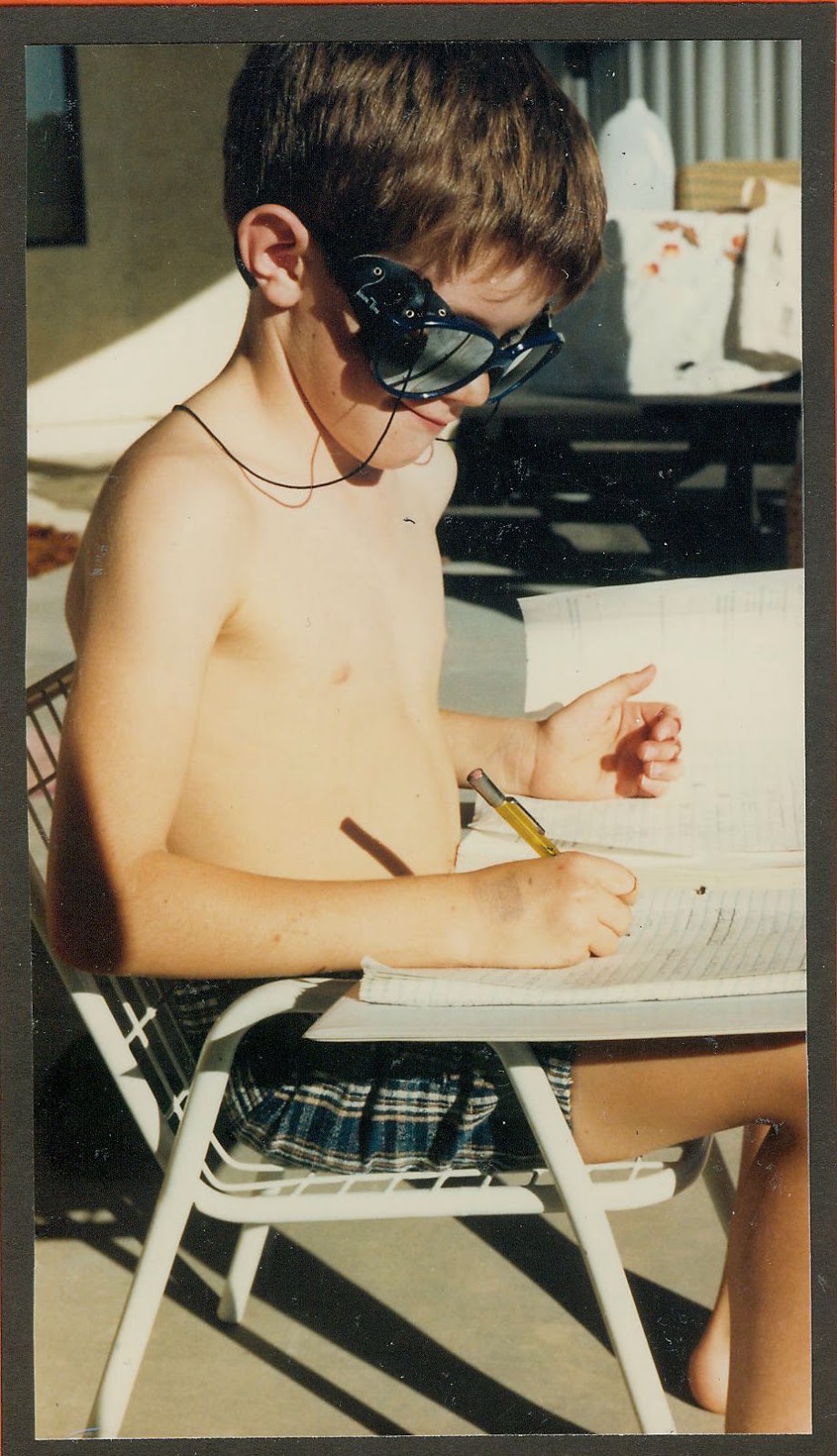
"Doing" my trigonometry homework in
our backyard on a warm, sunny,
Arizona afternoon.
One of my most beloved childhood practices was to borrow my brothers' textbooks to look through and then copy out of—pretending I was doing the same advanced high school homework they were.  As such, I became acquainted (at least in name) to calculus, chemistry, physics, English and American literature, trigonometry, economics, theology, etc.

One of the most satisfying single moments of my entire boyhood occurred one Friday evening after returning from a high school football game to find the books Hamlet and Othello sitting on my desk in my bedroom.  I had been begging my brothers to get them for me from their high school library (which I could not personally access).  They kindly acquiesced, and forever after viewed their lending of those two books to me (which I could hardly read and not in the least bit understand as a second grade) as a precious token of brotherly love and affection.

As I matured in both age and reading ability, I began to actually study books more seriously.  As I grew into my teen years, I discovered that I especially liked books related to personal development and self-leadership.  The seeds of this passion were sunned and watered by my reading of Dale Carnegie's How to Win Friends and Influence People and Dr. David J. Schwartz's The Magic of Thinking Big—both outstanding self-help books of antiquity from deep into the last century, and both of which I found on the bookshelves in my own home.  This was followed by my introduction to the work of my uncle, Hyrum W. Smith as well as Stephen R. Covey, Anthony Robbins, Norman Vincent Peale, and others.  I was hooked!

Teaching action shot of Dr. Jordan Jensen from 2012
While serving a 2-year mission for my Church, I discovered that I loved to teach as much, if not more, than I loved to read and write and study.  This natural blend of pre-sown personal proclivities, wonderful opportunities to nurture those seeds, and my growing chance to apply what I was learning led me, in time, to choose a career in education, and more specifically in the fields of self-help and personal development.

Along the way, I devoured additional self-help books and found that my interest was always piqued when my coursework included literature that possessed literary self-help or philosophical value (for example, as an English major, I made the fortuitous acquaintance of writers like Donne, Franklin, Emerson, Thoreau, Frost, etc.).  My passion for such literature was borne not just out of the joy and satisfaction that study itself brought to me, but because I needed the wisdom and help these authors afforded in my quest to overcome my own weaknesses, build upon my strengths, and work through perplexing life challenges I was facing—like my battle with OCD.

Click HERE to read about Dr. Jordan Jensen's battle with Obsessive-Compulsive Disorder (OCD)

Click HERE to read Part II

One book in particular—The Greatest Secret in the World by Og Mandino—I used on a daily basis for 45 straight weeks in a religious effort to work through my OCD and other challenges I was facing at the time.  To this day, that book—filled with all of my notes of progression, setbacks, and insights along the way—serves as a sacred reminder to me the value of investing great time, energy, passion, effort, and the will to do whatever is necessary to overcome oneself to reach greater heights and states of being in the future.

Within a few years of my Mandino experiment, I had figured out that one of my missions in life was to write my own book that could help other people in a similar way that all of these other books I had read had helped, inspired, and lifted me in my own life's journey and helped me to transcend or manage my own life's obstacles.  Recognizing I had already amassed a great deal of knowledge and insight on the subject, I set to work.  In 2005, I published my first book—I Am Sovereign: The Power of Personal Leadership.  It was directed to a teenage and young adult audience.  It was not commercially successful, but it was a building block in my early career that bolstered my confidence and opened up doorways of additional professional opportunity.

Back cover of Dr. Jordan Jensen's book, Self-Action Leadership
Ten years and a lot of reading, studying, research, and life experience later, I published what I intend to be my seminal work on the subject of personal leadership.  I call the book Self-Action Leadership: The Key to Personal, Professional, & Global Freedom.  No matter how old I live to be, and no matter how many books I write during the course of my career, I hope that this one book remains my seminal work—and is never surpassed in its eventual commercial success.

Why?

Because this ONE book provides a synergistic accumulation and unique presentation of everything I have ever learned that has benefitted me in the field of personal development and self-help over the course of the last three decades; and because I believe that this one book will be more helpful to a broader swath of society than any other book I will ever write.  Any additional books I write in the future will merely be an appendage to this seminal text.

The past several weeks I have written about how Self-Action Leadership training (along with the book) can benefit corporate and business audiences as well as educational groups (i.e. schools and classrooms).  In weeks to come, I will write about how civic leaders, parents, and persons dealing with or treating mental illness can benefit from studying the material, as well as sharing the information and providing training for their constituents, dependents, and patients.  But in the last analysis, Self-Action Leadership is, was designed to be, and I hope always will be, used primarily as a personal manual—an all-in-one comprehensive self-help guide and workbook that can bless the lives of those who read it, study it, and do the homework assignments contained therein.

Speaking of the homework assignments contained therein, one of the unique and most beneficial features of the text is a personal leadership challenge that we at Freedom Focused call The Self-Action Leadership (or SAL) Master Challenge.

This challenge consists of 25 concrete exercises that invites YOU—the reader—to do more than just read the book.  It encourages you to study the material, learn new vocabulary words, begin a personal journal and complete other relevant writing assignments, set goals, engage in activities of self-discipline, and eventually to write your own Self-Declaration of Independence & Constitution where you will begin to identify your life and career vision, mission, values, standards, goals, etc.

Click HERE and scroll toward the bottom of article to read more about writing your own Self-Declaration of Independence & Constitution.

Click HERE to watch a video of Dr. Jordan Jensen explaining the principle of writing a Self-Declaration of Independence & Constitution.

Those who undertake and complete the SAL Master Challenge will receive a special diploma (non-accredited) and medal to commemorate their achievement.  Their names will also be recorded on the Freedom Focused website where they will remain as long as Freedom Focused stands as The Center for Self-Action Leadership.

The SAL Challenge is NOT an easy challenge.  You will not be able to complete it quickly—and that is the point!  After nearly 30 years of studying the subject of personal development and self-help, and more importantly, after nearly THREE decades of working tirelessly to improve myself in the process, I have acquired the expertise necessary to create a comprehensive guide that will provide you—in one volume—with all of the essential principles, practices, and other elements contingent in the process of human existential growth and development.  And the good news is you don't have to spend nearly 30 years figuring it all out because I've already done it for you.  All you have to do is get the book, read it, complete the SAL Challenge, and then forever benefit from the blessings that come from the acquisition of vital knowledge in concert with the dedicated pursuit of self-work, self-sacrifice, goal setting, and personal discipline.

Click HERE to buy Dr. Jordan Jensen's book — SELF-ACTION LEADERSHIP

After you have finished reading the book and have completed the SAL Master Challenge, I invite you to email me to tell me about what you are learning and share your experiences.  I look forward to hearing from you!  You can reach me personally at jordan.jensen@freedomfocused.com


Note: This article is one of SIX articles in a special series dedicated to different AUDIENCES that Freedom Focused specifically targets with Self-Action Leadership training. We invite leaders and managers of these different audiences to click on links below to read the articles pertaining to your field or constituency.

Click HERE to access article for  BUSINESS PROFESSIONALS (Leaders, Managers, & Workers)

Click HERE to access article for  EDUCATORS  (Administrators, Teachers, & Staff)

Click HERE to access article for  STUDENTS & INDIVIDUALS

Click HERE to access article for PARENTS & FAMILIES

Click HERE to access article for ELECTED OFFICIALS, LEADERS, & ROLE MODELS

Click HERE to access article for PERSONS dealing with MENTAL ILLNESS


Self-Action Leadership  ~  The Book

SELF-ACTION LEADERSHIP is the key catalyst for initiating transformational leadership that lasts in any organization. The truth of the matter really is that simple; and the transformation of organizations through the holistic development of individuals really is that difficult—yet altogether possible for anyone willing to invest the time, effort, and sacrifice required to achieve authentic, transformational results.


Unlike any training program that has ever preceded it, Self-Action Leadership provides a single vehicle wherewith individual self-leaders can discover—and then act—upon the great truth that HOLISTIC personal development and growth spanning the mental, moral, spiritual, physical, emotional, and social elements of our individual natures is within the grasp of each one of us.


Back Cover of Self-Action Leadership, the Book
Note: Freedom Focused is a non-partisan, for-profit, educational corporation.  As such, we do not endorse or embrace political figures.  We do, however, comment from time-to-time on historical or political events that provide pedagogical backdrops to illuminating principles contained in the SAL Theory & Model.

Click HERE to learn more about the SAL Theory & Model.

To receive weekly articles from Freedom Focused & Dr. Jordan R. Jensen, sign up with your e-mail address in the white box on the right side of this page where it says "Follow by E-mail."

Click HERE to buy a copy of Dr. Jordan Jensen's new book, Self-Action Leadership: The Key to Personal, Professional, & Global Freedom.

Click HERE to read more about Dr. Jensen's book, Self-Action Leadership, and to review what experts in the leadership field are saying about this groundbreaking new personal development handbook.

Click HERE to learn more about Dr. Jordan R. Jensen.  Click HERE to visit the Freedom Focused website.


Wednesday, December 3, 2014

The Essential Role of Education

“Wisdom is the principal thing; therefore get wisdom: and with all thy getting get understanding.”

– Proverbs 4:7


In concert with love, education is the greatest gift you can give to another human being. Education is the foundation of all Existential Growth and achievement. It is also the gateway to personal freedom. I am who I am, and you are who you are, in large part because of our education. While human beings are free to choose their thoughts, speech, and actions, people make most of their choices based on a combination of what they know and don’t know. Knowledge creates opportunity and power while ignorance begets frailty and failure in thought, word, and deed. 

JJ's Journal: March 1988

    The Personal Journals of Jordan Rex Jensen  March  1988 MARCH   INDEX  1988 1     in School in Are Imaginary track team we have had more...