Chapter 6
The Essential Role of Education
—Proverbs 4:7

Before you can think about, say, or do anything, you must first know something. Thus, whatever you do think about, say, do, and believe is almost entirely a product of your education and experiences.
SELF-ACTION LEADERSHIP begins with education.
Education is among the greatest things you can acquire in life. Moreover, in concert with service and love, education is the greatest gift you can give to another human being.
Education is the foundation of all achievement, growth, progress, and success.
It is also the gateway to personal freedom.
I am who I am, and you are who you are, in large part because of our respective educations. While human beings are free to choose their thoughts, speech, actions, attitudes, and beliefs, we all make most of our choices based on a combination of what we know and don't know. Knowledge begets opportunity and power while ignorance leads to stagnation and vulnerability.
Education is obtained in three basic ways: precept, example, and inspiration.
PRECEPT refers to learning from what you hear someone say.
EXAMPLE refers to learning from what you see someone do.
INSPIRATION is a strictly internal process of learning that involves a combination of your own thought processes and that still small voice inside your mind and heart. Also known as the voice of conscience, this metaphysical life companion viscerally prompts and otherwise directs you to think about, say, and do things that are RIGHT—and by extension, beneficial to yourself and others in the long-run—and avoid things that are WRONG—and by extension, detrimental to yourself and/or others in the long-run.
RIGHT
Thoughts, speech, behavior, attitudes, and beliefs that result in positive, contributive, and constructive long-term consequences for self and others.
WRONG
Thoughts, speech, behavior, attitudes, and beliefs that result in negative, detrimental, and destructive long-term consequences for self and others.
Whether a lesson is taught and/or learned by precept, example, or inspiration, all lessons you learn influence the choices you make, which in-turn shape your life's story.
For example, if you are repeatedly taught to work hard, be honest, and take personal responsibility, chances are good you will become trustworthy, self-reliant, and successful in the long-run.
If, on the other hand, you are repeatedly taught to blame, game, shame, and call people names, chances are good you will become a hateful and irresponsible victim of your own mercurial circumstances and moods.
If you are repeatedly taught compassion, forgiveness, and peace, you are likely to become a loving and empathetic human being who makes the world a better place.
If you are repeatedly taught violence, vindictiveness, and revenge, you are likely to become an angry and embittered soul who seeks the misery of others.
If you are consistently taught discipline, diligence, determination, resilience, and resolve, you will most likely succeed in your life no matter what external difficulties you may face or how challenging your life was when you started out.
If you are consistently taught intemperance, laziness, victimization, and entitlement, you will mostly likely fail—and blame others for your failures—no matter what external privileges or blessings come your way.
That is the POWER of EDUCATION!
Thus, what we learn about—and what we teach to others—is an incredibly important part of our overall experience in this world.
Dr. JJ's Education
 |
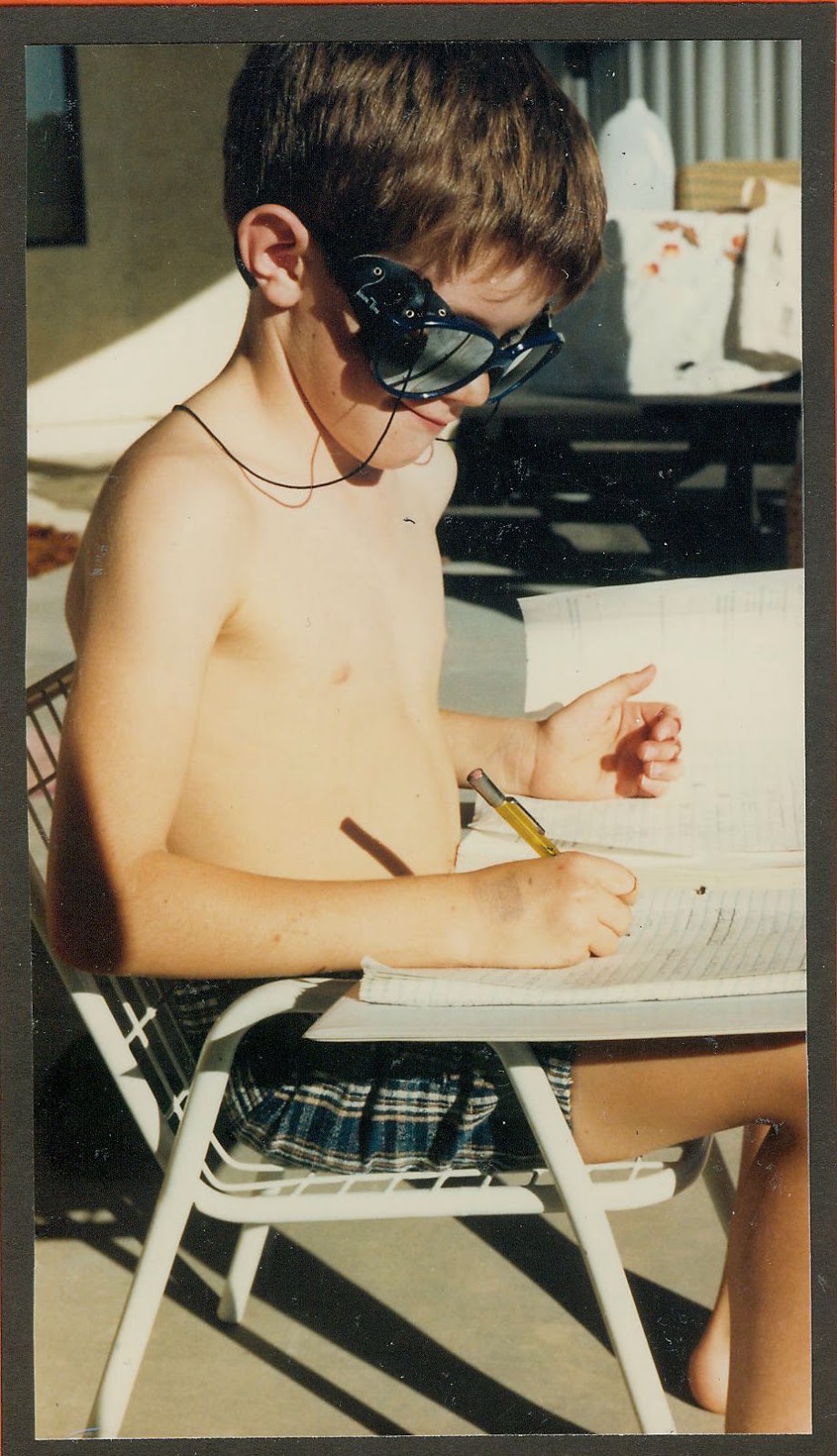
| Copying out of my older brothers' trigonometry textbook in first grade. Mesa, Arizona; circa 1987 |
My formal education was decent, but not particularly privileged. My first 13 years of schooling came in the public schools of rural southeastern Utah, suburban Phoenix (Mesa) Arizona, and Spokane, Washington. Later I earned a bachelor's degree from a public state college (now a state university) in Utah and a doctoral degree from a obscure, private, distance education graduate university in Southern California.
Suffice it to say, my academic pedigree by no means marks me as being unusually privileged; nor does it grant me access into the Ivy League intelligentsia. There are no big-name universities on my resume.
My informal education, however, was unusually blessed. It began at home where my family fueled my love of great books. My maternal grandparents were not financially well-to-do, but had spent a lifetime collecting books and had thereby accrued a home library containing several thousand volumes. It was in that library that I spent some of my choicest childhood hours.
Much of my education was acquired informally as I continually quenched my deep thirst for knowledge by reading books, devouring educational multimedia, carefully observing how wise, polished, and successful people thought, spoke, and acted, and asked a lot of questions wherever I went and to whomever I talked.
Most importantly, I have always strived to listen carefully to that metaphysical inner voice of conscience, which often sounds like my own voice teaching me—as if I was two persons instead of one—although this secondary, alter-ego voice of Conscience is always wiser and more mature than I am.
This voice of internal dialogue continually instructs me, provides me with valuable feedback, and encourages me to make wise choices and otherwise tread a more nobler pathway than I might naturally pursue if left to my own devices and intellect.
This metaphysical phenomenon of conscience reminds me of a leadership lesson I learned from studying about the life of Sir Winston Churchill. The lesson is this: a leader is often his own best teacher. [1]
While I have firm theological convictions about the ontology of my internal voice of conscience, there is no question that my own intellect also plays a key role in the ongoing tête-á-tête transpiring in my mind, heart, and soul. In this sense, I am very much one of my own best teachers—just like Churchill was one of his own best teachers.
My parents were also influential in my informal education growing up.
My dad, despite being a rural Renaissance man who delved into a variety of professional pursuits over the course of his eclectic career, was first and foremost an educator. He taught English in secondary schools in Utah, then Arizona, and then Utah again for a total of 23 years. He retired in the mid-2000s as an 8th grade English teacher.
Despite my parent's middle-class income and lifestyle, Dad made it a priority over the course of his lifetime to amass an impressive personal library. While it was a more modest collection than my maternal grandparents, it still boasted more than a thousand volumes.
After he retired from teaching, Dad increased his collection to 10,000 or more books. His secret was finding "Sale-of-the-Century" type deals offered by closing bookstores and other book vendors, who would offer large numbers of books for sale in bulk at incredibly low prices.
Perusing the books in Dad's home office or classroom libraries provided me with many choice hours of pleasure and joy growing up. It was an exercise in intellectual exploration for me, and I loved it! One year I helped my dad prepare and organize his classroom at Dobson High School in Mesa, Arizona prior to the start of a new school year. I say I "helped" him, but I really spent most of my time blissfully lost amidst his stacks and stacks of books.
To this day Dad is not wealthy financially; but he is very rich in BOOKS, and I still love spending time in his home library, which is much larger now than it was when I was growing up.
 |
| Dad's note to me inside my copy of The Complete Works of Shakespeare |
At age 10, my dad gave me a copy of The Complete Works of William Shakespeare as a Christmas gift. His note to me inside the front cover of this 2,334-page tome was indicative of my parent's love, support, and passion for reading, study, education, and the pursuit of my personal dreams and professional ambitions.
It read:
Christmas 1989
To my precious Jordan in hopes that this will be the beginning of a quality library for a "quality mind." I love and admire you so much. I hope you will discover as I have that some of life's best experiences can be found in great books. Mr. Shakespeare will mean more to you as you grow older, and age gives you the wisdom to appreciate the great truths contained herein.
Love,
Dad
Dec. 25, 1989
Mesa, Arizona
I was further blessed with five older siblings, who are between four and twelve (12) years older than me. This provided me with an early exposure to concepts, conversations, and textbooks that were far more advanced than the primary lessons I was receiving in elementary school.
This influence of my parents, siblings, extended family members, religious background, and personal study afforded me with continual opportunities to read, study, and otherwise learn about history, philosophy, psychology, religion & theology, critical thinking, logic, math & science, rhetoric, oratory, self-help, sales & marketing, management & leadership, personal finance, human relations, health & wellness, fitness, athletics, etc.
A Pedagogy of Parental Affirmation
In conjunction with the continual social, emotional, cultural, spiritual, and educational conversations and lessons in my home, my parents further instilled within me a powerful sense of my own worth and potential as a human being.
They taught me that if I was willing to work hard, follow the rules, take personal responsibility for my actions, and never give up, I could overcome any obstacles and accomplish great things in my life and career. Despite my foibles and flaws—and I had plenty—my parents, siblings, extended family, and teachers were nonetheless quick to tell me over-and-over again that I was capable, smart, and had a bright future.
I believed them.

In fourth grade, my teacher asked my parents to write a letter affirming their child. Mom's words meant a lot to me back then; they still do today.
"Jordan Jensen is indeed a unique and special human being. He is an example of determination and excellence in our home. The Jensen home would surely miss a great deal without Jordan's presence. Jordan is a good friend and tries not to ever offend or hurt one of his friends. We love Jordan and are very proud of his efforts and actions thus far in his life."
My father was similarly positive and enthusiastic in his affirmation of my capacity, potential, and worth. There was never a doubt in my mind that Dad really believed in my ability to do or be just about anything I decided to achieve or become. For example, one day, when I was about 10 or 11 years old, Dad and I were watching the news when I blurted out that maybe I would be a newscaster one day. This was not the first time I had announced an ambition for my future, yet Dad's reply was swift, certain, and confident: "Well, Jordan, if you want to become a newscaster, then you can become a newscaster.
My interest in broadcast journalism was fleeting, but Dad's affirming impact on my self-worth was lasting.
 |
| Parental love and affirmation can be a KEY to a child's success |
In sharing these stories, I am not suggesting parents and teachers fill their children and students' heads full of disingenuous platitudes or unrealistic potentialities. To be clear, my dad never told me I was destined to become a rocket scientist or that I could someday play quarterback for the Dallas Cowboys.
He was just consistently optimistic and hopeful about my legitimate potential in areas where I had already demonstrated natural abilities, a sincere desire to excel, and a strong work ethic. He was quick, therefore, to point out my potential as a writer and speaker. While he saw no harm in a little playful grandiosity, which made me feel like a prince, he was never unrealistic on my behalf—just incredibly affirming and encouraging.
 |
| With my Mama in Mesa, Arizona Circa 1987 |
How could I go wrong when the two most important people in my life were continually affirming my worth and supporting my potential and worthy desires? And it wasn't just Mom and Dad. My siblings, grandparents, aunts, uncles, cousins, school teachers, church leaders, neighbors, and friends were repeatedly reminding me that I was important, had tremendous potential, and could accomplish great things in my life.
This immediate and extended milieu of supporters were not perfect, but they were nearly perfect in their practice of positively affirming, encouraging, and supporting me as their son, brother, cousin, student, friend, etc.
In sharing these things, I do not mean to suggest that pedagogues and parents should allow a false sense of unrealistic optimism to strangle pragmatic realism in the lives of their students and children. But at the same time, they should also avoid letting cynical perceptions of present realities squelch realistic optimism about their legitimate potential for the future.
 |
| With Dad in Monticello, Utah Circa 1982 |
YOU can choose to break negative and destructive thought, speech, and behavioral patterns of your progenitors.
A Pedagogy of Reproof
As valuable as positive affirmations were in my overall education, it was only part of the story. Just as importantly, I was taught the difference between RIGHT and WRONG and what that difference entailed. Then, when I did something wrong, I was lovingly—albeit often firmly—reproved by parents, siblings, extended family, and teachers. Thus, discipline, reproof, and appropriate punishment were essential components of my moral education.
For example, at age four, I innocently pocketed some candies from a neighborhood grocery store. When my parents discovered the products their preschooler had pilfered, they wisely turned the incident into a learning experience by taking me back to the store to return the stolen items and apologize to the store manager. The lesson was not lost on me, and my life as a thief ended as quickly as it had begun.
On another occasion, I had opted to run wildly through the coat rack in my kindergarten class. I thought it was great fun to watch and feel the other kids' coats fly off the rack and tumble into a big heap on the floor. My teacher and classmates did not share my good humor in the matter; neither did my parents.
After receiving Mrs. Moore's phone call reporting the matter, my parents sternly scolded me for my inappropriate behavior. They further required that I apologize to Mrs. Moore and my classmates and promise I would not repeat my carless actions. That was the first and last time I was guilty of such rowdy behavior in Mrs. Moore's classroom, and I have my teacher and parents to thank for it.
This education in reproof involved being told—sometimes with a dead seriousness and steely firmness—when I was thinking, saying, or doing something that was wrong. From reprimands and rebukes to formal discipline and the removal of privileges, I received a fine education in what it meant to act inappropriately—and that acting thusly was not acceptable at home, school, church, or in the community.
I don't know anyone who likes the feeling of being corrected, much less rebuked or reproved. I certainly don't like it. I also don't know anyone who doesn't need correction and reproof from time-to-time, including myself; and I count myself blessed to have been surrounded by loved ones who were neither timid nor hesitant when it came to redirecting me when I got off course.
 |
| Benjamin Franklin (1706-1790) |
—Benjamin Franklin
Franklin is likely referring to a variety of life adversities in this particular quote. However, I believe this truism is especially applicable to necessary and wise—albeit uncomfortable or even hurtful—correction, discipline, and reproof from those whose experience and perspective transcends our own, and who either personally love us, or else professionally have our best interests in mind.
Some of the most painful moments of my life have come from being corrected, disciplined, reprimanded, or otherwise "called on the carpet" and held accountable for my actions. I don't like making mistakes and reproof usually comes as a huge blow to my pride.
I feel awful, foolish, guilty, and incompetent when I screw up. Such experiences cause me a great deal of discomfort. Another part of my pain stems from the shame and remorse I feel from having disappointed someone I love or respect. A third component involves the realization that I have fallen short of my potential. I despise failing and falling short of my potential can be agonizing for me.
And yet... all of this is a GOOD thing!
Why?
 |
| Ralph Waldo Emerson 1803-1882 |
—Ralph Waldo Emerson
No matter how caring and compassionate the delivery may be, reproof can influence one to feel small and ineffectual. It is not easy to face up to one's failures, faults, shortcoming, and weaknesses. Yet reproof has been absolutely essential to my personal and professional growth and progress; and it will be just as important to yours.
No human being is perfect. We can't always see beyond our own heads, and we are sometimes incapable of perceiving the need to change without outside intervention. Thank God there are others who care enough about us to inflict the kind of healing hurt that accompanies loving correction, discipline, and reproof.
It is far more efficient—and less painful—to listen to and internalize correction, discipline, and reproof than it is to blindly attempt to figure everything out all on your own through trial-and-error. While there are some life lessons you can learn only from experience, you can avoid much suffering by simply heeding the wise counsel of others who have gone before you. You can also learn a great deal from observing the decisions of others—and the consequences that accompany those actions.
Self-action leaders are courageous people who are not afraid to take wise, calculated risks on the altar of education and growth. But they are likewise prudent individuals who circumvent avoidable mistakes at every opportunity, and they maximize these opportunities by listening and then hearkening to wise council from others with more knowledge and experience than they have.
Church Education

My formal theological education commenced in between the ages of eighteen months and 3-years old in my church's "Nursery" program. I gave my first public address just shy of my fourth birthday in the "Primary" program (for 3-11-year-olds). Since that first speech, I have made informal comments in small and large groups of people and/or spoken formally in front of small or large audiences thousands of times in a variety of different church settings.
I have attended over four decades worth of Sunday School and other, related classes. I am a graduate of my church's "Seminary" and "Institute" programs, which represent six years of high school and college instruction on religious and scriptural topics.
I also served a 2-year full-time mission for my church in Edmonton, Calgary, Innisfail, and Camrose, Alberta, CANADA. My missionary service consisted of proselyting efforts, community service, and participation in local units of the church. I also had opportunities to lead and train other missionaries. I met and conversed with over 10,000 people from all over the world hailing from all walks of life.
It has all been an incredible EDUCATION!
In all, I have spent some 25,000 hours in ecclesiastical education, practice, service, training, and worship. My church education has taught—and continues to teach me—humility, obedience, self-discipline, moderation, chastity, forgiveness, compassion, tolerance, kindness, love, courage, self-restraint, self-sacrifice, generosity, leadership, hard work, resiliency, determination, persistence, vision, goal-setting, and competence in all kinds of communication and relationships.
While I cannot claim to perfectly personify all of these virtues all of the time, there is no question that my instruction therein has empowered my practice and exemplification thereof; and that is the hope, power, and glory of EDUCATION.
A Blessed Education
I have lived on this planet for nearly five (5) decades. While it is still strange sometimes to think of myself as "Dr. Jensen," I am aware that my education has been unusually blessed and favored. I openly acknowledge that I have had an anomalously privileged background and upbringing. It is hard to go wrong when everyone around you is teaching, guiding, encouraging, praising, and correcting you in positive, uplifting, and loving ways.
What about the legions of people who have not been so blessed?
I recognize that many, and perhaps even most, of my readers may not have been as blessed as I was in their own backgrounds, upbringing, and educations.
And that is OKAY!
The miracle of Self-Action Leadership is that it doesn't matter where you come from or what you may have faced in the past; your future can still be bright!
One of the most beautiful things about SAL is that it isn't a competition; it's an opportunity. As a self-action leader, you don't have to compete with me or anyone else for that matter. And I don't have to compete with you or anyone else either. We simply have to compete against our own past performances.
The goal of SAL is to make this intrapersonal, self-competition a never-ending quest for self-improvement and growth. Anyone and everyone can benefit from SAL in unique and important ways, no matter what may have happened (or not) in your past. In the inspiring words of Anthony Robbins—a world famous personal leadership coach: The past does not equal the future.
—Tony Robbins
REMEMBER: There is nothing inherently special about me; but everything is special about SAL principles and practices. Anyone who learns these principles and implements these practices will eventually attain similarly positive results in their life and career.
Our Duty to Learn and then Teach

There are TWO (2) basic duties I believe all human beings share in life. The first is to LEARN and the second is to TEACH. Once you have learned something that makes a positive difference and helps you avoid negative consequences in your life, you have a duty to teach those truths to others in appropriate and effective ways.
When it comes to SAL, teaching occurs primarily through example and secondarily through instruction—not the other ways around. In the words of Emerson: What you do speaks so loudly that I cannot hear what you say.
 |
| Ralph Waldo Emerson 1803-1882 |
"What you do speaks so loudly that I cannot hear what you say."
—Ralph Waldo Emerson
I have been taught, and then continually reminded about, SAL principles and practices dozens, hundreds, and in some cases even thousands of times throughout my life. Since I was just a little boy, I have hungered and thirsted wholeheartedly after these truths. Learning them ranks among the most fulfilling satisfactions of my life; teaching them to others is even more fun and rewarding.
Once you have learned and applied these truths yourself, I invite you to join my colleagues and me at Freedom Focused in our quest to teach and exemplify them to others at every opportunity throughout your lifetime.
As we work together as a united front dedicated to teaching and exemplifying SAL, everyone who sincerely wants to learn and is willing to work will be able to scale the towering heights of their limitless potential. May we each do our part by seeking out this knowledge, faithfully applying it in our own lives and careers, and then diligently sharing it as clearly, cogently, and enduringly as possible with others.
According to the educator, E.D. Hirsch, Jr., "the real test of any educational idea is its usefulness." [2] There are few, if any, more holistically useful principles and practices than the ones contained in this textbook. How do I know this? Because learning SAL principles and applying SAL practices have absolutely transformed my life and empowered me to become who I am today.
What will they do for YOU?
Only time and effort can tell the ending of that story!
How will your tale ultimately unfold?
Will you choose to become its hero?
Let's get moving and answer these questions!

- What has your educational journey been like so far?
- What elements of your past education have helped you?
- What elements of your past education have hindered or hurt you?
- What can you do, beginning today, to ensure that your future education is more proactive, productive, and precise than your past or present education?
—Dr. JJ
Author's Note: This is the 362nd Blog Post Published by Freedom Focused LLC since November 2013 and the 175th consecutive weekly blog published since August 31, 2020.
Click HERE for a compete listing of the other 361 FF Blog Articles
Click HERE for a complete listing of Freedom Focused SAL QUOTES
Click HERE for a complete listing of Freedom Focused SAL POEMS
Click HERE to access the FULL TEXT of Dr. JJ's Psalms of Life: A Poetry Collection
.........................
Tune in NEXT Wednesday for another article on a Self-Action Leadership related topic.

Click HERE to buy the SAL Textbooks
Chapter 6 Notes
1). Mansfield, S. (1995). Never Give In: The Extraordinary Character of Winston Churchill. Nashville, TN: Cumberland House. Page 227.
2). Hirsch, E.D., Jr. Kett, J.F., and Trefil, J. (2002). The New Dictionary of Cultural Literacy. Completely Revised and Updated. Boston, MA: Houghton Mifflin Company. Page xvi.