Showing posts with label education. Show all posts

Wednesday, March 27, 2024

The Power of Personal Experience


Chapter 13


The Power of Personal Experience 


Our personal experiences profoundly influence who we are, how we see the world, and what we eventually become. Like it or not, we are all products of our experiences. No matter how similar two people may be in terms of their race, ethnicity, culture, background and upbringing, DNA, disposition, personality, education, or career path, the experiences of each and every human being that has ever lived remain remarkably unique. 

Life is all about mining precious experiences
out of the ore of the everyday drudgery and humdrum
Experience matters—not only because it shapes who we are and how we see the world—but because precious gems of wisdom can be mined from its rocky ore. If you are willing to mine your experiences for these gems, you will be able to refine it to obtain insights worth their weight in silver, gold, or even diamonds—speaking either metaphorically or literally. 

Likewise, if you are willing to seek out new and challenging experiences, you will reap all sorts of riches in the form of knowledge, maturity, perspective, and personal capacity. 

No matter who you are, life is full of opportunities to gain worthwhile experiences. Sadly, many people fail to recognize opportunities for achievement and growth when they are staring them right in the face. Sadder still is when people do recognize opportunities, but fail to take advantage of them because of fear or laziness.

The great business philosopher, Jim Rohn, once spoke of his aged father who, even in his last days on Earth, was still actively engaged in productively living his life. Rohn counsels us to follow his father's example and take advantage of every worthy opportunity that crosses our path. As he puts is: "Don't miss anything" (1) that is worth doing.

Rohn further taught that embracing worthy opportunities is an impetus for the creation of wealth (financially as well as intellectually, physically, socially, etc.). According to Rohn, "If you live well, you will earn well." (2)

"If you live well, you will earn well."

—Jim Rohn


Unfortunately, many people get this formula mixed up; they mistakenly believe that if you earn well, then (and only then) you will live well. Rohn got the equation right—living well is the key to earning well, not the other way around. Your life doesn't improve as you get rich; you get rich as your life improves. 


SAL Mantra

Life doesn't improve as you get rich. You get rich as your life improves.


Lies, Damned Lies, and Statistics

It has been said that "there are three kinds of lies: lies, damned lies, and statistics." (3) If you watch television with a critical eye, you will readily perceive the insight of this statement. If you spend time online, you will find it corroborated even further. 

As one Internet expert (4) put it: "You can go on to Google [and] find whatever facts you want. You pick any story out there, give me fifteen minutes on Google, [and] I can give you facts that support both sides of the story." (5)

From media and politics to marketing and litigation, a diminishing ensemble of truth tellers face an uphill battle in their efforts to expose, indict, and quell the capable, determined, and well-funded "Spin Doctors" who are more interested in defending their point and proliferating their ideology than they are in opening up their eyes (or yours) to reality. It is a tragic waste of intelligence and a perpetual embarrassment to the collective populace. 

With the exception of BOOK the SEVENTH, where I share a few, brief stats in addition to presenting data from my own action research, I have intentionally chosen not to use statistics to support the points, postulates, and premises I put forth in this Life Leadership textbook. 

I have pursued this course for two (2) reasons.

FIRST, I am neither a statistician nor a sociologist. I am also not a cultural warrior, and I make a habit of NOT speaking on topics of which I am not an expert. I am an educator. I am also a writer (poetry and prose), philosopher, family man, religious leader, amateur historian, and athlete. It is, therefore, most appropriate that my message be communicated through the lens of pedagogy, literature (poetry and prose), philosophy, family, theology, history, and athletics.  

SECOND, no matter how reliable cited data may be, the veracity of the SAL philosophy and its accompanying theory and model cannot be validated on a strictly empirical basis. The honest consultation of heart and conscience must play a vital role. 

If you are unwilling to listen to the still, small voice of conscience that resides deep down in the sacred recesses of your own mind, heart, and soul, trust that visceral intuition, and be categorically honest with yourself along the way, you will find little value in this Life Leadership textbook. As Ralph Waldo Emerson once put it: Nothing is at last sacred but the integrity of your own mind.  


"Nothing is at last sacred but the integrity of your own mind."

—Ralph Waldo Emerson


It is absurd watching otherwise intelligent persons cite and then spin statistics in every which way—truth, reality, and consequences be damned—their only real intent being to protect and advance themselves and their own personal or professional pet projects and power, all the while lining their pockets with cash from the accompanying pecuniary pursuits.

Amazingly, the exact same—or at the least very similar—statistics are often used by opposing persons or organizations to champion entirely contrary conclusions and their concomitant causes. It is a profound insult to my (and your) intelligence. This use of statistics to selectively and seductively provide so-called empirical data to corroborate whatever ideological, social, political, or marketing point someone is paid to promote is nauseating and we at Freedom Focused do not respect anyone we see engaging in these dishonest practices.  

In an effort to avoid such sophistry, I have chosen to steer clear of statistics altogether. Instead, I rely on the highly credible words and works of a considerable collection of the finest minds, hearts, and souls that have existed throughout human history. I then ask readers to tap into YOUR own conscience to determine the veracity or speciousness of the principles and practices. 

For those who wish to verify and validate this message with statistics and have the time, energy, and expertise to access or compile them, you won't have much trouble producing a reference list that is many miles long. We encourage such parties to pursue said course if they wish; statistics is simply not our passion or project. Our desire is to share a message we already know in our hearts is right and true—with or without the added corroboration of statistics.  


The Power of a Well-Cultivated Idea


"It is funny how mortals always picture [devils]
as putting things into their minds;
in reality [their] best work is done
by keeping things out." (6)

—The Devil


Never underestimate the power of a well-cultivated idea rooted in True Principles and Universal Laws. One veracious idea properly planted in your mind and heart and then nourished with consistent action over time can positively transform a relationship, a career, or a life. I know this is true because I have experienced it over-and-over-and-over again throughout my own life's circuitous and challenging, yet enormously fulfilling journey.  

For example, the ideas planted in my mind, heart, and soul as I read and studied Dr. Stephen R. Covey's 7 Habits of Highly Effective People changed my life as a young college student. Not only did it produce many of the thought "acorns" that eventually grew up into the "Oak Tree" of this expansive Life Leadership textbook, but it also expanded my professional credibility and has been worth its weight in solid gold (literally and metaphorically) in my life and career.  

On one occasion, my knowledge of the 7 Habits material even helped me land a contract training position with a seminar company. I believe these same thought seeds will be worth untold millions of dollars to me before I retire. 

More importantly, they will contribute to my attainment of untold additional riches whose worth far outweighs any monetary remuneration. These riches include quality relationships, meaningful experiences, fulfilling achievements, and the opportunity to make a positive impact in the lives of other people. 

Indeed, the day will come when the fruit produced by these seeds will be of inestimable worth and value to countless others whom I will eventually reach with the unprecedented work you know hold in your hands.  

Talk about a real-life money tree! 

Indeed, that one book has helped to make me a very rich man (financially and otherwise). And guess how much it cost me to procure this gold mine of ideas? 

It cost me absolutely nothing, because I found it on the bookshelves of my own home growing up. It belonged to my parents and I annexed it into my own personal library (thanks Mom and Dad!). I should emphasize here that the book itself did not produce the magic in my life. It was my willingness to invest the time, energy, and thought power to read, digest, ponder, internalize, and act upon the information I found therein.

This was a small price to pay in comparison to the residual benefits I accrued from the efforts.

        But I still had to make the effort! 

And this is to say nothing of the impact of a host of other books, poems, speeches, essays, and quotes (7) have had on my life, career, and relationships.

Communication is, among other things, a process of planting "thought seeds" in the mind, heart, and soul of another person. Leadership is about putting the right kind of ideas into the minds, hearts, and spirits of those you lead and then influencing them to act wisely on those ideas for the purpose of benefitting oneself and others in the long-run. 

Individuals can become capable, influential, and powerful beyond measure when truth is allowed to properly germinate within their minds, hearts, and souls, and then steadily cultivated, fertilized, nurtured, pruned, and protected over time.  

The embrace and proliferation of right principles was the foundation of Winston Churchill's genius and success during World War II. Throughout the Blitz, the Battle of Britain, the African Campaign, the Italian Campaign, and finally the Allied invasion of northern France, Churchill was continually planting thought seeds of liberty, freedom, fortitude, resolve, resilience, endurance, calmness, patience, and personal power into the minds of the British Empire and her Allies throughout the world. Utilizing his talents to their utmost, Churchill the leader truly "mobilized the English language and sent it into battle," to the benefit and victory of us all. (8)

A middle-aged Winston Churchill
Obviously, this same principle and practice can be similarly applied to nefarious purposes through the corruption of educational processes and the sinister practice of brainwashing through the proliferation of propaganda. Hitler, Goebbels, Himmler, Heydrich, and their Nazi minions successfully indoctrinated the German masses with a steady diet of racist and xenophobic principles and propaganda throughout the 1930s. 

This pernicious program of poison fueled the Third Reich's extraordinary rise to power in the years leading up to the Second World War. The results of this diligent "sowing" of evil ideas was nearly as devastating as Churchill's campaign was triumphant. 

Fortunately—for all of us—Churchill triumphed over Hitler. 

        Unfortunately, evil is not always checked and extinguished as quickly and significantly as fascism was in the mid-1940s.  

This Life Leadership textbook provides you with a storehouse of true and virtuous ideals you can sow and ingrain into your mind, heart, and soul as well as the souls, hearts, and minds of those you teach, lead, and love. 

I invite YOU to plant these ideas by reading and pondering the principles of this book. 

I then encourage you to water, fertilize, prune, and protect by setting goals, working hard, and exercising persistence in applying the accompanying practices. 

Finally, I suggest you allow the sunshine of Serendipity to nourish your newly sprouted knowledge, skills, and habits. If you will do this, you will come to find that over time, the tree of your life will bear many bountiful bushels of delicious fruit in the form of growth, freedom, achievement, joy, and inner peace. 

YOU will have truly become an OAK TREE!


Your Unlimited Potential

I am not a perfect human being, nor do I claim to have all the answers to the challenges and mysteries of life. I do, however, place enormous confidence in SAL mixed with Serendipity because this potent and powerful existential cocktail has been developed, tested, and refined through the fiery crucibles of my own life and career experiences spanning nearly 40 years of time.

That's a LOT of time!

More importantly, it has been corroborated by the experiences of many of the world's wisest and most successful men and women throughout history—as recorded in their own words. 

Like emotional intelligence, your capacity and potential for freedom and growth is not limited by your genetic makeup or mimetic heritage alone. The only real limits are the ones you place upon yourself.

That means that in the end, you really have only yourself to blame if you fail to rise to the full measure of your potential.  

Everyone throughout history who has humbly and diligently learned SAL principles and applied SAL practices over time has eventually become very happy, successful, fulfilled, and at peace. Most of these persons wouldn't have known the principles by the name of "SAL" but that is okay because I didn't invent the principles or the practices. I merely organized them into an original package, gave that package a unique name, and then articulated its particulars in a creative and unusual way.

The beauty of SAL is that there are no limits to how much you can grow or how much freedom you can obtain over time. This fact engenders enormous hope for anyone interested in, and willing to apply SAL in one's life. It means you are able to move forward for as long and as far as you are willing to push forward, plow onward, and keep trying. This reality begs two key questions, as follows:

How far will you choose to go?

        How much will you choose to grow?

In the end, YOU—and you alone—will have to answer these two questions for yourself, and your answer will ultimately be articulated not in words, but in actions and results.

How will you choose to act?

        And what will you choose to become?  


In Your Journal

  • What is something you could do this week, month, or year to gain an educational or otherwise meaningful experience that you might have avoided before reading this chapter? 
  • Who and/or what do you want to become in the long-run?
  • What are some of the changes you must make to realize your future vision?


This is the end of BOOK the SECOND: In Pursuit of Change, Growth, and Freedom: An Introduction to Self-Action Leadership. It marks the conclusion of the SAL prefacing material. The next book introduces the SAL Philosophy, which sets up the SAL Theory and Model to come in BOOKS the FOURTH and FIFTH.  


—Dr. JJ

Wednesday, March 27, 2024
Palm Beach Gardens, Florida, USA


Author's Note: This is the 381st Blog Post Published by Freedom Focused LLC since November 2013 and the 192nd consecutive weekly blog published since August 31, 2020.   

Click HERE for a compete listing of the other 380 FF Blog Articles 

Click HERE for a complete listing of Freedom Focused SAL QUOTES  

Click HERE for a complete listing of Freedom Focused SAL POEMS   

Click HERE to access the FULL TEXT of Dr. JJ's Psalms of Life: A Poetry Collection

Click HERE for a complete listing of Self-Action Leadership Articles

Click HERE for a complete listing of Fitness, Heath, & Wellness Articles

Click HERE for a complete listing of Biographical & Historical Articles


Click HERE for a complete listing of Dr. JJ's Autobiographical Articles

.........................

Tune in NEXT Wednesday for another article on a Self-Action Leadership related topic.  

And if you liked this blog post, please share it with your family, friends, colleagues, and students—and encourage them to sign up to receive future articles for FREE every Wednesday.

To sign up, please email freedomfocused@gmail.com and say SUBSCRIBE, or just YES, and we will ensure you receive a link to each new blog article every Wednesday.  


Click HERE to buy the SAL Textbooks    


Chapter 13 Notes

1.  Rohn, J. (2000). Building Your Network Marketing Business. (Compact Disc). VideoPlus.

2.  Ibid. 

3.  Attributed to Mark Twain (1835-1910) and Benjamin Disraeli (1804-1881), among others.

4.  Michael Maslansky, author of The Language of Trust: Selling Ideas in a World of Skeptics. See URL: www.maslansky.com

5.  Michael Maslansky speaking on The O’Reilly Factor. Fox News Channel. January 6, 2015. URL: http://www.foxnews.com/on-air/oreilly/index.html#/v/3974678980001

6.  Lewis, C.S. (1995). The Screwtape Letters. New York: Bantam. Chapter IV, Page 11.

7.  To review a list of the books, poems, speeches, essays, and quotes that have had the greatest impact on the life of Dr. JJ, see Appendix A & B.

8.  President John F. Kennedy said this of Churchill upon granting him honorary U.S. citizenship nearly two decades after the end of World War II.

Wednesday, November 29, 2023

The Essential Role of Education


Chapter 6


The Essential Role of Education


"Wisdom is the principal thing; therefore get wisdom:
and with all thy getting get understanding."

—Proverbs 4:7


ALL change, growth, and success begin with EDUCATION.

Before you can think about, say, or do anything, you must first know something. Thus, whatever you do think about, say, do, and believe is almost entirely a product of your education and experiences.

SELF-ACTION LEADERSHIP begins with education.  

Education is among the greatest things you can acquire in life. Moreover, in concert with service and love, education is the greatest gift you can give to another human being. 

Education is the foundation of all achievement, growth, progress, and success. 

It is also the gateway to personal freedom. 

I am who I am, and you are who you are, in large part because of our respective educations. While human beings are free to choose their thoughts, speech, actions, attitudes, and beliefs, we all make most of our choices based on a combination of what we know and don't know. Knowledge begets opportunity and power while ignorance leads to stagnation and vulnerability.

Education is obtained in three basic ways: precept, example, and inspiration. 

PRECEPT refers to learning from what you hear someone say.

    EXAMPLE refers to learning from what you see someone do.

        INSPIRATION is a strictly internal process of learning that involves a combination of your own thought processes and that still small voice inside your mind and heart. Also known as the voice of conscience, this metaphysical life companion viscerally prompts and otherwise directs you to think about, say, and do things that are RIGHT—and by extension, beneficial to yourself and others in the long-run—and avoid things that are WRONG—and by extension, detrimental to yourself and/or others in the long-run.

RIGHT

Thoughts, speech, behavior, attitudes, and beliefs that result in positive, contributive, and constructive long-term consequences for self and others.


WRONG

Thoughts, speech, behavior, attitudes, and beliefs that result in negative, detrimental, and destructive long-term consequences for self and others.


Whether a lesson is taught and/or learned by precept, example, or inspiration, all lessons you learn influence the choices you make, which in-turn shape your life's story. 

For example, if you are repeatedly taught to work hard, be honest, and take personal responsibility, chances are good you will become trustworthy, self-reliant, and successful in the long-run. 

If, on the other hand, you are repeatedly taught to blame, game, shame, and call people names, chances are good you will become a hateful and irresponsible victim of your own mercurial circumstances and moods.

If you are repeatedly taught compassion, forgiveness, and peace, you are likely to become a loving and empathetic human being who makes the world a better place. 

If you are repeatedly taught violence, vindictiveness, and revenge, you are likely to become an angry and embittered soul who seeks the misery of others.  

If you are consistently taught discipline, diligence, determination, resilience, and resolve, you will most likely succeed in your life no matter what external difficulties you may face or how challenging your life was when you started out. 

If you are consistently taught intemperance, laziness, victimization, and entitlement, you will mostly likely fail—and blame others for your failures—no matter what external privileges or blessings come your way. 

That is the POWER of EDUCATION!

Thus, what we learn about—and what we teach to others—is an incredibly important part of our overall experience in this world.   


Dr. JJ's Education

Copying out of my older brothers'
trigonometry textbook in first grade.
Mesa, Arizona; circa 1987
All of my life I have been blessed with an outstanding education, for which I am very grateful. This education is the foundation of who I am. This Life Leadership textbook is a direct outgrowth of my education and experiences over the past four-and-a-half decades.

My formal education was decent, but not particularly privileged. My first 13 years of schooling came in the public schools of rural southeastern Utah, suburban Phoenix (Mesa) Arizona, and Spokane, Washington. Later I earned a bachelor's degree from a public state college (now a state university) in Utah and a doctoral degree from a obscure, private, distance education graduate university in Southern California.

Suffice it to say, my academic pedigree by no means marks me as being unusually privileged; nor does it grant me access into the Ivy League intelligentsia. There are no big-name universities on my resume. 

My informal education, however, was unusually blessed. It began at home where my family fueled my love of great books. My maternal grandparents were not financially well-to-do, but had spent a lifetime collecting books and had thereby accrued a home library containing several thousand volumes. It was in that library that I spent some of my choicest childhood hours.

Much of my education was acquired informally as I continually quenched my deep thirst for knowledge by reading books, devouring educational multimedia, carefully observing how wise, polished, and successful people thought, spoke, and acted, and asked a lot of questions wherever I went and to whomever I talked.

Most importantly, I have always strived to listen carefully to that metaphysical inner voice of conscience, which often sounds like my own voice teaching me—as if I was two persons instead of one—although this secondary, alter-ego voice of Conscience is always wiser and more mature than I am.

This voice of internal dialogue continually instructs me, provides me with valuable feedback, and encourages me to make wise choices and otherwise tread a more nobler pathway than I might naturally pursue if left to my own devices and intellect.  

This metaphysical phenomenon of conscience reminds me of a leadership lesson I learned from studying about the life of Sir Winston Churchill. The lesson is this: a leader is often his own best teacher.  [1]  

While I have firm theological convictions about the ontology of my internal voice of conscience, there is no question that my own intellect also plays a key role in the ongoing tête-á-tête transpiring in my mind, heart, and soul. In this sense, I am very much one of my own best teachers—just like Churchill was one of his own best teachers. 

My parents were also influential in my informal education growing up. 

My dad, despite being a rural Renaissance man who delved into a variety of professional pursuits over the course of his eclectic career, was first and foremost an educator. He taught English in secondary schools in Utah, then Arizona, and then Utah again for a total of 23 years. He retired in the mid-2000s as an 8th grade English teacher. 

Despite my parent's middle-class income and lifestyle, Dad made it a priority over the course of his lifetime to amass an impressive personal library. While it was a more modest collection than my maternal grandparents, it still boasted more than a thousand volumes. 

After he retired from teaching, Dad increased his collection to 10,000 or more books. His secret was finding "Sale-of-the-Century" type deals offered by closing bookstores and other book vendors, who would offer large numbers of books for sale in bulk at incredibly low prices.

Perusing the books in Dad's home office or classroom libraries provided me with many choice hours of pleasure and joy growing up. It was an exercise in intellectual exploration for me, and I loved it! One year I helped my dad prepare and organize his classroom at Dobson High School in Mesa, Arizona prior to the start of a new school year. I say I "helped" him, but I really spent most of my time blissfully lost amidst his stacks and stacks of books. 

To this day Dad is not wealthy financially; but he is very rich in BOOKS, and I still love spending time in his home library, which is much larger now than it was when I was growing up.
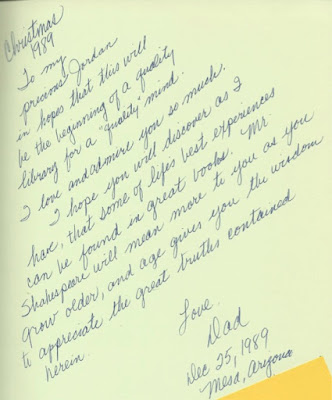
Dad's note to me inside my copy of
The Complete Works of Shakespeare
When I was a little boy, my parents encouraged me to check out books from public libraries and provided transportation to-and-from these bastions of book learning. I also started building my own library at a very young age. 

By the time I was 10-years old, immediate and extended family members knew exactly what to get me for birthdays and Christmas. Between these gifts and my own creative and proactive procurements, I had amassed a personal library that exceeded 500 volumes by the time I was in my early 20s. My home library today is more than double that size, and will undoubtedly continue to grow in coming years.  

At age 10, my dad gave me a copy of The Complete Works of William Shakespeare as a Christmas gift. His note to me inside the front cover of this 2,334-page tome was indicative of my parent's love, support, and passion for reading, study, education, and the pursuit of my personal dreams and professional ambitions. 

It read:

Christmas 1989

To my precious Jordan in hopes that this will be the beginning of a quality library for a "quality mind." I love and admire you so much. I hope you will discover as I have that some of life's best experiences can be found in great books. Mr. Shakespeare will mean more to you as you grow older, and age gives you the wisdom to appreciate the great truths contained herein.

Love,

Dad

Dec. 25, 1989

Mesa, Arizona

I was further blessed with five older siblings, who are between four and twelve (12) years older than me. This provided me with an early exposure to concepts, conversations, and textbooks that were far more advanced than the primary lessons I was receiving in elementary school. 

This influence of my parents, siblings, extended family members, religious background, and personal study afforded me with continual opportunities to read, study, and otherwise learn about history, philosophy, psychology, religion & theology, critical thinking, logic, math & science, rhetoric, oratory, self-help, sales & marketing, management & leadership, personal finance, human relations, health & wellness, fitness, athletics, etc. 


A Pedagogy of Parental Affirmation

In conjunction with the continual social, emotional, cultural, spiritual, and educational conversations and lessons in my home, my parents further instilled within me a powerful sense of my own worth and potential as a human being. 

They taught me that if I was willing to work hard, follow the rules, take personal responsibility for my actions, and never give up, I could overcome any obstacles and accomplish great things in my life and career. Despite my foibles and flaws—and I had plenty—my parents, siblings, extended family, and teachers were nonetheless quick to tell me over-and-over again that I was capable, smart, and had a bright future. 

I believed them.

This repeated positive reinforcement helped shape my self-image and prepare me for future success. A concrete example of how this played out in my day-to-day life involved sticky notes my mom used to leave in my room to find after I got home from school. Often these notes were reminders of chores, but they almost always included a smiley face and an "I Love You!" 

In fourth grade, my teacher asked my parents to write a letter affirming their child. Mom's words meant a lot to me back then; they still do today. 

"Jordan Jensen is indeed a unique and special human being. He is an example of determination and excellence in our home. The Jensen home would surely miss a great deal without Jordan's presence. Jordan is a good friend and tries not to ever offend or hurt one of his friends. We love Jordan and are very proud of his efforts and actions thus far in his life." 

My father was similarly positive and enthusiastic in his affirmation of my capacity, potential, and worth. There was never a doubt in my mind that Dad really believed in my ability to do or be just about anything I decided to achieve or become. For example, one day, when I was about 10 or 11 years old, Dad and I were watching the news when I blurted out that maybe I would be a newscaster one day. This was not the first time I had announced an ambition for my future, yet Dad's reply was swift, certain, and confident: "Well, Jordan, if you want to become a newscaster, then you can become a newscaster.

My interest in broadcast journalism was fleeting, but Dad's affirming impact on my self-worth was lasting.

Parental love and affirmation can be a KEY
to a child's success
Years later, before leaving home to attend college for the first time, a similar exchange between Dad and me took place that I will forever cherish. That particular morning had been unnecessarily stressful due to last-minute preparations and poor planning on my part. To make matters worse, I had absentmindedly misplaced my car keys. I eventually found them, and began heading to my car to leave. 

Right before I got into my car, Dad approached me, looked into my eyes, and with a smile on his face and a twinkle in his eye said: "Jordan, someday you will speak before Congress; but right now, you just need to remember where you put your keys!" 

He grinned widely and we both laughed. After a warm and loving embrace, Dad waved me off to college and I drove away feeling like a million bucks knowing my dad thought I was pretty special—in spite of my many mindless mistakes, lingering immaturities, and persisting insecurities.

In sharing these stories, I am not suggesting parents and teachers fill their children and students' heads full of disingenuous platitudes or unrealistic potentialities. To be clear, my dad never told me I was destined to become a rocket scientist or that I could someday play quarterback for the Dallas Cowboys. 

He was just consistently optimistic and hopeful about my legitimate potential in areas where I had already demonstrated natural abilities, a sincere desire to excel, and a strong work ethic. He was quick, therefore, to point out my potential as a writer and speaker. While he saw no harm in a little playful grandiosity, which made me feel like a prince, he was never unrealistic on my behalf—just incredibly affirming and encouraging.

With my Mama in Mesa, Arizona
Circa 1987
While my parents were lavish in their support of my goals and affirmation of my worth, they never put excessive pressure on me to pursue an activity or endeavor for their own sakes, or in which I was uninterested or poorly suited. In other words, they never tried to live their lives through me. Instead, they encouraged me to pursue my own passions, rejoiced in my successes, and comforted me through my disappointments and failures.

How could I go wrong when the two most important people in my life were continually affirming my worth and supporting my potential and worthy desires? And it wasn't just Mom and Dad. My siblings, grandparents, aunts, uncles, cousins, school teachers, church leaders, neighbors, and friends were repeatedly reminding me that I was important, had tremendous potential, and could accomplish great things in my life. 

This immediate and extended milieu of supporters were not perfect, but they were nearly perfect in their practice of positively affirming, encouraging, and supporting me as their son, brother, cousin, student, friend, etc.  

In sharing these things, I do not mean to suggest that pedagogues and parents should allow a false sense of unrealistic optimism to strangle pragmatic realism in the lives of their students and children. But at the same time, they should also avoid letting cynical perceptions of present realities squelch realistic optimism about their legitimate potential for the future.  

With Dad in Monticello, Utah
Circa 1982
I painfully recognize that not everyone is born into a family with such luxuries in the form of parental and sibling affirmation, love, and support. Such temporary troubles do not, however, diminish anyone's innate worth as a human being, nor does it forever stunt one's future potential. 

Regardless of your upbringing, your potential for progress and growth remains limitless if you are willing to take invest the time and effort required to overcome the challenges of the past. Healing from wounds of the past and letting go of its accompanying pain is not easy; but it is possible. 

Even if no one has ever told you this before, believe it now! 

Hold on to hope for the future and exercise faith in yourself and the good people of the world. Believe that you can work hard, make good choices, and eventually overcome every challenge of your past to yet become very happy and successful. 

Even if it takes years or decades to fully transcend what has gone before in your life, it is worth the effort to change and become. This textbook will help show you how. Then, if you decide to have children yourself, you can choose to right the wrongs of your parents by giving your own children the love, affection, encouragement, and support you were denied. 

YOU can choose to break negative and destructive thought, speech, and behavioral patterns of your progenitors.  


A Pedagogy of Reproof

As valuable as positive affirmations were in my overall education, it was only part of the story. Just as importantly, I was taught the difference between RIGHT and WRONG and what that difference entailed. Then, when I did something wrong, I was lovingly—albeit often firmly—reproved by parents, siblings, extended family, and teachers. Thus, discipline, reproof, and appropriate punishment were essential components of my moral education. 

For example, at age four, I innocently pocketed some candies from a neighborhood grocery store. When my parents discovered the products their preschooler had pilfered, they wisely turned the incident into a learning experience by taking me back to the store to return the stolen items and apologize to the store manager. The lesson was not lost on me, and my life as a thief ended as quickly as it had begun. 

On another occasion, I had opted to run wildly through the coat rack in my kindergarten class. I thought it was great fun to watch and feel the other kids' coats fly off the rack and tumble into a big heap on the floor. My teacher and classmates did not share my good humor in the matter; neither did my parents. 

After receiving Mrs. Moore's phone call reporting the matter, my parents sternly scolded me for my inappropriate behavior. They further required that I apologize to Mrs. Moore and my classmates and promise I would not repeat my carless actions. That was the first and last time I was guilty of such rowdy behavior in Mrs. Moore's classroom, and I have my teacher and parents to thank for it. 

This education in reproof involved being told—sometimes with a dead seriousness and steely firmness—when I was thinking, saying, or doing something that was wrong. From reprimands and rebukes to formal discipline and the removal of privileges, I received a fine education in what it meant to act inappropriately—and that acting thusly was not acceptable at home, school, church, or in the community. 

I don't know anyone who likes the feeling of being corrected, much less rebuked or reproved. I certainly don't like it. I also don't know anyone who doesn't need correction and reproof from time-to-time, including myself; and I count myself blessed to have been surrounded by loved ones who were neither timid nor hesitant when it came to redirecting me when I got off course.  

Benjamin Franklin
(1706-1790)
Benjamin Franklin once wrote: that which hurts, instructs.


"That which hurts, instructs."

—Benjamin Franklin


Franklin is likely referring to a variety of life adversities in this particular quote. However, I believe this truism is especially applicable to necessary and wise—albeit uncomfortable or even hurtful—correction, discipline, and reproof from those whose experience and perspective transcends our own, and who either personally love us, or else professionally have our best interests in mind. 

Some of the most painful moments of my life have come from being corrected, disciplined, reprimanded, or otherwise "called on the carpet" and held accountable for my actions. I don't like making mistakes and reproof usually comes as a huge blow to my pride. 

I feel awful, foolish, guilty, and incompetent when I screw up. Such experiences cause me a great deal of discomfort. Another part of my pain stems from the shame and remorse I feel from having disappointed someone I love or respect. A third component involves the realization that I have fallen short of my potential. I despise failing and falling short of my potential can be agonizing for me.  

And yet... all of this is a GOOD thing!

        Why? 

Ralph Waldo Emerson
1803-1882
Because there is no better motivation for change than authentic, heartfelt, sincere pain and regret. This is one reason why the American philosopher, Ralph Waldo Emerson once quipped that: a healthy discontent is good.


"A healthy discontent is good."

—Ralph Waldo Emerson


No matter how caring and compassionate the delivery may be, reproof can influence one to feel small and ineffectual. It is not easy to face up to one's failures, faults, shortcoming, and weaknesses. Yet reproof has been absolutely essential to my personal and professional growth and progress; and it will be just as important to yours. 

No human being is perfect. We can't always see beyond our own heads, and we are sometimes incapable of perceiving the need to change without outside intervention. Thank God there are others who care enough about us to inflict the kind of healing hurt that accompanies loving correction, discipline, and reproof.

It is far more efficient—and less painful—to listen to and internalize correction, discipline, and reproof than it is to blindly attempt to figure everything out all on your own through trial-and-error. While there are some life lessons you can learn only from experience, you can avoid much suffering by simply heeding the wise counsel of others who have gone before you. You can also learn a great deal from observing the decisions of others—and the consequences that accompany those actions.

Self-action leaders are courageous people who are not afraid to take wise, calculated risks on the altar of education and growth. But they are likewise prudent individuals who circumvent avoidable mistakes at every opportunity, and they maximize these opportunities by listening and then hearkening to wise council from others with more knowledge and experience than they have.  


Church Education

The purpose of this textbook is not to promote religion or proselytize for my faith. Nevertheless, in a book that draws heavily on my personal narrative, it would be intellectually negligent to overlook the impact of my religious upbringing and education on my overall education and outlook. This is due to the sheer amount of time and effort I have invested—and continue to engage—in spiritual nurturance and religious practice.

My formal theological education commenced in between the ages of eighteen months and 3-years old in my church's "Nursery" program. I gave my first public address just shy of my fourth birthday in the "Primary" program (for 3-11-year-olds). Since that first speech, I have made informal comments in small and large groups of people and/or spoken formally in front of small or large audiences thousands of times in a variety of different church settings.

I have attended over four decades worth of Sunday School and other, related classes. I am a graduate of my church's "Seminary" and "Institute" programs, which represent six years of high school and college instruction on religious and scriptural topics. 

I also served a 2-year full-time mission for my church in Edmonton, Calgary, Innisfail, and Camrose, Alberta, CANADA. My missionary service consisted of proselyting efforts, community service, and participation in local units of the church. I also had opportunities to lead and train other missionaries. I met and conversed with over 10,000 people from all over the world hailing from all walks of life.

It has all been an incredible EDUCATION! 

In all, I have spent some 25,000 hours in ecclesiastical education, practice, service, training, and worship. My church education has taught—and continues to teach me—humility, obedience, self-discipline, moderation, chastity, forgiveness, compassion, tolerance, kindness, love, courage, self-restraint, self-sacrifice, generosity, leadership, hard work, resiliency, determination, persistence, vision, goal-setting, and competence in all kinds of communication and relationships. 

While I cannot claim to perfectly personify all of these virtues all of the time, there is no question that my instruction therein has empowered my practice and exemplification thereof; and that is the hope, power, and glory of EDUCATION. 


A Blessed Education

I have lived on this planet for nearly five (5) decades. While it is still strange sometimes to think of myself as "Dr. Jensen," I am aware that my education has been unusually blessed and favored. I openly acknowledge that I have had an anomalously privileged background and upbringing. It is hard to go wrong when everyone around you is teaching, guiding, encouraging, praising, and correcting you in positive, uplifting, and loving ways. 

What about the legions of people who have not been so blessed? 

I recognize that many, and perhaps even most, of my readers may not have been as blessed as I was in their own backgrounds, upbringing, and educations. 

And that is OKAY!

The miracle of Self-Action Leadership is that it doesn't matter where you come from or what you may have faced in the past; your future can still be bright!

One of the most beautiful things about SAL is that it isn't a competition; it's an opportunity. As a self-action leader, you don't have to compete with me or anyone else for that matter. And I don't have to compete with you or anyone else either. We simply have to compete against our own past performances.

The goal of SAL is to make this intrapersonal, self-competition a never-ending quest for self-improvement and growth. Anyone and everyone can benefit from SAL in unique and important ways, no matter what may have happened (or not) in your past. In the inspiring words of Anthony Robbins—a world famous personal leadership coach: The past does not equal the future. 


"The past does not equal the FUTURE."

—Tony Robbins


REMEMBER: There is nothing inherently special about me; but everything is special about SAL principles and practices. Anyone who learns these principles and implements these practices will eventually attain similarly positive results in their life and career.  


Our Duty to Learn and then Teach

Having learned, practiced, and deeply internalized SAL principles and practices myself, I now see it as my solemn duty to teach them to others. I wrote this textbook in an effort to fulfill this responsibility. I have dedicated my life and career to teaching other people what I have been so incredibly blessed to learn myself. 

Everything good that has come into my life as an adult is a result of learning and then practicing the correct principles I was taught in my formative, adolescent, and young adult years. I am honored to share what I have learned. I hope you will choose to studiously learn and then diligently practice this knowledge... for your own everlasting benefit.  

There are TWO (2) basic duties I believe all human beings share in life. The first is to LEARN and the second is to TEACH. Once you have learned something that makes a positive difference and helps you avoid negative consequences in your life, you have a duty to teach those truths to others in appropriate and effective ways. 

When it comes to SAL, teaching occurs primarily through example and secondarily through instruction—not the other ways around. In the words of Emerson: What you do speaks so loudly that I cannot hear what you say.  


Ralph Waldo Emerson
1803-1882

"What you do speaks so loudly that I cannot hear what you say
."

—Ralph Waldo Emerson


I have been taught, and then continually reminded about, SAL principles and practices dozens, hundreds, and in some cases even thousands of times throughout my life. Since I was just a little boy, I have hungered and thirsted wholeheartedly after these truths. Learning them ranks among the most fulfilling satisfactions of my life; teaching them to others is even more fun and rewarding. 

Once you have learned and applied these truths yourself, I invite you to join my colleagues and me at Freedom Focused in our quest to teach and exemplify them to others at every opportunity throughout your lifetime. 

As we work together as a united front dedicated to teaching and exemplifying SAL, everyone who sincerely wants to learn and is willing to work will be able to scale the towering heights of their limitless potential. May we each do our part by seeking out this knowledge, faithfully applying it in our own lives and careers, and then diligently sharing it as clearly, cogently, and enduringly as possible with others.  

According to the educator, E.D. Hirsch, Jr., "the real test of any educational idea is its usefulness."  [2]  There are few, if any, more holistically useful principles and practices than the ones contained in this textbook. How do I know this? Because learning SAL principles and applying SAL practices have absolutely transformed my life and empowered me to become who I am today. 

What will they do for YOU?

        Only time and effort can tell the ending of that story!

                How will your tale ultimately unfold?

                        Will you choose to become its hero?

Let's get moving and answer these questions!  


In Your Journal

  • What has your educational journey been like so far?
  • What elements of your past education have helped you?
  • What elements of your past education have hindered or hurt you?
  • What can you do, beginning today, to ensure that your future education is more proactive, productive, and precise than your past or present education?


—Dr. JJ

Wednesday, November 29, 2023
Palm Beach Gardens, Florida, USA


Author's Note: This is the 362nd Blog Post Published by Freedom Focused LLC since November 2013 and the 175th consecutive weekly blog published since August 31, 2020.   

Click HERE for a compete listing of the other 361 FF Blog Articles 

Click HERE for a complete listing of Freedom Focused SAL QUOTES  

Click HERE for a complete listing of Freedom Focused SAL POEMS   

Click HERE to access the FULL TEXT of Dr. JJ's Psalms of Life: A Poetry Collection

Click HERE for a complete listing of Self-Action Leadership Articles

Click HERE for a complete listing of Fitness, Heath, & Wellness Articles

Click HERE for a complete listing of Biographical & Historical Articles


Click HERE for a complete listing of Dr. JJ's Autobiographical Articles

.........................

Tune in NEXT Wednesday for another article on a Self-Action Leadership related topic.  

And if you liked this blog post, please share it with your family, friends, colleagues, and students—and encourage them to sign up to receive future articles for FREE every Wednesday.

To sign up, please email freedomfocused@gmail.com and say SUBSCRIBE, or just YES, and we will ensure you receive a link to each new blog article every Wednesday.  


Click HERE to buy the SAL Textbooks    


Chapter 6 Notes

1).  Mansfield, S. (1995). Never Give In: The Extraordinary Character of Winston Churchill. Nashville, TN: Cumberland House. Page 227. 

2).  Hirsch, E.D., Jr. Kett, J.F., and Trefil, J. (2002). The New Dictionary of Cultural Literacy. Completely Revised and Updated. Boston, MA: Houghton Mifflin Company. Page xvi. 


Wednesday, October 25, 2023

A Personal Letter from the Author


 Book the First


Life Leadership Begins with Education


Dedicated to:

LEADERS, EDUCATORS, PARENTS, and INDIVIDUALS everywhere in hopes they might internalize the great truth taught by President Theodore Roosevelt, who wisely noted that...


"To educate a person in mind
and not in morals is to educate
a menace to society."


—Theodore Roosevelt


Chapter 1


A Personal Letter from the Author


Dear Reader:

If someone writes a book and nobody reads it, you could argue that the writer largely wasted his or her time writing that book in the first place. With this in mind, I want to THANK YOU for taking time out of your busy life and career to read this book; it means a lot to me.  

This is no ordinary book. 

To begin with, it wasn't a quick or convenient writing project. In fact, I have been preparing for the task since 1987, when I was only seven (7) years old. That's a long time... thirty-eight (38) years to be exact! 

The first 18 years—from 1987-2005—were years of preliminary preparation where I learned to read, write, study, and think analytically and critically. These were the years of my formal education on up through my 4-year bachelor's degree in English. These years provided me with a variety of valuable opportunities to develop, practice, refine, and polish my skills as a writer, speaker, and thinker. 

In conjunction with completing my schoolwork and penning thousands of pages in personal journals and letters, I also landed jobs with a couple of newspapers, which further honed my skill as a writer. The last 20-plus years (2005-2026) have been spent writing, editing, revising, and polishing this same book over-and-over again SEVEN (7) different times. 

That's right; you now hold in your hands the SEVENTH Edition of the SAL Textbook. Each of these seven editions have built upon one another, making the complete work longer and more substantive and polished with each succeeding edition. Because of the close connection that these different editions have with each other, it bears providing YOU—the reader—with a brief history of how we arrived at this, the landmark 7th edition.  

First Edition of the SAL Textbook
Self-Published in 2006
The FIRST Edition of the SAL Textbook was published in 2006 as a one-volume, 302-page, personal leadership guide for high school students (teenagers). It was self-published by BookSurge and was titled—I Am Sovereign: The Power of Personal Leadership. 

The SECOND Edition went unpublished in 2007. Its title was—Leaders for Life: The Complete Step-by-Step Guide to Personal Leadership. Despite getting a professional publisher behind the project, the owner inexplicably and dishonestly reneged on our signed contract, thereby leaving me in a lurch. Things like that happen sometimes during our lives and careers in this world. I learned from that experience the value of trust, and discovered that some people's word (even on a signed contract) isn't worth much.

The THIRD Edition came to life in the form of my 1,149-page doctoral dissertation, published in four (4) volumes in 2013, the same year I completed my Doctoral degree in education. It had a long, scholarly title I will not bore you with here.  

The FOURTH Edition was an 800-page, popular recapitulation of my doctoral dissertation. In other words, I took the material in my 4-volume academic thesis and reframed it for a layman's audience. This process involved eliminating the scholarly citations, simplifying the formatting, language, organization, and structure of the text and otherwise making it easier and more interesting to read. This edition was self-published by authorHouse in the late summer of 2013, and was titled: Self-Action Leadership: The Key to Everything.   

FIFTH Edition, self-published by
authorHouse in 2015
The FIFTH Edition was self-published in 2015, again by authorHouse. It was a comprehensive revision of the FOURTH Edition, including a subtitle change to Self-Action Leadership: The Key to Personal, Professional, and Global Freedom. It weighed in at 740 pages.

For the SIXTH Edition, I finally landed an official publisher—Cambridge Scholars Publishing—an academic printing house in the United Kingdom. 

This time the publisher made good on its word and everyone involved came through on their contractual commitments. The SIXTH Edition was the first time the SAL material appeared in TWO (2) separate volumes—one volume for the Self-Action Leadership (SAL) Theory and one for the SAL Model, including two new subtitles, as follows: A Theoretical Framework for Existential Growth (Volume 1) and An Action Research-Based Character Development Model (Volume 2).

This edition was published in 2019 and had a combined 1,295-page count. Overall, I was pleased with how this 2-volume edition turned out, but have since grown frustrated by its costly academic price tag and other variables involved in its practical functionality for students and practitioners.   

Five years later, beginning in September 2023, the time arrived to undertake yet another revision, paving the way for this, the 7th Edition. This time around, my goal was to make all the material available for FREE on the Internet by serially publishing it a chapter or section at a time on the Freedom Focused blog. 

I further employed the online serial publication as a means of further revising, updating, reformatting, and polishing the texts in preparation to submit a new manuscript for publication as a New and Improved, single-volume SEVENTH Edition. This new and freshly published work is more accessible, affordable, and attractive than its immediate predecessor (6th Edition). 

I am thrilled that YOU now hold this newest 7th Edition of the SAL Textbook in your hands.  

It is not an ordinary book. 

To begin with, it took 25 years and thousands-upon-thousands of hours to prepare, plan, organize, compose, edit, revise, polish, and then repeat the entire process SEVEN (7) times. 

Thus, the book is a long and substantive tome.  

I hope you will not let their length or seeming complexity and difficulty discourage or dissuade you from diving head-, heart-, and soul-long into them, because I know that YOU can do hard tasks and accomplish great things... even harder tasks and greater things than you realize. Moreover, I know that the principles and practices outlined in this text can change your life... if you are willing to pay the price that authentic change requires.  

How do I know this? 

Because incorporating the principles and practices outlined in this book has changed my own life for the better over and over and over again throughout my life and career, and I am an infinitely better human being, man, husband, father, son, brother, friend, and citizen because of these transformational changes and growth. 

I also know this because there is nothing inherently special about me; but everything is special about the principles and practices outlined in this book. Therefore, if you are willing to apply yourself to them with the same energy, focus, and determination that I have, you will eventually reap similar benefits over time. 

Of this fact I am absolutely certain.   

If you intend on becoming a serious student of Self-Action Leadership and are committed to completing the SAL Master Challenge as outlined in Chapter 5 of BOOK the FIRST, then you will need to read all of this 2-volume work and study it closely. That means when you come to a difficult chapter or section, you will be expected to push through it, forge ahead, and never give up until you have summited your own SAL mountaintop by finishing the entire work and completing the SAL Master Challenge.

Those who persevere in pursuing this Road Less Traveled to its final destination will discover that far greater awards await you at the finish line—and beyond. These awards include personal and professional growth and positive changes to your mind, heart, and soul—the epicenters where the real magic will take place. Accompanying these changes will be many tangible blessings in your life and career that will further evince how far you have come. 

Such blessings may include finding that special someone, earning a promotion, raise, or landing the job of your dreams. Most valuably, you will discover that you are a happier, more satisfied and fulfilled human being who experiences inner joy and peace the likes of which you have never experienced before. 

On the other hand, if you are not intending to pursue the SAL Master Challenge just yet, but prefer to peruse this book as a more casual reader, I also invite you to not get discouraged and give up too early. If you meet up with a section or chapter you find boring or difficult, just skip to another passage and start again from there. I promise you will eventually find something that will be easier, more interesting, and perhaps just the thing you need to read or learn to help you along your way at any given juncture of your career or life. Then, as your confidence grows, you can aim for a more ambitious undertaking down the road... whereupon you can eventually tackle the entire text and conquer the SAL Master Challenge.

Christopher P. Neck, Ph.D.
As Dr. Christopher P. Neck so kindly put it in the FOREWORD to this book, there really is "Something for Everyone" in this book. I invite you to get to work discovering what that something is that can benefit you today, tomorrow, and forever.

THANK YOU for honoring me and my company, Freedom Focused, by taking time to read and study what I have so painstakingly put together over the course of my entire professional career, which is now well into its third decade.

Like the SAL Textbook, FREEDOM FOCUSED is no ordinary company. Our vision is simple to state, but difficult to actually realize. Our aim is not merely to sell books and training; that is just a means to an end. Our ultimate objective is to influence the broader culture in societal-changing ways through positive and transformational individual, familial, organizational, national, and international change.

We envision a world that is more safe, fair, just, and good—even a world full of SELF-ACTION LEADERS. We are committed to being catalysts of this change and leaders of this movement. Thus, we will persist in pursuing our mission to our last breaths in this world—and beyond.  This vision will be realized the same way that any other vision has ever been realized throughout the history of the world... ONE mind, heart, and soul at-a-time. 

I respectfully invite YOU to join us on this grand, inspiring, and noble QUEST.

All you have to do to begin is start being honest with "The Guy in the Glass" and then...

Keep

     On

          Reading and taking

ACTION!


The Guy in the Glass

When you get what you want in your struggle for pelf  [1]
And the world makes you King for a day,
Then go to the mirror and look at yourself,
And see what that guy has to say.

For it isn't your Father, or Mother, or Wife,
Whose judgment upon you must pass.
The feller whose verdict counts most in your life
Is the guy staring back from the glass.

He's the feller to please, never mind all the rest,
For he's with you clear up to the end,
And you've passed your most dangerous, difficult test
If the guy in the glass is your friend.

You may be like Jack Horner and "chisel" a plumb
And think you're a wonderful guy,
But the man in the glass thinks you're only a bum
If you can't look him straight in the eye.

You can fool the whole world down the pathway of years,
And get pats on the back as you pass,
But your final reward will be heartache and tears
If you've cheated the guy in the glass.  [2]

By: Dale Wimbrow
             (1895-1954)

Respectfully Yours in SAL,

Jordan  R . Jensen

What do you see when YOU look in a mirror? Do you like what you see on the inside and outside of your person, personality, and character? Or would you prefer to see something different—something that is a little better and a little nobler—in the future? 

If so, then keep reading, because...


These books can help!


—Dr. JJ

Wednesday, October 25, 2023
Palm Beach Gardens, Florida, USA


Author's Note: This is the 356th Blog Post Published by Freedom Focused LLC since November 2013 and the 170th consecutive weekly blog published since August 31, 2020.   

Click HERE for a compete listing of the other 355 FF Blog Articles 

Click HERE for a complete listing of Freedom Focused SAL QUOTES  

Click HERE for a complete listing of Freedom Focused SAL POEMS   

Click HERE to access the FULL TEXT of Dr. JJ's Psalms of Life: A Poetry Collection

Click HERE for a complete listing of Self-Action Leadership Articles

Click HERE for a complete listing of Fitness, Heath, & Wellness Articles

Click HERE for a complete listing of Biographical & Historical Articles


Click HERE for a complete listing of Dr. JJ's Autobiographical Articles

.........................

Tune in NEXT Wednesday for another article on a Self-Action Leadership related topic.  

And if you liked this blog post, please share it with your family, friends, colleagues, and students—and encourage them to sign up to receive future articles for FREE every Wednesday.

To sign up, please email freedomfocused@gmail.com and say SUBSCRIBE, or just YES, and we will ensure you receive a link to each new blog article every Wednesday.  


Click HERE to buy the SAL Textbooks


Chapter 1 Notes

1).  Pelf refers to money, especially when acquired dishonestly.

2). This poem is reprinted with permission of the Wimbrow Family.

JJ's Journal: 1984

          From the Personal Journals of My Father Rex Buckley Jensen  1984 Monday, January 9, 1984 Annual School Picture Monticello, Utah Se...