Wednesday, December 6, 2023

A Quest for CULTURAL LITERACY


Chapter 7


A Quest for CULTRUAL LITERACY


Can you answer the following questions? 

  • Who is credited with composing The Odyssey, and who is the protagonist of the story?
  • Who discovered the formula, E = MC-squared and what phenomenon of physics does it describe?
  • Who won the Battle of Austerlitz on December 2, 1805, exactly one year to-the-day after being crowned Emperor of the French at the Cathedral of Notre Dame in Paris?
  • What black athlete won three gold medals at the Nazi-sponsored 1936 Olympic Games in Berlin?
  • What famous English nurse became known as "The Lady with the Lamp" during her service in what war from 1853-56?  
  • Who did Abraham Lincoln refer to as "the little lady that made this great war?" What war was he referencing, and what did the woman do that led Lincoln to say this about her?
  • What English politician was most prominent in the movement to abolish the slave trade in the United Kingdom in 1807? 
  • Who is the richest black female in the world? 
  • What South African president of the 1990s is credited with helping to curtail apartheid?
  • What was the name of the Native American Man who created the first system of writing for his people, and to what tribe did he belong?
  • What professional tennis stars constitute "The Big Three"?
  • What do the following acronyms stand for (or refer to): NATO, MLB, DNA, MI6, NFL, DOD, HTML/HTTP?
  • In what war were the following battles fought: Mons, Ypres, Somme, Verdun, Passchendaele, Tannenburg?
  • What athletic and acrobatic American silent film star of the 1920's was nicknamed "The Great Stone Face?" 
  • What invention of the 1960s and subsequent technological development of the 1990s rivalled Johan Gutenberg's Printing Press in terms of its transformative worldwide influence?

See Footnote (1) for answers to these question.

If you can answer all or most of these questions, I congratulate you! It means you are a highly educated and culturally literate person. If you can answer many of these questions, I also congratulate you. It means you are well on your way to becoming highly educated and culturally literate.

If you can only answer a few of these questions, it means you have made a good start, but still have a way to go on your quest to become well educated and culturally literate. If you don't have a clue about the answer to most or all of these questions, don't despair! It's never too late to begin the process of become more educated and culturally literate. 

Cultural literacy refers to being well educated in key knowledge points spanning a variety of relevant topics within a given culture or society. These topics include, but are not limited to: language (including figurative language), literature,  history,  philosophy,  politics, religion and theology, mythology, math, science, entertainment, pop culture, and sports. 

CULTURAL LITERACY

Being educated, literate, and conversant in key knowledge points spanning a variety of different topics within a given culture or society.


Being culturally literate allows you to converse intelligently with a variety of people on a spectrum of topics. It bespeaks the possession of a solid, well-rounded general education about life, the world, and the universe. 

Cultural literacy garners positive social attention and builds credibility among those with whom you associate—especially when you communicate your knowledge and sophistication in a relevant, modest, and listening-centric manner. Perhaps most importantly, cultural literacy will open up doors of opportunity for you both personally and professionally. 

We live in a world of specialization and specialists. This is a good thing. After all, much of our medical, technological, social, and civil advancements have arisen because of the rise of specialization and the tremendous synergy that cooperative interdependence creates. As the acronym T.E.A.M suggests, Together Everyone Achieves More.

SYNERGY refers to the power and productivity that is unleashed when individuals work together effectively and cooperatively. In his famous work, The 7 Habits of Highly Effective People, Stephen R. Covey taught the principle of synergy by using a simple mathematical formula as follows: 1 + 1 = 3 (or more). In Covey's words, when two (or more) people work together effectively and cooperatively, the "whole [becomes] greater than the sum of its parts." (2)  He then elaborates as follows:

"Compromise means that 1 + 1 = 1 1/2. Both [parties] give and take. ... [but] synergy means that 1 + 1 may equal 8, 16, or even 1,600. ... [Synergy] produces solutions better than any originally proposed, and all parties know it. Furthermore, [all involved] genuinely enjoy the creative [process that generates synergy]." (2a)

Specialization combined with Creative Cooperation
creates all kinds of wonderful SYNERGY
 
A great deal of power is unleashed when individuals specialize to become experts in a narrow personal or career niche. The most advanced societies on Earth are those that are the most successful in working together interdependently through individual specialization. 

Conversely, the most underdeveloped societies are those that prioritize individual independence (doing everything for oneself) above interdependent specialization.

This is not to say that independence is not important and should not be valued. As Dr. Stephen R. Covey has pointed out, independence is clearly a higher state of being than dependence, and remains a vital stepping stone along the road to interdependence. Nevertheless, INDEPENDENCE is on a lower ontological level—and is ultimately a prerequisite to an even higher state of being, namely: INTERDEPENDENCE.  (2b)

In a world that rightly values specialists and specialization, it can be easy to forget the dual importance and unquestionable personal and professional value of obtaining a wide swath of general knowledge that spans a spectrum of disciplines. Regardless of your individual or career specialization, the pursuit of a well-rounded education and the pathways to leadership and influence is a journey that includes cultural literacy.  


A Self-Action Leader's Quest for Cultural Literacy

Odessa Opera House in Ukraine
According to the educator, E.D. Hirsch, Jr.—a preeminent expert on cultural literacy—"to be culturally literate is to possess the basic information needed to thrive in the modern world."  (3)  According to Hirsch, "The breadth of that information is great, extending over the major domains of human activity from sports to science."  (4)

Hirsch and his colleagues, Joseph Kett and James Trefil, explain further that, "by definition, cultural literacy falls between the specialized and the generalized ... [and] to become part of cultural literacy a [point of knowledge] must have lasting significance." (5)

Cultural literacy is an outgrowth of deep reading and mature communication skills. This is because, as Hirsch points out, effective "oral and written communication requires a lot of shared background knowledge." (6)  Increasing one's cultural literacy involves the process of acquiring that "shared background knowledge." 

"We all know that reading is the most important academic skill, and that there is a big reading gap between the haves and the have-nots in our schools [and communities and nations].  (7) To have a good general reading ability, you need to know about a lot of things.  (8) We [also] know that reading skill is a key not just to a child's success in school, but also, in the Information Age, to his or her chances in life. ... True literacy—reading with comprehension—requires a lot more than sounding out the words on the page. Those who possess the needed, taken-for-granted knowledge [of the culturally literate] can understand what they read, and those who lack that knowledge cannot. The haves learn ever more from what they read and hear; the have-nots fall further behind and lose the chance to become participating members of the wider community."  (9)

To specialize means to know a lot about a little, whereas to be culturally literate means to know a little about a lot. While it is both possible—and usually preferable—to find success by focusing on one niche area of expertise in your career, the best way to maximize your long-term potential for both professional success and personal fulfillment is to strive to become culturally literate as well. To become culturally literate, you must acquire a basic understanding of the key knowledge points spanning all major subjects, not merely an advanced comprehension of one or two. 

A fascinating component of cultural literacy is that most of the information needed to acquire it has already been available for a long time. It consists largely in subjects like history, philosophy, literature, theology and religion, math, science, and art, the fundamentals and heroes of which have been around for centuries and change gradually (if at all). 

In the words of Hirsch and his colleagues:

"Over ninety percent of what one needs to know [to be culturally literate] has remained stable in all subjects except the obvious ones of recent history, science, and technology. And even in those subjects, the core of needed knowledge has remained very stable. The core contents of a first-rate school curriculum are not arbitrary elements, and in most areas of learning they do not change either rapidly or radically over time. (10) Most striking of all, 80 percent of literate culture has been in use for more than a hundred years!"  (11)

Hirsch, et al., calls the "disappearance ... of literate culture (that is, traditional history, myth, and literature) ... from the early curriculum ... a mistake of monumental proportions."  (12)

"We help people in the underclass rise economically by teaching them how to communicate effectively beyond a narrow social sphere, and that can only be accomplished by teaching them shared, traditional literate culture. Thus the inherent conservatism of literacy leads to an unavoidable paradox: the social goals of liberalism require educational conservatism. We only make social and economic progress by teaching everyone to read and communicate, which means teaching myths and facts that are predominantly traditional. Those who evade this inherent conservatism of literacy in the name of multicultural antielitism are in effect elitists of an extreme sort."  (13)

At Freedom Focused, we do not suggest educators favor cultural literacy over specialization, or vice versa. Rather, we encourage a balanced promotion of both in a way that can be creatively catered and flexibly applied to all students. In the cogent words of Hirsch and his colleagues: "the real test of any educational idea is its usefulness."  (14)

We enthusiastically concur with this practical statement of common sense. Whether you are promoting specialization, cultural literacy, SAL, or something else entirely, the only thing that really matters in the end is that the pedagogy promotes practical successes, productive contributions to self and others, and positive legacies that continually build and fortify solid character.  


Cultural Literacy and Specialization in my Own Life

I am very much a specialist in a few key areas, such as: writing, speaking, teaching, editing, organizing, and leading. I have invested tens of thousands of hours learning, developing, practicing, refining, and polishing these five skills over the past four decades. I also have natural aptitudes and talents in these same areas. As a result, I have gotten very good at them as a specialist. 

In addition to the acquisition of these skills, I have spent an additional 20-30 thousand hours in the pursuit of cultural literacy. This quest includes 19 years of formal education, reading and studying a wide variety of different subjects through different mediums (e.g. books, newsprint, Internet, magazines, periodicals, etc.), watching a lot of educational and entertaining multimedia, engaging in conversation with and asking questions of an array of individuals spanning a spectrum of different cultural, political, racial, gender, religious, educational, and vocational backgrounds, and then synergizing it all through an ongoing process of deep, reflective, critical thinking and journaling. 

My home office library in Palm Beach Gardens, Florida
The value I place on my own cultural literacy is illustrated by the contents of my home office library. The accompanying picture is too small to make out individual titles of books in my personal collection, but suffice it to say, among the 1,000-plus volumes in my office and home are titles spanning the following fields or subjects:

  • English, American, and World literature (including fiction, nonfiction, drama, poetry, and letters)
  • History & politics
  • Biography & autobiography
  • Geography
  • Philosophy
  • Psychology
  • Theology & religion
  • Mathematics (including algebra, trigonometry, and calculus)
  • Science (including astronomy, chemistry, geology, and physics)
  • Health & Wellness
  • Humor
  • Music
  • Education
  • Genealogy
  • General reference
In addition to this eclecticism in my home library, I have also decorated my office over the years in ways that capture my interest in and passion for a variety of subjects and endeavors related to cultural literacy. Such topics, not already listed above include the following:
  • Marriage and family
  • Childhood mementos
  • Academic degrees 
  • Athletics and Sports (including baseball, basketball, football, tennis, track & field, cross-country, road racing, and triathlon)
  • Art
  • Hobbies (e.g. archery, military, and historical reenacting)
  • Personal achievements, athletic medals, and other awards
  • Patriotism
  • Cityscapes and maps
  • Inspirational quotes and poems
  • Pictures of historical and other heroes
  • Entertainment & technology
My intent in sharing this information is not to impress you with what a well-rounded, culturally literate person I am. Nor is it my purpose to persuade you to embrace the same interests and hobbies as I do. My goal is merely to impress upon you that being a well-rounded, culturally literate person is a valuable asset that will bless your life and benefit your career in many ways—as it has blessed mine.

Cultural literacy aides Creativity
I have benefitted greatly over the years from my pursuit of an eclectic education and my embrace of an array of hobbies, interests, and experiences. One such benefit is the ability to come across to others as intelligent, well-educated, and highly experienced. 

Another benefit is being an interesting and engaging conversationalist—not because I can brag about how much I know and have done, but because I can ask thought-provoking questions that engage others—and then season the repartee with relevant contributions I know will pique my audience's interest. This then serves as a preface to deepening each tête-à-tête in a mutually enjoyable and meaningful way. 

People who are well-rounded and culturally literate have more power and influence than those who are not. Being culturally literate is like being skilled in language and communication skills—it empowers you within your sphere of influence, and beyond. 

But it is not something you can buy at the store and download quickly to your brain; it takes concerted effort over long periods of time to become culturally literate. If you are willing to pay the price, you can eventually become a highly literate person, culturally and otherwise.  

A key component of Self-Action Leadership is making education a high priority in your life—and not just in terms of your formal education that ends after you finish high school, college, or graduate studies; but in terms of your informal education that continues throughout your life. And cultural literacy is a key component of continuing education. 

At Freedom Focused, we place an especially high value on cultural literacy because we want our leaders, managers, trainers, consultants, and workers to understand the world around them, the history of that world, the way it operates today, and what the future is likely to hold. 

We further desire that our Agents at all levels and in all functions continually feed their minds through deep and broad reading, study, investigation, inquiry, action research, and other calculated and wise experimentation in the name of learning. 

We value cultural literacy so highly, in fact, that we even require leaders, managers, and trainers to pass a 500-question cultural literacy test that spans 13 different subjects before offering them a job.

These areas of inquiry include:
  • Geography..................................................75 Questions 
  • History........................................................75 Questions
  • Literature....................................................50 Questions
  • Philosophy..................................................25 Questions
  • Government & Politics...............................25 Questions
  • Science........................................................25 Questions
  • Mathematics................................................25 Questions
  • Health & Medicine......................................25 Questions
  • Art...............................................................25 Questions
  • Theater & cinema........................................25 Questions
  • Music and entertainment.............................25 Questions
  • Sports..........................................................25 Questions
  • Theology & Religion..................................25 Questions
  • Business and Industry.................................25 Questions
  • Technology & Agriculture..........................25 Questions

Self-Action Leadership is about more than being a good person and leading yourself to do the right things. It is also about realizing your potential on a personal, professional, and ontological level. Continually working on your communication skills as part of an ongoing pursuit of cultural literacy will help you in realizing these grand existential objectives. 

Being culturally literate enlarges the mind and gives you the tools to learn about a spectrum of different races, cultures, religions, and philosophies representing people and events from different walks of life all around the world. Cultural literacy also expands your opportunities to learn from others and relate to them on a deeper level. It gives you the tools to think more deeply and introspectively as you strive to examine yourself and your worldview in pursuit of light and truth.  

For me personally, cultural literacy has enabled me to relate to and make connections and build relationships with a wide variety of people from many different backgrounds and hierarchical stratifications. It has also empowered me with an empathy for those whose backgrounds, upbringings, and ancestral histories differ from my own. As a result, I am a more compassionate, sensitive, and tolerant human being. It has simultaneously empowered me to become a person of influence among those whom I converse and associate.  

Simply stated, cultural literacy helps us to bridge divides, promote authentic intercultural and inter-ideological connections, and achieve greater social and cultural harmony in the process. And if there is one thing our world stands in desperate need, it is HARMONY and UNITY and the productive and synergistic problem-solving capabilities and potential that only unity and harmony can engender. 


In Your Journal

1. What are you currently doing to enhance your cultural literacy?

2. What is something you could begin doing right now to further enhance your cultural literacy?

3. In what way/s could you better build upon common beliefs in an effort to promote greater harmony and unity in your family, organization, community, and nation?


—Dr. JJ

Wednesday, December 6, 2023
Palm Beach Gardens, Florida, USA


Author's Note: This is the 363rd Blog Post Published by Freedom Focused LLC since November 2013 and the 176th consecutive weekly blog published since August 31, 2020.   

Click HERE for a compete listing of the other 362 FF Blog Articles 

Click HERE for a complete listing of Freedom Focused SAL QUOTES  

Click HERE for a complete listing of Freedom Focused SAL POEMS   

Click HERE to access the FULL TEXT of Dr. JJ's Psalms of Life: A Poetry Collection

Click HERE for a complete listing of Self-Action Leadership Articles

Click HERE for a complete listing of Fitness, Heath, & Wellness Articles

Click HERE for a complete listing of Biographical & Historical Articles


Click HERE for a complete listing of Dr. JJ's Autobiographical Articles

.........................

Tune in NEXT Wednesday for another article on a Self-Action Leadership related topic.  

And if you liked this blog post, please share it with your family, friends, colleagues, and students—and encourage them to sign up to receive future articles for FREE every Wednesday.

To sign up, please email freedomfocused@gmail.com and say SUBSCRIBE, or just YES, and we will ensure you receive a link to each new blog article every Wednesday.  


Click HERE to buy the SAL Textbooks    


Chapter 7 Notes

Footnote 1: 

Question 1.  Homer, Odysseus / Ulysses (Roman/Latin equivalent)
Question 2.  Albert Einstein, gravity
Question 3.  Napoleon Bonaparte
Question 4.  Jesse Owens
Question 5.  Florence Nightingale, Crimean War
Question 6.  Harriet Beecher Stowe, American Civil War, Wrote the bestselling novel: Uncle Tom's Cabin
Question 7.  William Wilberforce
Question 8.  Oprah Winfrey
Question 9.  Nelson Mandela
Question 10.  Sequoyah, Cherokee
Question 11.  Roger Federer, Rafael Nadal, Novak Djokovic
Question 12.  North American Treaty Organization, Major League Baseball, deoxyribonucleic acid, Military Intelligence Sector 6 (UK Foreign Intelligence Service), National Football League, Department of Defense, hypertext markup language/hypertext transfer protocol
Question 13.  The Great War (World War I)
Question 14.  Joseph Frank "Buster" Keaton
Question 15.  The Internet
Question 16.  Jesse Owens

Footnote 2).  Covey, S.R. (1989). The 7 Habits of Highly Effective People: Powerful Lessons in Personal Change. New York: NY: Fireside. Pages 262-263. 

Footnote 2a).  Ibid. Page 271. 

Footnote 2b).  Ibid. See page 53.   

3).  Hirsch, Jr. E.D. (1987). Cultural Literacy: What Every American Needs to Know. Boston, MA: Houghton Mifflin Company. Page xiii.

4).  Ibid. 

5).  Hirsch, Jr., E.D., Kett, J.F., and Trefil, J. (2002). The New Dictionary of Cultural Literacy. Completely Revised and Updated. Boston, MA: Houghton Mifflin Company. Page xi. 

6).  Hirsch, Jr. E.D. (1987). Cultural Literacy: What Every American Needs to Know. Boston, MA: Houghton Mifflin Company. Page 19.

7).  Hirsch, Jr., E.D., Kett, J.F., and Trefil, J. (2002). The New Dictionary of Cultural Literacy. Completely Revised and Updated. Boston, MA: Houghton Mifflin Company. Page vii, viii. 

8).  Ibid. Page xiii.

9).  Ibid. Page vii, viii.

10).  Hirsch, Jr., E.D., Kett, J.F., and Trefil, J. (1993). The New Dictionary of Cultural Literacy. 2nd Edition. Revised and Updated. Boston, MA: Houghton Mifflin Company. Page viii.

11).  Hirsch, Jr., E.D., Kett, J.F., and Trefil, J. (2002). The New Dictionary of Cultural Literacy. Completely Revised and Updated. Boston, MA: Houghton Mifflin Company. Page xvi. 

12).  Ibid. Page xv.

13).  Ibid. Page xvi.

14).  Ibid. 

Wednesday, November 29, 2023

The Essential Role of Education


Chapter 6


The Essential Role of Education


"Wisdom is the principal thing; therefore get wisdom:
and with all thy getting get understanding."

—Proverbs 4:7


ALL change, growth, and success begin with EDUCATION.

Before you can think about, say, or do anything, you must first know something. Thus, whatever you do think about, say, do, and believe is almost entirely a product of your education and experiences.

SELF-ACTION LEADERSHIP begins with education.  

Education is among the greatest things you can acquire in life. Moreover, in concert with service and love, education is the greatest gift you can give to another human being. 

Education is the foundation of all achievement, growth, progress, and success. 

It is also the gateway to personal freedom. 

I am who I am, and you are who you are, in large part because of our respective educations. While human beings are free to choose their thoughts, speech, actions, attitudes, and beliefs, we all make most of our choices based on a combination of what we know and don't know. Knowledge begets opportunity and power while ignorance leads to stagnation and vulnerability.

Education is obtained in three basic ways: precept, example, and inspiration. 

PRECEPT refers to learning from what you hear someone say.

    EXAMPLE refers to learning from what you see someone do.

        INSPIRATION is a strictly internal process of learning that involves a combination of your own thought processes and that still small voice inside your mind and heart. Also known as the voice of conscience, this metaphysical life companion viscerally prompts and otherwise directs you to think about, say, and do things that are RIGHT—and by extension, beneficial to yourself and others in the long-run—and avoid things that are WRONG—and by extension, detrimental to yourself and/or others in the long-run.

RIGHT

Thoughts, speech, behavior, attitudes, and beliefs that result in positive, contributive, and constructive long-term consequences for self and others.


WRONG

Thoughts, speech, behavior, attitudes, and beliefs that result in negative, detrimental, and destructive long-term consequences for self and others.


Whether a lesson is taught and/or learned by precept, example, or inspiration, all lessons you learn influence the choices you make, which in-turn shape your life's story. 

For example, if you are repeatedly taught to work hard, be honest, and take personal responsibility, chances are good you will become trustworthy, self-reliant, and successful in the long-run. 

If, on the other hand, you are repeatedly taught to blame, game, shame, and call people names, chances are good you will become a hateful and irresponsible victim of your own mercurial circumstances and moods.

If you are repeatedly taught compassion, forgiveness, and peace, you are likely to become a loving and empathetic human being who makes the world a better place. 

If you are repeatedly taught violence, vindictiveness, and revenge, you are likely to become an angry and embittered soul who seeks the misery of others.  

If you are consistently taught discipline, diligence, determination, resilience, and resolve, you will most likely succeed in your life no matter what external difficulties you may face or how challenging your life was when you started out. 

If you are consistently taught intemperance, laziness, victimization, and entitlement, you will mostly likely fail—and blame others for your failures—no matter what external privileges or blessings come your way. 

That is the POWER of EDUCATION!

Thus, what we learn about—and what we teach to others—is an incredibly important part of our overall experience in this world.   


Dr. JJ's Education

Copying out of my older brothers'
trigonometry textbook in first grade.
Mesa, Arizona; circa 1987
All of my life I have been blessed with an outstanding education, for which I am very grateful. This education is the foundation of who I am. This Life Leadership textbook is a direct outgrowth of my education and experiences over the past four-and-a-half decades.

My formal education was decent, but not particularly privileged. My first 13 years of schooling came in the public schools of rural southeastern Utah, suburban Phoenix (Mesa) Arizona, and Spokane, Washington. Later I earned a bachelor's degree from a public state college (now a state university) in Utah and a doctoral degree from a obscure, private, distance education graduate university in Southern California.

Suffice it to say, my academic pedigree by no means marks me as being unusually privileged; nor does it grant me access into the Ivy League intelligentsia. There are no big-name universities on my resume. 

My informal education, however, was unusually blessed. It began at home where my family fueled my love of great books. My maternal grandparents were not financially well-to-do, but had spent a lifetime collecting books and had thereby accrued a home library containing several thousand volumes. It was in that library that I spent some of my choicest childhood hours.

Much of my education was acquired informally as I continually quenched my deep thirst for knowledge by reading books, devouring educational multimedia, carefully observing how wise, polished, and successful people thought, spoke, and acted, and asked a lot of questions wherever I went and to whomever I talked.

Most importantly, I have always strived to listen carefully to that metaphysical inner voice of conscience, which often sounds like my own voice teaching me—as if I was two persons instead of one—although this secondary, alter-ego voice of Conscience is always wiser and more mature than I am.

This voice of internal dialogue continually instructs me, provides me with valuable feedback, and encourages me to make wise choices and otherwise tread a more nobler pathway than I might naturally pursue if left to my own devices and intellect.  

This metaphysical phenomenon of conscience reminds me of a leadership lesson I learned from studying about the life of Sir Winston Churchill. The lesson is this: a leader is often his own best teacher.  [1]  

While I have firm theological convictions about the ontology of my internal voice of conscience, there is no question that my own intellect also plays a key role in the ongoing tête-á-tête transpiring in my mind, heart, and soul. In this sense, I am very much one of my own best teachers—just like Churchill was one of his own best teachers. 

My parents were also influential in my informal education growing up. 

My dad, despite being a rural Renaissance man who delved into a variety of professional pursuits over the course of his eclectic career, was first and foremost an educator. He taught English in secondary schools in Utah, then Arizona, and then Utah again for a total of 23 years. He retired in the mid-2000s as an 8th grade English teacher. 

Despite my parent's middle-class income and lifestyle, Dad made it a priority over the course of his lifetime to amass an impressive personal library. While it was a more modest collection than my maternal grandparents, it still boasted more than a thousand volumes. 

After he retired from teaching, Dad increased his collection to 10,000 or more books. His secret was finding "Sale-of-the-Century" type deals offered by closing bookstores and other book vendors, who would offer large numbers of books for sale in bulk at incredibly low prices.

Perusing the books in Dad's home office or classroom libraries provided me with many choice hours of pleasure and joy growing up. It was an exercise in intellectual exploration for me, and I loved it! One year I helped my dad prepare and organize his classroom at Dobson High School in Mesa, Arizona prior to the start of a new school year. I say I "helped" him, but I really spent most of my time blissfully lost amidst his stacks and stacks of books. 

To this day Dad is not wealthy financially; but he is very rich in BOOKS, and I still love spending time in his home library, which is much larger now than it was when I was growing up.
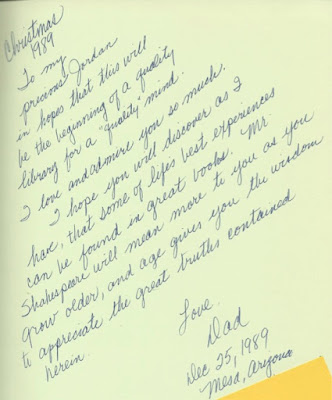
Dad's note to me inside my copy of
The Complete Works of Shakespeare
When I was a little boy, my parents encouraged me to check out books from public libraries and provided transportation to-and-from these bastions of book learning. I also started building my own library at a very young age. 

By the time I was 10-years old, immediate and extended family members knew exactly what to get me for birthdays and Christmas. Between these gifts and my own creative and proactive procurements, I had amassed a personal library that exceeded 500 volumes by the time I was in my early 20s. My home library today is more than double that size, and will undoubtedly continue to grow in coming years.  

At age 10, my dad gave me a copy of The Complete Works of William Shakespeare as a Christmas gift. His note to me inside the front cover of this 2,334-page tome was indicative of my parent's love, support, and passion for reading, study, education, and the pursuit of my personal dreams and professional ambitions. 

It read:

Christmas 1989

To my precious Jordan in hopes that this will be the beginning of a quality library for a "quality mind." I love and admire you so much. I hope you will discover as I have that some of life's best experiences can be found in great books. Mr. Shakespeare will mean more to you as you grow older, and age gives you the wisdom to appreciate the great truths contained herein.

Love,

Dad

Dec. 25, 1989

Mesa, Arizona

I was further blessed with five older siblings, who are between four and twelve (12) years older than me. This provided me with an early exposure to concepts, conversations, and textbooks that were far more advanced than the primary lessons I was receiving in elementary school. 

This influence of my parents, siblings, extended family members, religious background, and personal study afforded me with continual opportunities to read, study, and otherwise learn about history, philosophy, psychology, religion & theology, critical thinking, logic, math & science, rhetoric, oratory, self-help, sales & marketing, management & leadership, personal finance, human relations, health & wellness, fitness, athletics, etc. 


A Pedagogy of Parental Affirmation

In conjunction with the continual social, emotional, cultural, spiritual, and educational conversations and lessons in my home, my parents further instilled within me a powerful sense of my own worth and potential as a human being. 

They taught me that if I was willing to work hard, follow the rules, take personal responsibility for my actions, and never give up, I could overcome any obstacles and accomplish great things in my life and career. Despite my foibles and flaws—and I had plenty—my parents, siblings, extended family, and teachers were nonetheless quick to tell me over-and-over again that I was capable, smart, and had a bright future. 

I believed them.

This repeated positive reinforcement helped shape my self-image and prepare me for future success. A concrete example of how this played out in my day-to-day life involved sticky notes my mom used to leave in my room to find after I got home from school. Often these notes were reminders of chores, but they almost always included a smiley face and an "I Love You!" 

In fourth grade, my teacher asked my parents to write a letter affirming their child. Mom's words meant a lot to me back then; they still do today. 

"Jordan Jensen is indeed a unique and special human being. He is an example of determination and excellence in our home. The Jensen home would surely miss a great deal without Jordan's presence. Jordan is a good friend and tries not to ever offend or hurt one of his friends. We love Jordan and are very proud of his efforts and actions thus far in his life." 

My father was similarly positive and enthusiastic in his affirmation of my capacity, potential, and worth. There was never a doubt in my mind that Dad really believed in my ability to do or be just about anything I decided to achieve or become. For example, one day, when I was about 10 or 11 years old, Dad and I were watching the news when I blurted out that maybe I would be a newscaster one day. This was not the first time I had announced an ambition for my future, yet Dad's reply was swift, certain, and confident: "Well, Jordan, if you want to become a newscaster, then you can become a newscaster.

My interest in broadcast journalism was fleeting, but Dad's affirming impact on my self-worth was lasting.

Parental love and affirmation can be a KEY
to a child's success
Years later, before leaving home to attend college for the first time, a similar exchange between Dad and me took place that I will forever cherish. That particular morning had been unnecessarily stressful due to last-minute preparations and poor planning on my part. To make matters worse, I had absentmindedly misplaced my car keys. I eventually found them, and began heading to my car to leave. 

Right before I got into my car, Dad approached me, looked into my eyes, and with a smile on his face and a twinkle in his eye said: "Jordan, someday you will speak before Congress; but right now, you just need to remember where you put your keys!" 

He grinned widely and we both laughed. After a warm and loving embrace, Dad waved me off to college and I drove away feeling like a million bucks knowing my dad thought I was pretty special—in spite of my many mindless mistakes, lingering immaturities, and persisting insecurities.

In sharing these stories, I am not suggesting parents and teachers fill their children and students' heads full of disingenuous platitudes or unrealistic potentialities. To be clear, my dad never told me I was destined to become a rocket scientist or that I could someday play quarterback for the Dallas Cowboys. 

He was just consistently optimistic and hopeful about my legitimate potential in areas where I had already demonstrated natural abilities, a sincere desire to excel, and a strong work ethic. He was quick, therefore, to point out my potential as a writer and speaker. While he saw no harm in a little playful grandiosity, which made me feel like a prince, he was never unrealistic on my behalf—just incredibly affirming and encouraging.

With my Mama in Mesa, Arizona
Circa 1987
While my parents were lavish in their support of my goals and affirmation of my worth, they never put excessive pressure on me to pursue an activity or endeavor for their own sakes, or in which I was uninterested or poorly suited. In other words, they never tried to live their lives through me. Instead, they encouraged me to pursue my own passions, rejoiced in my successes, and comforted me through my disappointments and failures.

How could I go wrong when the two most important people in my life were continually affirming my worth and supporting my potential and worthy desires? And it wasn't just Mom and Dad. My siblings, grandparents, aunts, uncles, cousins, school teachers, church leaders, neighbors, and friends were repeatedly reminding me that I was important, had tremendous potential, and could accomplish great things in my life. 

This immediate and extended milieu of supporters were not perfect, but they were nearly perfect in their practice of positively affirming, encouraging, and supporting me as their son, brother, cousin, student, friend, etc.  

In sharing these things, I do not mean to suggest that pedagogues and parents should allow a false sense of unrealistic optimism to strangle pragmatic realism in the lives of their students and children. But at the same time, they should also avoid letting cynical perceptions of present realities squelch realistic optimism about their legitimate potential for the future.  

With Dad in Monticello, Utah
Circa 1982
I painfully recognize that not everyone is born into a family with such luxuries in the form of parental and sibling affirmation, love, and support. Such temporary troubles do not, however, diminish anyone's innate worth as a human being, nor does it forever stunt one's future potential. 

Regardless of your upbringing, your potential for progress and growth remains limitless if you are willing to take invest the time and effort required to overcome the challenges of the past. Healing from wounds of the past and letting go of its accompanying pain is not easy; but it is possible. 

Even if no one has ever told you this before, believe it now! 

Hold on to hope for the future and exercise faith in yourself and the good people of the world. Believe that you can work hard, make good choices, and eventually overcome every challenge of your past to yet become very happy and successful. 

Even if it takes years or decades to fully transcend what has gone before in your life, it is worth the effort to change and become. This textbook will help show you how. Then, if you decide to have children yourself, you can choose to right the wrongs of your parents by giving your own children the love, affection, encouragement, and support you were denied. 

YOU can choose to break negative and destructive thought, speech, and behavioral patterns of your progenitors.  


A Pedagogy of Reproof

As valuable as positive affirmations were in my overall education, it was only part of the story. Just as importantly, I was taught the difference between RIGHT and WRONG and what that difference entailed. Then, when I did something wrong, I was lovingly—albeit often firmly—reproved by parents, siblings, extended family, and teachers. Thus, discipline, reproof, and appropriate punishment were essential components of my moral education. 

For example, at age four, I innocently pocketed some candies from a neighborhood grocery store. When my parents discovered the products their preschooler had pilfered, they wisely turned the incident into a learning experience by taking me back to the store to return the stolen items and apologize to the store manager. The lesson was not lost on me, and my life as a thief ended as quickly as it had begun. 

On another occasion, I had opted to run wildly through the coat rack in my kindergarten class. I thought it was great fun to watch and feel the other kids' coats fly off the rack and tumble into a big heap on the floor. My teacher and classmates did not share my good humor in the matter; neither did my parents. 

After receiving Mrs. Moore's phone call reporting the matter, my parents sternly scolded me for my inappropriate behavior. They further required that I apologize to Mrs. Moore and my classmates and promise I would not repeat my carless actions. That was the first and last time I was guilty of such rowdy behavior in Mrs. Moore's classroom, and I have my teacher and parents to thank for it. 

This education in reproof involved being told—sometimes with a dead seriousness and steely firmness—when I was thinking, saying, or doing something that was wrong. From reprimands and rebukes to formal discipline and the removal of privileges, I received a fine education in what it meant to act inappropriately—and that acting thusly was not acceptable at home, school, church, or in the community. 

I don't know anyone who likes the feeling of being corrected, much less rebuked or reproved. I certainly don't like it. I also don't know anyone who doesn't need correction and reproof from time-to-time, including myself; and I count myself blessed to have been surrounded by loved ones who were neither timid nor hesitant when it came to redirecting me when I got off course.  

Benjamin Franklin
(1706-1790)
Benjamin Franklin once wrote: that which hurts, instructs.


"That which hurts, instructs."

—Benjamin Franklin


Franklin is likely referring to a variety of life adversities in this particular quote. However, I believe this truism is especially applicable to necessary and wise—albeit uncomfortable or even hurtful—correction, discipline, and reproof from those whose experience and perspective transcends our own, and who either personally love us, or else professionally have our best interests in mind. 

Some of the most painful moments of my life have come from being corrected, disciplined, reprimanded, or otherwise "called on the carpet" and held accountable for my actions. I don't like making mistakes and reproof usually comes as a huge blow to my pride. 

I feel awful, foolish, guilty, and incompetent when I screw up. Such experiences cause me a great deal of discomfort. Another part of my pain stems from the shame and remorse I feel from having disappointed someone I love or respect. A third component involves the realization that I have fallen short of my potential. I despise failing and falling short of my potential can be agonizing for me.  

And yet... all of this is a GOOD thing!

        Why? 

Ralph Waldo Emerson
1803-1882
Because there is no better motivation for change than authentic, heartfelt, sincere pain and regret. This is one reason why the American philosopher, Ralph Waldo Emerson once quipped that: a healthy discontent is good.


"A healthy discontent is good."

—Ralph Waldo Emerson


No matter how caring and compassionate the delivery may be, reproof can influence one to feel small and ineffectual. It is not easy to face up to one's failures, faults, shortcoming, and weaknesses. Yet reproof has been absolutely essential to my personal and professional growth and progress; and it will be just as important to yours. 

No human being is perfect. We can't always see beyond our own heads, and we are sometimes incapable of perceiving the need to change without outside intervention. Thank God there are others who care enough about us to inflict the kind of healing hurt that accompanies loving correction, discipline, and reproof.

It is far more efficient—and less painful—to listen to and internalize correction, discipline, and reproof than it is to blindly attempt to figure everything out all on your own through trial-and-error. While there are some life lessons you can learn only from experience, you can avoid much suffering by simply heeding the wise counsel of others who have gone before you. You can also learn a great deal from observing the decisions of others—and the consequences that accompany those actions.

Self-action leaders are courageous people who are not afraid to take wise, calculated risks on the altar of education and growth. But they are likewise prudent individuals who circumvent avoidable mistakes at every opportunity, and they maximize these opportunities by listening and then hearkening to wise council from others with more knowledge and experience than they have.  


Church Education

The purpose of this textbook is not to promote religion or proselytize for my faith. Nevertheless, in a book that draws heavily on my personal narrative, it would be intellectually negligent to overlook the impact of my religious upbringing and education on my overall education and outlook. This is due to the sheer amount of time and effort I have invested—and continue to engage—in spiritual nurturance and religious practice.

My formal theological education commenced in between the ages of eighteen months and 3-years old in my church's "Nursery" program. I gave my first public address just shy of my fourth birthday in the "Primary" program (for 3-11-year-olds). Since that first speech, I have made informal comments in small and large groups of people and/or spoken formally in front of small or large audiences thousands of times in a variety of different church settings.

I have attended over four decades worth of Sunday School and other, related classes. I am a graduate of my church's "Seminary" and "Institute" programs, which represent six years of high school and college instruction on religious and scriptural topics. 

I also served a 2-year full-time mission for my church in Edmonton, Calgary, Innisfail, and Camrose, Alberta, CANADA. My missionary service consisted of proselyting efforts, community service, and participation in local units of the church. I also had opportunities to lead and train other missionaries. I met and conversed with over 10,000 people from all over the world hailing from all walks of life.

It has all been an incredible EDUCATION! 

In all, I have spent some 25,000 hours in ecclesiastical education, practice, service, training, and worship. My church education has taught—and continues to teach me—humility, obedience, self-discipline, moderation, chastity, forgiveness, compassion, tolerance, kindness, love, courage, self-restraint, self-sacrifice, generosity, leadership, hard work, resiliency, determination, persistence, vision, goal-setting, and competence in all kinds of communication and relationships. 

While I cannot claim to perfectly personify all of these virtues all of the time, there is no question that my instruction therein has empowered my practice and exemplification thereof; and that is the hope, power, and glory of EDUCATION. 


A Blessed Education

I have lived on this planet for nearly five (5) decades. While it is still strange sometimes to think of myself as "Dr. Jensen," I am aware that my education has been unusually blessed and favored. I openly acknowledge that I have had an anomalously privileged background and upbringing. It is hard to go wrong when everyone around you is teaching, guiding, encouraging, praising, and correcting you in positive, uplifting, and loving ways. 

What about the legions of people who have not been so blessed? 

I recognize that many, and perhaps even most, of my readers may not have been as blessed as I was in their own backgrounds, upbringing, and educations. 

And that is OKAY!

The miracle of Self-Action Leadership is that it doesn't matter where you come from or what you may have faced in the past; your future can still be bright!

One of the most beautiful things about SAL is that it isn't a competition; it's an opportunity. As a self-action leader, you don't have to compete with me or anyone else for that matter. And I don't have to compete with you or anyone else either. We simply have to compete against our own past performances.

The goal of SAL is to make this intrapersonal, self-competition a never-ending quest for self-improvement and growth. Anyone and everyone can benefit from SAL in unique and important ways, no matter what may have happened (or not) in your past. In the inspiring words of Anthony Robbins—a world famous personal leadership coach: The past does not equal the future. 


"The past does not equal the FUTURE."

—Tony Robbins


REMEMBER: There is nothing inherently special about me; but everything is special about SAL principles and practices. Anyone who learns these principles and implements these practices will eventually attain similarly positive results in their life and career.  


Our Duty to Learn and then Teach

Having learned, practiced, and deeply internalized SAL principles and practices myself, I now see it as my solemn duty to teach them to others. I wrote this textbook in an effort to fulfill this responsibility. I have dedicated my life and career to teaching other people what I have been so incredibly blessed to learn myself. 

Everything good that has come into my life as an adult is a result of learning and then practicing the correct principles I was taught in my formative, adolescent, and young adult years. I am honored to share what I have learned. I hope you will choose to studiously learn and then diligently practice this knowledge... for your own everlasting benefit.  

There are TWO (2) basic duties I believe all human beings share in life. The first is to LEARN and the second is to TEACH. Once you have learned something that makes a positive difference and helps you avoid negative consequences in your life, you have a duty to teach those truths to others in appropriate and effective ways. 

When it comes to SAL, teaching occurs primarily through example and secondarily through instruction—not the other ways around. In the words of Emerson: What you do speaks so loudly that I cannot hear what you say.  


Ralph Waldo Emerson
1803-1882

"What you do speaks so loudly that I cannot hear what you say
."

—Ralph Waldo Emerson


I have been taught, and then continually reminded about, SAL principles and practices dozens, hundreds, and in some cases even thousands of times throughout my life. Since I was just a little boy, I have hungered and thirsted wholeheartedly after these truths. Learning them ranks among the most fulfilling satisfactions of my life; teaching them to others is even more fun and rewarding. 

Once you have learned and applied these truths yourself, I invite you to join my colleagues and me at Freedom Focused in our quest to teach and exemplify them to others at every opportunity throughout your lifetime. 

As we work together as a united front dedicated to teaching and exemplifying SAL, everyone who sincerely wants to learn and is willing to work will be able to scale the towering heights of their limitless potential. May we each do our part by seeking out this knowledge, faithfully applying it in our own lives and careers, and then diligently sharing it as clearly, cogently, and enduringly as possible with others.  

According to the educator, E.D. Hirsch, Jr., "the real test of any educational idea is its usefulness."  [2]  There are few, if any, more holistically useful principles and practices than the ones contained in this textbook. How do I know this? Because learning SAL principles and applying SAL practices have absolutely transformed my life and empowered me to become who I am today. 

What will they do for YOU?

        Only time and effort can tell the ending of that story!

                How will your tale ultimately unfold?

                        Will you choose to become its hero?

Let's get moving and answer these questions!  


In Your Journal

  • What has your educational journey been like so far?
  • What elements of your past education have helped you?
  • What elements of your past education have hindered or hurt you?
  • What can you do, beginning today, to ensure that your future education is more proactive, productive, and precise than your past or present education?


—Dr. JJ

Wednesday, November 29, 2023
Palm Beach Gardens, Florida, USA


Author's Note: This is the 362nd Blog Post Published by Freedom Focused LLC since November 2013 and the 175th consecutive weekly blog published since August 31, 2020.   

Click HERE for a compete listing of the other 361 FF Blog Articles 

Click HERE for a complete listing of Freedom Focused SAL QUOTES  

Click HERE for a complete listing of Freedom Focused SAL POEMS   

Click HERE to access the FULL TEXT of Dr. JJ's Psalms of Life: A Poetry Collection

Click HERE for a complete listing of Self-Action Leadership Articles

Click HERE for a complete listing of Fitness, Heath, & Wellness Articles

Click HERE for a complete listing of Biographical & Historical Articles


Click HERE for a complete listing of Dr. JJ's Autobiographical Articles

.........................

Tune in NEXT Wednesday for another article on a Self-Action Leadership related topic.  

And if you liked this blog post, please share it with your family, friends, colleagues, and students—and encourage them to sign up to receive future articles for FREE every Wednesday.

To sign up, please email freedomfocused@gmail.com and say SUBSCRIBE, or just YES, and we will ensure you receive a link to each new blog article every Wednesday.  


Click HERE to buy the SAL Textbooks    


Chapter 6 Notes

1).  Mansfield, S. (1995). Never Give In: The Extraordinary Character of Winston Churchill. Nashville, TN: Cumberland House. Page 227. 

2).  Hirsch, E.D., Jr. Kett, J.F., and Trefil, J. (2002). The New Dictionary of Cultural Literacy. Completely Revised and Updated. Boston, MA: Houghton Mifflin Company. Page xvi. 


Monday, November 27, 2023

SAL Master Challenge EXERCISE #1


SAL Master Challenge

EXERCISE  #1


Self-action leaders are JOURNALERS


Journal writing is one of the most beneficial, therapeutic, and valuable practices and habits you can ever engage in your life and career. I first started journaling on January 1, 1987, when I was only seven years old. I have been an enthusiastic and prolific journaler ever since, penning thousands of pages in all sorts of different diaries and journal records and lists. 

The blessings to my life and career from doing this have been many and varied. For example, it has bolstered and strengthened my memory, improved my self-esteem and self-image, and helped me to become the writer I am today. 

As you prepare to begin your study and application of SAL, it is vital that you obtain a personal diary to accompany you on your journey.

The first SAL Challenge exercise is to obtain a notebook, or save an electronic text file on your computer, where you can begin your personal SAL-Journal. This diary will accompany your reading and study of the SAL Textbooks and your completion of the SAL Master Challenge.

Throughout the SAL Textbooks, you will come across an image of a hand with a feather pen. Underneath this image it will read: In Your Journal. 
In Your Journal


This image will be followed by a journal writing question or prompt, which you will be required to answer or otherwise complete as part of your SAL Master Challenge. In addition to answering these specific journal prompts and questions, we encourage you to reflect in your journal at the end of each chapter—or at any other point throughout your study of the SAL Textbooks. The purpose of this journal is to record inspiration and other thoughts, feelings, questions, ideas, dreams, aspirations, concerns, fears, frustrations, goals, etc.

Before beginning a new journal entry, always record the DATE. Doing so will increase the value of the journal to you in the future. It will also bolster memory recall.   

Also use your journal to record unfamiliar VOCABULARY words you come across in the SAL Textbook and beyond. Then, with the help of a dictionary, write down the word's part/s of speech, etymology, and definition/s. Finally, creatively compose a practice sentence using each new word.  

Self-action leaders are hard workers. They also value education. As such, they strive diligently to become highly literate and numerate. 

Lastly, they are effective communicators who are culturally literate and possess a high degree of personal refinement and professional polish. Keeping a journal and expanding your vocabulary are key personal academic pursuits that will help you to achieve these worthy states of being.

TASKS to COMPLETE

1).  Obtain a personal diary or journal.

2).  Read Theodore Roosevelt's speech, Citizenship in a Republic, and record your reflections thereon.


I have completed the SAL Master Challenge EXERCISE #1


Your initials:__________         AP initials:__________


—Dr. JJ

Monday, November 27, 2023
Palm Beach Gardens, Florida, USA


Author's Note: This is the 361st Blog Post Published by Freedom Focused LLC since November 2013 and the 175th consecutive weekly blog published since August 31, 2020.   

Click HERE for a compete listing of the other 360 FF Blog Articles 

Click HERE for a complete listing of Freedom Focused SAL QUOTES  

Click HERE for a complete listing of Freedom Focused SAL POEMS   

Click HERE to access the FULL TEXT of Dr. JJ's Psalms of Life: A Poetry Collection

Click HERE for a complete listing of Self-Action Leadership Articles

Click HERE for a complete listing of Fitness, Heath, & Wellness Articles

Click HERE for a complete listing of Biographical & Historical Articles


Click HERE for a complete listing of Dr. JJ's Autobiographical Articles

.........................

Tune in NEXT Wednesday for another article on a Self-Action Leadership related topic.  

And if you liked this blog post, please share it with your family, friends, colleagues, and students—and encourage them to sign up to receive future articles for FREE every Wednesday.

To sign up, please email freedomfocused@gmail.com and say SUBSCRIBE, or just YES, and we will ensure you receive a link to each new blog article every Wednesday.  


Click HERE to buy the SAL Textbooks

Wednesday, November 22, 2023

The SAL Master Challenge


Chapter 5


The SAL Master Challenge


This chapter introduces the Self-Action Leadership MASTER CHALLENGE (SAL-MC), which, if diligently embraced and pursued to completion, will exponentially increase the long-term value of reading and studying these textbooks.

Throughout my life, I have been blessed with many opportunities to engage in challenges and exercises similar to those you are about to embark upon in the SAL Textbooks. These opportunities arose in a variety of different settings, including school, scouting, church, and my own independent reading and studying initiatives. 

In 1997, prior to my senior year in high school, I completed the requirements to become an Eagle Scout, the highest rank in the Boy Scouts of America. Becoming an Eagle Scout is a singular honor for a Boy Scout and requires a great deal of time, effort, and personal commitment. Fewer than five percent (5%) of registered Boy Scouts rise to this prestigious rank. 

A Boy Scout's parents are also usually closely involved as well. In my case, however, my parents did not coax or push me into the Scouting program; nor did they micromanage any of my efforts. I therefore took personal pride in proactively pursuing my Eagle because it was something I genuinely wanted for myself, not something my parents or scout leaders pressured or coerced me to complete.

The requirements for becoming an Eagle Scout included earning merit badges in 21 different knowledge/skill areas, camping overnight at least 20 times, engaging in many hours of general community service, and then leading my peers in planning and completing a specific and unique community service project. My "Eagle Project" involved building and painting a bench and then installing it in the City Park in my hometown of Monticello, Utah.  

Throughout my Scouting journey I learned, developed, grew, and acquired new knowledge, skills, and confidence as a human being, citizen, and leader. As a result of my efforts, I became something better, stronger, and more capable than I was before. 

These acts of committing myself to a specific set of outlined disciplines and requirements—and then following through on those objectives—developed a pattern of internal and external growth and progress that has greatly blessed my life, career, and relationships ever since.   

My set of scriptures with markings for specific
passages required for memorization
A similar opportunity arose in the Seminary program of my church, which consisted of four years of scripture classes taken during my four years in high school (grades 9-12). In addition to graduating from Seminary, I also had the opportunity to become a "Master Scriptorian" by memorizing 100 scripture excerpts—25 per year for each of the four required courses. It required a lot of determination, effort, and focus to memorize 100 scriptures, and the exercise did wonders for both my confidence and memory.

Later, while serving as a full-time missionary for my church, I had a chance to tackle an even more ambitious goal and earn my "Master Disciple" certificate, which required a lot of reading, study, and even more memorization than I had done in Seminary. This award was preceded by "Gold," "Silver," and "Bronze" certificates, each of which came with a progressive list of tasks to be completed en route to earning the highest certificate of "MASTER DISCIPLE."  

A fourth example of engaging in this kind of deep, disciplined, and ambitious self-growth and improvement took place when I was a freshman in college during the 2001-2002 school year. During this time, I participated in an extended and intensive self-help program lasting for forty-five (45) weeks. I found the program in Og Mandino's book, entitled: The Greatest Secret in the World.

My copy of Og Mandino's
Greatest Secret in the World
With homemade cover for
added protection
This challenge required that I take certain action steps three-times per day for 225 days (five days per week). I invested much thought and many hours of focused reading, pondering, reflecting, recording, and analyzing throughout the process. As was the case when I earned my Eagle Scout award, completing Mandino's ambitious 45-week "Success Recorder" (1) transmuted my very being into something more capable, confident, determined, and substantive that it was before.  

Throughout my secular and religious education and training, I have had other, similar experiences that have likewise empowered me to become something greater than I was before. Suffice it to say, great power may be harnessed through conscious ACTION directed conscientiously toward an intentional and well-defined goal. In developing the SAL Master Challenge, I have drawn on all of my erstwhile experiences for the benefit of your personal and professional change, growth, and freedom. 

If you are willing to commit to the challenge and rigor of the SAL Master Challenge and see it through to completion, I promise you will experience some of the same positive growth trajectories I have enjoyed from tackling similar opportunities.  

The SAL Master Challenge requirements consist of a series of homework assignments that accompany your reading and studying of the SAL Textbooks. At the end of this chapter, you will find a copy of these requirements. This is where you will keep track of your progress and achievements.

Helping my older brother Wayne (front right) with his
Eagle Project in 1985.  I did the same project 12 years later.
I am in the background in the orange shirt, age 6.
Upon earning my Eagle Scout award, I joined an honorary fraternity of fellow Eagle Scouts known as The Eagle's Nest. Those who complete the SAL Master Challenge will likewise enter an elite and honorary worldwide club known as The Freedom Circle. Entering the Freedom Circle is considered an official gateway toward becoming a self-action leader.

As you progress along your journey towards the Freedom Circle, you will keep track of your own progress. You will also determine (on the altar of your personal honor and integrity) when you have satisfactorily completed ALL of the requirements.  

Are you prepared to begin your own journey towards the Freedom Circle?

    Do you have the desire, will, work ethic, and attitude required to do hard things?

        Do you desire to change and grow more than you seek to remain as you are?

If so...

    Then read on!  


SAL MASTER CHALLENGE

Requirements


1.  Find an Accountability Partner (AP) in the form of a spouse, family member, friend, supervisor, teacher, coach, colleague, mentor, etc. Review with them the SAL Master Challenge requirements. Recruit them to serve as a witness, support, and cheerleader to your efforts.

Accountability partner's name:_______________________________________

Your initials:__________         AP initials:__________


2.  Read and study the entire SAL Textbook (all eight (8) book-sections)

Your initials:__________         AP initials:__________


3.  Complete all 25 Homework Exercises throughout the SAL Textbooks.

Your initials:__________         AP initials:__________


4.  Record 200 handwritten or 100 typed (double spaced) pages in your SAL Journal in response to the "In Your Journal" questions or prompts contained throughout the SAL Textbooks.

Your initials:__________         AP initials:__________


5.  Draft a SAL-Declaration of Independence and SAL-Constitution and review with your Accountability Partner.

Your initials:__________         AP initials:__________


6.  Share these books—and what you have learned and experienced—with three (3) people who have not read or studied them yet. Invite them to read and study the SAL Textbooks and complete the SAL Master Challenge.  

Your initials:__________         AP initials:__________


On my HONOR, I affirm and attest that I have completed ALL requirements of the SAL Master Challenge. By virtue of the authority delegated to me by Dr. JJ and Freedom Focused LLC, I hereby declare myself a Self-Action Leader committed to rising to the highest levels of Existential Growth throughout my life and career.


_______________________________________
Your Signature


_______________________________________
Accountability Partner's Signature


______________________________________________
Completion Date


—Dr. JJ

Wednesday, November 22, 2023
Palm Beach Gardens, Florida, USA


Author's Note: This is the 360th Blog Post Published by Freedom Focused LLC since November 2013 and the 174th consecutive weekly blog published since August 31, 2020.   

Click HERE for a compete listing of the other 359 FF Blog Articles 

Click HERE for a complete listing of Freedom Focused SAL QUOTES  

Click HERE for a complete listing of Freedom Focused SAL POEMS   

Click HERE to access the FULL TEXT of Dr. JJ's Psalms of Life: A Poetry Collection

Click HERE for a complete listing of Self-Action Leadership Articles

Click HERE for a complete listing of Fitness, Heath, & Wellness Articles

Click HERE for a complete listing of Biographical & Historical Articles


Click HERE for a complete listing of Dr. JJ's Autobiographical Articles

.........................

Tune in NEXT Wednesday for another article on a Self-Action Leadership related topic.  

And if you liked this blog post, please share it with your family, friends, colleagues, and students—and encourage them to sign up to receive future articles for FREE every Wednesday.

To sign up, please email freedomfocused@gmail.com and say SUBSCRIBE, or just YES, and we will ensure you receive a link to each new blog article every Wednesday.  


Click HERE to buy the SAL Textbooks


Chapter 5 Notes

1).  Mandino, O. (1972). The Greatest Secret in the World. New York, NY: Bantam Books. Page 26.  

JJ's Journal: February 1988

  The Personal Journals of Jordan Rex Jensen  February  1988 Monday, February 1, 1988 JJ slam dunking a mini soccer ball in the driveway of ...