Monday, August 31, 2020

What Sets SAL apart from Everything Else?


What sets Self-Action Leadership (SAL) apart from all other options on the market—past or present?


The answer is simple: COMPREHENSIVENESS and long-term RESULTS.


SAL is about far more than getting motivated, setting goals, improving performance, or even winning a game or championship—although it serves as an umbrella that secures and protects all of those things as well.

SAL is about an individual's holistic development. It's about empowering individuals to make a quantum leap in their ability to use their own minds and hearts to become better, smarter, and more caring, capable, and accomplished people than they previously were.

Just as importantly, SAL is about getting onto a personal life-pathway that will lead to desirable long-term results in one's personal life and career. For as all highly successful leaders understand, the true measure of one's success and legacy is not merely degrees, promotions, fame, money, or personal achievements. It is about the kind of influence you have on othersin conjunction with the family you build, the true friends you acquire, and the impact you have on your community, state, nation, and world. 

As I developed the SAL Theory & Model over the past two decades, many people have wondered (and some have even vocally queried) why I chose to break the cardinal rules of personal development coursework (and marketing) in the 21st century. In other words, why did I write two long, black-and-white textbooks that are heavier on substance than they are on style, color, and seeming sell-ability.

The answer is simple: authentic people—like YOU—want authentic solutions to the very real and perplexing problems and dilemmas they face in life. And the reality is that the ONLY authentic solution to personal development and other self-leadership snafus involve careful learning, diligent study, and then consistent and persistent application of true principles over time.

There is no other way!

Deep down, I think we all intuitively know this is true. Unfortunately, we are often too ignorant (sometimes intentionally) and lethargic (or even lazy) to pursue authentic pathways to real results. Why? Because real results are usually difficult to achieve. It's so much easier (in the short-run) to just hide from our problems and pretend they don't really exist.

Put another way, the reason I consciously chose to develop a seemingly 18th, 19th, or 20th century solution for the 21st century is because the principles and practices that lead to long-term success have not changed one iota in the past 6, sixty, 600, or even 6,000 years. While different authors have come up with a cornucopia of creative ways and means of packaging parts and portions of this TRUE FORMULA over the years, the fact is that no one has ever assembled a holistic, secular, and academically-based theory and model that covers the full-spectrum of both the art and science of personal development.

Until now that is... because that's what SAL offers!

In other words, SAL provides infinitely more than a "pep talk," "motivational speech," or even a "30/60/90-day success program." Rather, SAL offers a veritable lifelong guidebook for successfully navigating life itself as a human being. If such a guidebook were in fact to exist—and the principles and practices it outlined actually worked when followed—wouldn't you want it to have 1,300 pages as opposed to 1.3, thirteen, or 130?

You see, my friends, the real magic of the SAL material comes to life as individuals commit to carefully reading and studying the SAL Manuals on a daily basis over an extended period of time, thus allowing the principles to seep deep into their minds and hearts, thereby taking root into their very souls. Add to this a committed daily practice and application of the principles, and you begin to see—over time—remarkable and unprecedented transformations of an individual's personal and professional capacity and performance.  

While professional training and mentoring can and should facilitate this process, the real magic occurs as a person immerses oneself in the material and then begins to think deeply and critically about how the principles apply to him or her in a relevant, practical manner. Followed up by committed and diligent action, this method is failure-proof.

Growing up, my father taught me that that nothing in life worth having comes fast or easy. You and I both know that Dad's words to me are TRUE. If you want to be the BEST at something—or more importantly, your best as a human being—there is only one true pathway that leads to that objective. That journey involves PAYING THE PRICE that authentic accomplishment and long-term success demands.

A generation ago, Dr. Stephen R. Covey noted that we live in a world where far too many of us are overly prone to embrace "quick-fix" and "band-aid" approaches and solutions to our problems. It's even worse in our present generation, where many people—and even many leaders—too often seek to solve decades- or even centuries-old problems in a single 140-character Tweet!

While "quick-fix" and "band-aid" approaches to problem-solving may mask the pain of those problems in the short-run, we all know that in the long-run, there is only one way to solve problems. As M. Scott Peck once quipped, "The only way to solve a problem is to solve it." That sounds simple enough in theory; but in actual practice, solving deep problems is rarely quick or easy.

But it can be done!

SAL teaches you the hows to achieve the kind of real and authentic personal problem solving and inner growth that leads to outward success. I am here to give you the opportunity to change, grow, and become consummately successful—over time—by following those true principles upon which long-term change, growth, and success are predicated. And just imagine what these kind of individual character transformations would do to YOUR own personal and professional victories down the road?

When it comes to getting things done, there is never a better time than the PRESENT. Yes, budgets are tight right now and everything else is extra difficult as we continue slogging through this once-in-a-century pandemic. Yet, I have discovered in my own life and career that no matter what your circumstances may be, there is almost always enough time and/or money to do what you really want to do—if you want to do it badly enough. Furthermore, could there be a better time to invest in your own personal and professional development? Indeed, the time may very well be perfect for YOU to begin undertaking an initiative of this nature.  

How badly do you want to see your life, or the lives of your subordinates or students absolutely transformed through an immersion in Self-Action Leadership principles and practices? 

When YOU decide you want it badly enough, click HERE to procure your own copy of Self-Action Leadership, Volumes 1 & II.  

Sincerely—and with RESPECT,

-Dr. JJ

.........................

If you liked this blog post, please share it with your family, friends, colleagues, and students—and encourage them to sign up to receive future articles for FREE every Wednesday.


To sign up, please email freedomfocused@gmail.com and say SUBSCRIBE, or just YES, and we will ensure you receive a link to each new blog article every Wednesday.    

Tuesday, June 30, 2020

The Role of Proactivity in Self-Action Leadership


The Self-Action Leadership Theory, Model, and Textbooks are now officially published and available in print form.

Now that leaders, educators, and parents around the United States and world can review the material, how can they determine whether it is worthy or wanting in terms of its potential value in their organizations, schools, and homes? 

The answer to this question will differ from reviewer to reviewer. After all, different people view the world in different ways. But it will also depend on how PROACTIVE each reviewer is.

This is because proactivity is the essence of Self-Action Leadership (SAL). It is also because SAL does not provide quick or simple solutions to deep problems.

Why?

Because quick or simple solutions to serious problems usually don’t exist—no matter how badly we may wish for or hope that they would. More often, deep problems require deep solutions, which in-turn require extensive amounts of focus, discipline, dedication, consistence, and persistence (in other words, PROACTIVITY) to access and animate in real life.

Anyone who tells you otherwise is selling you snake oil.  

As such, those who are unwilling to carefully and seriously review the SAL material probably won’t recognize its true potential. Instead, they’ll just see two long textbooks capable of collecting a lot of dust.

Dr. David G. Anthony, an incredibly accomplished professional educator—who wrote the Afterword to the SAL Textbooks—initially felt the same reactive pull of unwillingness that you may feel as you are confronted with two, long, print textbooks.

In Anthony’s own words:

“When Jordan originally invited me to review an 802-page manuscript of this book, I balked a bit, wondering when I would possibly have time to review such a tome. It is interesting to note how some of life’s most important, rewarding, and ultimately enjoyable tasks initially appear so uninviting. In the end, I opted to set myself to the task, and I am so glad that I did. 


“I thank Jordan for inviting me to read this work. He has earned my endorsement. Reading the Self-Action Leadership textbooks may be the most worthwhile thing you do this year. I hope the message of SAL makes its way into the minds and hearts of students, parents, and business professionals everywhere. Its presence in the literature is a service to our country—and world.”

As Doctor Anthony—and all other highly proactive self-action leaders—understands, “You get out of something what you are willing to put into it.” Over time, that is just a mathematical reality. In other words, what goes around comes around, and you absolutely reap what you sow in the long-run.

Given these realities, I have been pondering lately on the power of PROACTIVITY in both our personal and professional lives.

It was disciplined and focused proactivity (on my part) over the past 17 years that led to the creation and publication of the SAL Theory, Model, and Textbooks. Similarly, it will be proactivity (on your part) that leads to the effective and productive utilization of this new, cutting-edge, and groundbreaking personal leadership material.

The question is: “To what extent are you willing to do whatever it takes to realize your goals and help your students, athletes, staff members, colleagues, and subordinates to realize theirs?” In other words, how PROACTIVE are you willing to be when it comes to investigating SAL and then ensuring that your students carefully study and apply it as well?

I have been passionate about the concept of proactivity ever since I learned about it from Dr. Stephen Covey back in 2001. Probably more than anyone else in the world, Dr. Covey deserves credit for making the term “PROACTIVE” commonplace in modern English usage. After all, you won’t even find the word in most twentieth century dictionaries. Yet today it is one of the more commonly used words in educational, business, and a variety of other societal lexicons.

In Dr. Covey’s famous book—The 7 Habits of Highly Effective People—he selected “Proactivity” as the FIRST habit in his famous model.

Why?

Because proactivity is the mindset and habit that makes all other positive actions and achievements possible. Proactivity is like the fuel that makes an airplane fly or an automobile drive. Similarly, it is proactivity that makes Self-Action Leadership (SAL) productively operative in our lives and careers.

Proactive people inspire me because they consist of those relatively few individuals in our communities, organizations, and society-at-large who consistently exercise initiative, work hard, pull their weight (and usually much more), solve problems, and build worthwhile things that last. Everything a proactive person touches tends to accelerate and improve over time. Everything positive, productive, useful, and helpful around us exists because of PROACTIVE PEOPLE.

REACTIVITY is the opposite of PROACTIVITY. Unfortunately, there are usually a lot more reactive people than there are proactive people in any given organization or community.  

Reactive people do not respond to situations productively, rationally, or even sanely. Rather, they react based on their moods, feelings, impulses, environmental conditions, prejudices, misinformation (and false information), and social pressures. Proactive people, on the other hand, respond to situations intelligently and empathetically based on values, standards, laws, order, courtesy, empathy, love, and their own internal consciences, which are continually governed by a principle-centered compass that consistently points to principled ideals Covey describes as “True North.”

In Covey’s words, “Response-ability” [is] the ability to choose your response [regardless of internal or external stimuli or pressure]. Highly proactive persons recognize that responsibility. They do not blame circumstances, conditions, or conditioning for their behavior. Their behavior is a product of their own conscious choice, based on values, rather than a product of their conditions, based on feelings” (See “Be Proactive” Chapter of The 7 Habits of Highly Effective People).

According to Covey, “The ability to subordinate an impulse to a value is the essence of the proactive person” (Ibid.). In summing up the essence of proactivity, Covey explains that, “We are responsible for our own effectiveness, for our own happiness, and ultimately, I would say, for most of our circumstances” (Ibid.).

That last statement can be tough medicine to take when life gets difficult or seems unfair. And since life is often difficult and seems unfair, we must take a great many doses of this medicine if we are to transcend our difficulties and rise to higher planes on the powerful wings of proactivity. The good news is that the difficulty and the seeming unfairness of life does not negate the power of proactivity in our lives—as long as we are given an opportunity to learn about and practice it.

Perhaps you are wondering why I use the word “seeming” before the word “unfair” in the preceding paragraph. After all, aren’t things often unfair—plain and simple—in life? Furthermore, is it not obvious that things are much more unfair for some people than others? While a one-dimensional or superficial answer to this question would obviously be “YES”, the reality is often deeper and more complicated.

To illustrate my point, consider the fact that historically speaking, some of the greatest and most accomplished persons to ever live in this world were dealt extremely difficult hands at various junctures of their lives. Was it fair that Theodore Roosevelt had to deal with breathtaking asthma growing up, or that Franklin Roosevelt was dealt a devastating blow of polio that put him in a wheelchair in middle life? Was it fair that Abraham Lincoln lacked the money and opportunity to receive a quality formal education? Was it fair that Frederick Douglass was born into slavery or that Helen Keller entered this world deaf and blind? Was it fair that the genius Stephen Hawking became a physical invalid relatively early on in life, or that Christopher Reeve (aka Superman) broke his neck in an equestrian accident in his physical and professional prime? Or what about the profound prejudices and other oppressive forces that Gandhi, Martin Luther King, Jr., and Nelson Mandela had to face? Or the deep and onerous social, cultural, and personal challenges that Oprah Winfrey overcame to become the billionaire media mogul she is today?

In every example listed above, the individuals named were able to achieve success not only in spite of their challenges, but in part because of them. In other words, take away their challenges—the seeming unfairness—and it is possible they would not have risen nearly as high as they did in their lives and careers. That is why, in hindsight, highly successful people often refer to their past by saying: “I wouldn’t change a thing—even if I could.” Such people recognize that their difficulties and challenges were just as important to their overall success as their advantages and benefits—and sometimes even more so—because of what they became due to the extraordinary growth they achieved by overcoming deep and painful obstacles.

This does not mean, of course, that all unfairness is good or desirable. Some unfairness is, in fact, rooted in human error, prejudice, and evil—something that proactive persons of conscience are quick to identify, condemn, and seek to extinguish wherever they find it festering. What it does mean is that seeming unfairness in life almost always contains seeds of opportunity that proactive persons can use to learn, grow, progress, and achieve. As such, the next time you find yourself saying: “It’s not fair,” consider what the other side of the coin might produce over time through personal proactivity. After all, hindsight often demonstrates the tremendous value to be found on the other side of significant life difficulties and challenges. In the words of Garth Brooks’ famous Country Music song: “Some of God’s greatest gifts are unanswered prayers.” 

For the proactive, there is something magical about adversity. It actually makes a person far stronger and more accomplished than they would have been under easier circumstances. Athletes become stronger by lifting heavy weights and persistently pushing through pain, bad weather, injuries, and other adversity—not by coasting downhill with a brisk tailwind at their backs. Why would it be different for human beings in general, either personally or professionally?

For the reactive, however, adversity can be mind-numbing and completely draining; the challenges stop them cold in their tracks. Seemingly unable to go any further, the reactive are then quick to complain about how unfair life is. And from their own limited perspectives, they are right!

How different the world would be if everyone had an equal opportunity to learn about and then practice PROACTIVITY from their youth on up! Unfortunately, far too many individuals throughout our country and world have learned for far too long—from bad examples and poor pedagogy—to confront their personal and professional problems and the seeming unfairness of life reactively rather than proactively.

I personally am no stranger to adversity. From being dealt a devastating case of mental illness (OCD and depression) in my adolescence to confronting significant personal, relational, and professional challenges in young adulthood, my life has not been easy. I imagine yours hasn’t been either. But that doesn’t mean life is irreversibly unfair, or that you are doomed to failure and penury—no matter where you may have started out, or how significant your trials may presently be. I can tell you with certainty that I wouldn't be where I am now in my life or career without the growth and progress obtainable only through successfully surmounting the manifold challenges with which life has dealt me. My trials and crucibles were not fun. They were excruciating. But they have absolutely made me who and what I am today. For that, I wouldn't go back and eradicate them—even if I could.  

There is so much hope for overcoming whatever adversity may come your way in life, especially when you understand the principles and practices of Self-Action Leadership and are willing to be PROACTIVE in your pursuit thereof.

Fortunately, I read Covey’s 7 Habits of Highly Effective People when I was a freshman in college. It changed my life and led to my own diligent pursuit of a similar career. What is the purpose of that career To help educate and inspire others to become highly proactive persons who build things and initiate positive, productive, and meaningful change as opposed to reactive people who blame, shame, complain, and call people names.

One of the most proactive things that any individual can undertake—especially in this day-and-age of short attention spans—is to dedicate time, effort, and energy to deep reading and study about the most important things in life. In other words, to simply sit quietly for substantial periods of time in thoughtful, reflective, and diligent reading and study of high-quality wisdom literature.

I know the value of this activity because of my own life-changing experience reading Covey’s 7 Habits—and other life-changing literature throughout the past three decades of my life. As a result, I spent the last 17 years creating a NEXT-GEN 7 Habits-esque comprehensive personal leadership textbook that leaders, educators, coaches, and parents can use to begin to turn the tide against the pandemic of reactivity we see all around us. But instead of a primarily popular read designed for a corporate environment and the literature of the layman, SAL is a bona fide educational textbook that proactive educators, schools, and even scholars can legitimately embrace—to the benefit of themselves, their staff members, and most importantly—their students.

It takes a LOT of proactivity to spend some of your hard-earned money to buy a long, detailed textbook and then invest the time and effort to read, study, apply its principles, and teach it to others. For those willing to be proactive, I promise you will be empowered with a greater desire and ability to become a solution to the problems you face at home and work—as well as to the challenges presently perplexing our communities, nation, and world. Additionally, you will find yourself gradually and steadily rising to higher levels of growth, success, achievement, happiness, and inner peace.

I have dedicated nearly half my life to creating an educational solution to the preventable and solvable difficulties we see all over America and throughout the world. I plead with persons in positions of power and influence to investigate how this proposed solution can begin to make a palpable difference in the lives of students, workers, and human beings everywhere.

According to Stephen Covey, “Your most important work is always ahead of you, never behind you.” How might Self-Action Leadership empower and further the vital work that lies in your future?

There’s only ONE way to find out.

In Summary, PROACTIVE Persons (aka Self-Action Leaders):

· Take the initiative
· Focus on solutions
· Build things

They Are:

· Self-disciplined and focused
· Results oriented
· Willing to try new things and even fail in order to learn. And when they do fail, they immediately pick themselves up, study out a new and better approach, and then try again.


REACTIVE persons, on the other hand:

· Wait for others to take the initiative
· Focus on problems
· Tear people (and things) down

They are:

· Undisciplined and focus on

     o Blaming,
     o Shaming,
     o Complaining, and
     o Name calling


What kind of a person do you want to become?

     What kind of people do you want your students, staff members, or subordinates to become?

          What are you willing to do to realize your desires and objectives?


Freedom Focused is here to help reactive people become Proactive People and proactive people to realize their full potential. We accomplish these objectives in three simple (but not necessarily easy) steps.


1. Read and study the SAL Theory, Model, and Textbooks

2. Enliven and expand upon the material with LIVE TRAINING by myself (Dr. Jordan Jensen) or another Freedom Focused Facilitator.

3. Reiterate and repeat steps one and two with ongoing training, coaching, mentoring, and consulting on a strategically planned or as-needed basis.


.........................

Tune in NEXT Wednesday for another article on a Self-Action Leadership related topic.  

And if you liked this blog post, please share it with your family, friends, colleagues, and students—and encourage them to sign up to receive future articles for FREE every Wednesday.

To sign up, please email freedomfocused@gmail.com and say SUBSCRIBE, or just YES, and we will ensure you receive a link to each new blog article every Wednesday.  

Click HERE to learn more about Freedom Focused

Click HERE to learn more about Dr. Jordan Jensen

Click HERE to buy the SAL Textbooks

Tuesday, June 9, 2020

The Making of a Champion


Attention Coaches, Leaders, and Educators Everywhere: 


Practically speaking, what exactly is the FUNCTIONAL AIM of the Self-Action Leadership Textbooks and training?

To answer this question, I'd like to pose a few questions to YOU, as follows:

1. When, in the past, were YOU most focused on and diligently dedicated to a single-minded purpose?

2. What was your goal, objective, or "End in Mind" for giving it your all for that particular period of time?

3. Did you achieve it?

4. If so, how did it feel?

5. Would you like to replicate those feelings and accomplishments?


When I think about these questions myself, I immediately go back to my junior year in high school during the lead-up to winning the State cross-country championship in my school's classification.

After finishing 4th at the State Meet the previous year as a sophomore, I was determined to not be a bride's maid my junior season. For several months following the 1996 Summer Olympics (which was very inspiring to watch), I was completely zoned in on my objective. In short, I exercised highly effective Self-Action Leadership and was richly rewarded with an individual Gold Medal and First Place team trophy at season's end. As an individual athlete and a Team Captain, I accomplished everything I set out to achieve.

It was enormously rewarding.

As someone once said: "Once a Champion, always a Champion." I believe this is true for the simple reason that this outlying achievement has continued to burnish and bolster my self-image and confidence for the past 24 years, despite accomplishing more significant and more important things since that time.

What about YOU?

I'm guessing you could probably hearken back to something similar in your own personal life or professional career. What made that particular season, semester, or time period so special? What set it apart from other periods of your life when your efforts and results were less spectacular?

The idea behind the Self-Action Leadership seminars and textbooks is to provide YOU and your student athletes with an opportunity to intentionally simulate these outlying periods of heightened preparation and increased focus that lead us to become our very best either personally or professionally. Such opportunities can, in fact, be intentionally created by diligently reading, studying, and learning the principles of SAL and then applying their accompanying practices over set periods of time.

What do you have to lose to train your students in SAL, equip them with textbooks, coaching, and mentoring, and then really GO FOR IT in your upcoming season, semester, year, et cetera?

How far might you go by taking this unique, time-tested approach?

Would it be worth it to give it a shot, knowing from your own past experiences how valuable such endeavors can be?

If your honest answers to these questions are:

1). I have nothing to lose and everything to gain.

2). It is definitely worth a shot -- just to see how far we might go.

3). Without any question, YES!


Then I look forward to hearing from you soon to begin developing a specific plan to transform your team, classroom, school, district, organization, etc., into the Championship Program it was destined to become.

See You at the Top-

-Dr. JJ


Visit FREEDOMFOCUSED.COM for more information

Click HERE to read the Foreword & Afterword to the SAL Textbooks, written by Christopher P. Neck, Ph.D., and David G. Anthony, Ed.D.

Friday, June 5, 2020

Humility in Leadership


As promised, today I share two examples of high profile, executive leaders who demonstrate that loftiness of position should not elevate anyone beyond doing what needs to be done, when it needs doing, no matter how seemingly lowly the labor at hand may be. These leaders exemplify the great truth that no one should be "above" scrubbing a toilet (literally or figuratively) or attending to any other necessary task.  


The Hyrum W. Smith Story


Shortly after graduating from college, I got a part-time job as a retail salesman in a FranklinCovey store in Atlanta, Georgia. One day, my manager told me of an experience she once had with my Uncle Hyrum. She and her colleagues were setting up a table of Hyrum’s books to sell at a national FranklinCovey symposium. As they worked, Hyrum—the co-founder of the entire company—just happened to walk by. Immediately, he jumped in and started helping them complete the menial labor of setting up the table of books. My manager was surprised. Her comment to me was, “I didn’t think CEOs unloaded boxes.” 

Hyrum’s actions left an impression on my manager that positively influenced her own leadership style. The story, in turn, left a positive impression on me. It continually serves as a reminder that no matter how high I may ascend within a hierarchy, I should never think myself too good or important to lend a helping hand when needed. And if that means setting up tables or washing dishes or scrubbing toilets, then so be it! If a job needs to be done, no self-action leader should ever consider him or herself to be above any honest labor that needs completing—no matter how lowly that work might seem. Hyrum’s humble actions demonstrate how a leader’s actions and interactions between other leaders and subordinates can influence a more egalitarian company culture.


The Stirling D. Pack, Ph.D. Story


Stirling D. Pack Jr., Ph.D., is a former senior vice president of a Fortune 500 corporation in the Houston, Texas area. Through hard work and diligence, Pack rose through the ranks of his company to eventually become a “big shot,” making millions and flying around the world on corporate jets.

Shortly before Pack retired, Nick—a lowly graphic technician—visited Pack in his office to present a thank you gift. Why? In Nick’s words: “You were the only senior executive in this entire company that ever treated me like a human being.” 

Pack did not know Nick well. In fact, he had to think for a moment to recall how he knew Nick at all. Then he remembered: Nick had assisted him a time or two as an IT specialist by designing some slides for his executive presentations. That was the only association Stirling ever had with Nick. Pack did not tell me what he did or said to make Nick feel so valued; I don’t think he remembered himself. The point is that he did. Pack was the kind of leader who understood the great truth that no one is “just-a” graphic technician, “just-an” administrative assistant, “just-a” custodian, or “just-a” new hire. 

Stirling understood that existentially speaking, he was no better than Nick. As such, he treated him with the same kind of respect and regard as he would have treated his own supervisor—the CEO of the entire company. All of the greatest leaders I have known share this intellectual understanding of Existential Equality, which Pack so effectively demonstrated in his interactions with other people, including—and perhaps especially—with his subordinates.

The story of Stirling and Nick remind me of a stanza of verse from the poetry of Henry Wadsworth Longfellow (The Builders):

Nothing useless is, or low;
    Each thing in its place is best;
And what seems but idle show
    Strengthens and supports the rest.   

The best leaders are humble. They understand that one's own innate existential worth does not exceed any other human being—no matter how intelligent, gifted, or accomplished he or she may be. This realization instills within such leaders a deep reverence for their colleagues and subordinates. As a result, they treat other people as if they were the most important asset they have; because that is exactly what they are!

.........................

Tune in NEXT Wednesday for another article on a Self-Action Leadership related topic.  

And if you liked this blog post, please share it with your family, friends, colleagues, and students—and encourage them to sign up to receive future articles for FREE every Wednesday.

To sign up, please email freedomfocused@gmail.com and say SUBSCRIBE, or just YES, and we will ensure you receive a link to each new blog article every Wednesday.  

Click HERE to learn more about Freedom Focused

Click HERE to learn more about Dr. Jordan Jensen

Click HERE to buy the SAL Textbooks


Thursday, June 4, 2020

Dutifully Doing the Dirty Work of SAL

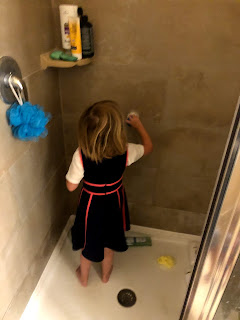
Today I taught my seven and five year old one of the most important lessons anyone can ever learn in life: how to scrub a toilet and clean a bathroom.

Perhaps I am overstating the point a bit, but hear me out...

All my life, I have been a believer in the power of scrubbing toilets and cleaning bathrooms. There is nothing quite so satisfying as beholding a beautiful baño that sparkles, shines, and smells good by virtue of my own willed effort, detailed focus, and gritty elbow grease.

Likewise, there is nothing quite so rewarding as progressing in your life and career in ways that decrease the likelihood that you'll have to clean bathrooms if you don't want to! You see, the beauty of SAL is that it empowers you to do the dirty work of life so well that eventually you won't have to do much dirty work anymore.

Due in part to my OCD, I am VERY GOOD at cleaning bathrooms. And narcissistic though the following sentiment may be, I have always been convinced that there is something special about someone who can do the same. Perhaps it is because my personal experiences have taught me that most people avoid cleaning the bathroom at almost all costs, and even when forced to finally address the problem, tend to do a subpar job of it. And "cleaning the bathroom" here can also serve as a metaphor for any dirty, grimy, and difficult, but necessary work that must be done at home or at work.

This annoying fact of collective humanity was a perpetual annoyance for me growing up, and more particularly as a young unmarried man in college and beyond where I was always more willing and capable of cleaning a bathroom than any of my roommates. As such, you can guess who ended up doing the dirty work of cleaning the bathroom most often—especially at the end of a semester prior to a landlord's inspection.

Although I confess this fact about my fellows spawned some bitterness in my young heart, there was also something inside of me continually whispering that in the long run, karma would be kind to people with such will and determination to do what had to be done, no matter how unpleasant. I was further inspired by the wisdom of Thomas Huxley, who once wrote:

"The most valuable result of all education is to make you do the thing you have to do, when it ought to be done, whether you like it or not. It is the first lesson that ought to be learned. And however early a man [or woman's] training begins, it is probably the last lesson that he [or she] learns thoroughly."

Over the years, I have occasionally met individuals who are truly SAL superstars when it comes to cleaning bathrooms—and I am always impressed and heartened when I do. One especially salient example is my good friend, Kari Ginn. Years ago, I attended the same church congregation as Kari and her husband Kirk and their beautiful family. Kirk was the congregational leader at the time, making Kari a high profile member as well. One Saturday morning, I arrived at the home of a member of our congregation to assist other members in packing up the family's belongings for a move.

As I walked through the home, I observed who was there and what they were doing. Some were participating more actively than others, but I'll never forget who I saw on her hands and knees vigorously scrubbing the shower floor in the bathroom. It was Kari. Of all the women in the congregation, you would think Kari should have been exempt from such lowly labor. Yet SHE was the one setting the ultimate example for the rest of us. That image of Kari humbly kneeling to attend to the dirty work that nobody else wanted to do was a priceless picture of pure, honest, and unpaid service on behalf of another. I will never forget it. And I'll bet the Ginn's bathrooms were probably among the cleanest in the neighborhood.

Like it or not—and none of us much like it—LIFE is filled with dirty, grimy, and messy work (both physically and metaphysically speaking) that must be attended to if we desire to live happy, successful, and prosperous lives. It has been my experience—both personally and from observing others—that those who enjoy the most happiness and peace of mind in the long-run are the ones who most proactively tackle the dirty jobs in life in the short-run. Such people are personifications of Self-Action Leadership.

And the cool part is that over time, their efforts are rewarded in a variety of ways—including having to do less and less of the dirty work themselves. This reward comes about in part because those individuals are usually the ones who become leaders and managers, who, of necessity must delegate most of the dirty work to others. Although it should be noted that the GREATEST LEADERS are the ones who never rise so high that they cannot stoop down to "scrub a toilet" (literally or figuratively) if the occasion requires it. Moreover, such leaders are quick to jump in and model for others how such work should be done as needed. Tomorrow I will publish another blog post that shares the story of two highly successful executives (Stirling D. Pack, Ph.D., and the late Hyrum W. Smith) who exemplified this principle in their own high profile organizations.  

The rewards can also come because one's own personal financial situation improves to the point where he or she can pay others to do some of the dirty work for them. I confess that as Lina's and my financial status has progressed over time, we have hired professional cleaners in the past, and we will undoubtedly do so in the future as well. 

But that doesn't mean we won't still teach our kids how to scrub a toilet and clean a bathroom til it sparkles—so they'll know how to do it when they go out on their own. Fortunately, our brief stint in Carlsbad probably won't include professional cleaners, opening up a perfect opportunity for me to teach my kids—my primary profession until Freedom Focused finally takes off—this most important of life lessons, and provide them with a chance to practice it until they possess the skill themselves.


Carlsbad, New Mexico
Thursday, June 4, 2020 


Click HERE to read the Foreword & Afterword to the SAL Textbooks, written by Christopher P. Neck, Ph.D., and David G. Anthony, Ed.D.


Sunday, May 31, 2020

Cultivating the Spirit of Exploration

After Nearly a Decade on the Sidelines, the U.S. Sends Americans Back to Space!

I have always been passionate about America's involvement in exploring the "Final Frontier" of Outer Space. It is, after all, no coincidence that I developed the Self-Action Leadership Theory out of a metaphysical metaphor and extended analogy rooted in Space exploration.
In my last blog post, I lamented the extended moratorium of the United States' commitment to Space Exploration, punctuated by the retirement of the Space Shuttle Program back in 2011.

In light of this lamentation, you can imagine the joy, excitement, and pride I felt when SpaceX's Crew Dragon rocket successfully blasted off at Cape Canaveral, Florida, yesterday afternoon at 3:22 p.m. EST, carrying astronauts Robert Behnken and Douglas Hurley to the International Space Station.

Click HERE to watch the Launch. 

Fueling my enthusiasm even further is my wife's and my friendship with Sarah (McNeese) Walker, currently a Senior Mission Manager at SpaceX headquarters in Los Angeles. I first met Sarah when Lina, Sarah, and their two other roommates were just 19 year-old sophomores at The Georgia Institute of Technology (Georgia Tech). Suffice it to say, there was a lot of brainpower in that college dorm! No wonder the good Lord made me wait until I was 27 before I was worthy of holding my own among that mighty milieu of misses. I must have seemed like a grandpa to them at the time, which is, no doubt, why those candid coeds christened me "Mr. 27."  Little did I know at the time what great things that young quartet would eventually accomplish.  

We are so proud of you Sarah!

South African born SpaceX Founder and CEO, Elon Musk—who faced severe bullying and other challenges growing up—is now the veritable king of Earth and Space (at least for the weekend). Musk was overcome with emotion and nearly at a loss for words after watching his long-held dream become a reality on Saturday afternoon.

Once he did find the words, he remarked:

"I think this is something that should really get people right on the heart of anyone who has any spirit of exploration.  And the United States is a distillation of the human spirit of exploration and I think this is something that is particularly important in the United States, but appeals to everyone throughout the world who has within them the spirit of exploration."  

Click HERE to watch post-launch remarks by Vice President Pence & President Trump.  

Musk went on to say that,

"I'm really quite overcome with emotion on this day, so it's kind of hard to talk, frankly.  It's been 18 years working towards this goal so it's hard to believe that it's happened."

Unlike Musk, a physicist and engineer, I am a metaphysicist and writer. Like Musk, I am an entrepreneur who has been working for nearly 18 years in an effort to launch my own rocket ship, although of the metaphysical variety. It's not quite there yet, but it's very close; you might even say it is on the launching pad.

While Musk aims to someday take people into Outer Space, I hope to one day take people to the outer reaches of their metaphysical potential as human beings. The Self-Action Leadership Theory teaches men and women how to do just that by advancing step-by-step through the Nine Stages of Existential Growth, analogized by the layers of Earth's atmosphere reaching high up into the outermost reaches of Outer Space.

Click HERE to read a Scholarly Article on the Self-Action Leadership Theory.  

Click HERE to buy the textbook, Self-Action Leadership, Volume I: A Theoretical Framework for Existential Growth

Sadly, yesterday's success in space can be contrasted by violent clashes here on the ground, sparked by the unspeakable tragedy of George Floyd's completely inexcusable murder at the hands of ruthless police officers in Minneapolis, Minnesota last week. The rampant violence, looting, and arson that accompanied the highly justified protests were also inexcusable. Suffice it to say, deeply entrenched and stubbornly pervasive problems persist all around us.

It is interesting to note that erstwhile achievements in Outer Space — hearkening back to the 1960s and 1970s — were also accompanied by strikingly similar civil unrest at home. It is sad that we have not made more progress in the past half century. But if there is one thing that yesterday's successful rocket launch should signal to all of us, it is that Hope Springs Eternal. Hope for healing. Hope for CHANGE. Hope for helping each other succeed. And Hope for a better and brighter future for ALL of us. 

At Freedom Focused, we are fervently committed to being part of the solution to problems all around us. And as educators and role models, we strive our utmost to leave this Planet a better place than we found it by serving our fellowmen and empowering them to more fully realize their limitless potential as human beings and children of God.  

Click HERE to learn more about our vision and mission as educators and role models at Freedom Focused

This juncture in the history of humanity — and more specifically in the unfolding story of the United States of America — provides all of us with an opportunity to pause and reflect. In so doing, may we direct those reflections inward in that kind of self-reflection borne of honest and humble introspection.

In other words, instead of pointing fingers at others, which is so easy to do at a time like this (or any time for that matter), may we each ask ourselves that painful and piercing question: "How am I part of the problem, if only in my thought processes?" And as a follow-up question, may we further query ourselves as follows: "What can I tangibly do beginning today to become part of the solution," with the recognition that I can only control my own thoughts, speech, and actions; but that in that control, I can be an agent of positive and productive change inside my own metaphysical world as well as a powerful and growing influence in the broader world itself.

By cultivating the Spirit of Exploration in our own minds, hearts, and spirits, I am confident that we can begin to nurture real and lasting change in our own lives, relationships, and homes. By so doing, we can gradually become catalysts of real and lasting change in our organizations, communities, regions, states, nations, and world-at-large.

There can be no greater quest than to indefatigably pursue that kind of positive change that comes from within and then blesses all without. Join us, and together we will transform our nation and world into the truly remarkable place it is capable of becoming.


Wednesday, May 20, 2020

Why I Founded Freedom Focused


Why did I decide—17 years ago—to found an educational training company?

Perhaps an even better question is: Why am I still indomitably and indefatigably (some might even say stubbornly) sticking with my original plan despite the fact that very few people want to listen to what I have to say (YET), meaning that nearly two decades later, things still aren't entirely "off the ground"? And in light of this present reality, why would I still have no intention of ever pursuing anything other than building Freedom Focused? Why am I, in the words of Og Mandino, so intractably willing to "persist until I succeed" no matter how long it takes, and no matter how difficult the pathway proves to be?

These are good questions, and for those who are interested, I have answers.

In truth, many of the reasons are personal, and despite my love of Truth and Right Action, I certainly don't claim to be an unsullied altruist. From personal drive, ambition, and an amorous romance with the written and spoken word, to a manic motivation to maximize my personal potential and an insatiable itch to influence others and positively impact the world, my reasons are many and varied. I also possess a penetrating passion and parching thirst for freedom, adventure, opportunity, and variety, a determination to live my life without regrets, and an absolute insistence on being true to the authentic core and essence of who I really am—rather than allowing social and other external pressures to form my life and career in their own images.

Indeed, a cornucopia of different explanations exist for my continuing career craze.

However, this blog post is not about any of these things. Instead, this article addresses a subject that will probably be a lot more interesting to YOU.

Another—just as powerful—reason I founded Freedom Focused back in 2003, is articulated by a quote from one of my favorite 19th century American philosophers, authors, and poets: Ralph Waldo Emerson.


"A healthy discontent is good."

Emerson


I possess no small amount of "Healthy Discontent" about life, people, and the world around me. One of the more salient examples—as outlined in my last article—is how much I despise litter, and how committed I am to making my own, small contribution to mitigating that pervasive problem.

As a self-action leader, making a commitment to being part of the solution to problems is essential. Passive whining and complaining about "how bad things are" is a useless epidemic in our nation and world. If you have the strength to complain about something, then you also have the strength to stop whining about it on social media and then get to work proactively doing something about it. As Gandhi so compellingly remarked: "You must be the change you wish to see in the world."


"YOU must be the CHANGE you wish to see in the world"

Gandhi


Just as those who fail to vote lose their moral authority to critique elected officials, those who merely "complain on the couch" (or on facebook) are, in fact, part of the problem.

Moreover, it is crucial to comprehend the complete panorama of the reality we face, which unveils a 360-degree vista that is as marvelous as it is menacing. In other words, despite any and all problems we individually and collectively face as human beings, we still live in the greatest, easiest, safest, cleanest, and most comfortable and luxurious time in the history of Planet Earth. As such, it is vital that we keep our complaints in perspective—no matter how valid each concern may be.

With that said, my personal "healthy discontents" boil down to five items, as follows:

1. Supervisory Egotism

2. Subordinate Recalcitrance

3. Dishonesty

4. A Dearth of Quality

5. Lack of Innovation


I will now address these items one-by-one, after which I will explicate how Self-Action Leadership (SAL) carries the potential to solve—or at very least meaningfully mitigate these problems in a significant and substantive way.


1. Supervisory Egotism

"Supervisory egotism" refers to leaders and managers in positions of formal authority who abuse their power and otherwise exercise unrighteous dominion over their subordinates. Chances are you've probably worked for someone like this; also known as the Jerk Boss. Unfortunately, it is the nature of many—if not most—people to use their personal power or influence to take varying degrees of unfair or unjust advantage over others who possess less power and influence than they do. Unless a supervisor is routinely checked by a higher-up, or possesses the self-discipline, character, and integrity to check oneself at every turn, it is almost inevitable that people will eventually abuse their power in one way or another and to one degree or another.

Common symptoms of supervisory egotism include greed, jealousy, withholding justly deserved praise, rewards, recognition, advancement, and other perks from others (while hogging the same for oneself), and deviously or unfairly preventing the rise of talented subordinates who may have even more ability or potential than oneself. Instead of doing the right thing in every situation because it is the right thing, egotistical supervisors are continually looking out for number one—to the detriment of anyone and everyone—and the consequences to others be damned!

One of the most unnecessary and invidious acts of supervisory egotism involves executive compensation. Those at the top don't need 100, 200, or even 300 times the annual salary of a median worker's salary. That kind of income disparity is the personification of greed. Ten, twenty, or thirty times is plenty. That is why Freedom Focused will limit its executive pay (including me as CEO) to only 13 times our median worker's salary.  If we someday rise to the level of our potential and are able to fully implement this sensible policy, just imagine how much more capital we'll have on hand to invest in providing world-class products and services to our clients! Just as importantly, imagine how much more empowered we will be to justly remunerate our hard working employees!


2. Subordinate Recalcitrance

This is the opposite problem of supervisory egotism. Instead of a boss abusing his or her authority and power, subordinate recalcitrance involves followers who refuse to respect, listen to, or heed wise and reasonable policies, procedures, edicts, and counsel of leaders. Chances are you probably work with someone like this right now. You know, the Jerk Employee. Or, perhaps you may fall into this category yourself from time-to-time (always remember that the essence of SAL involves identifying and then going to work on your own weaknesses and shortcomings, no matter how painful the process may initially be).

Whereas supervisory egotism involves pride and arrogance from the top looking down, subordinate recalcitrance involves pride and arrogance from the bottom looking up. This phenomenon inhibits productivity and poisons organizational cohesion. Persons who exercise subordinate recalcitrance are not very teachable or coachable. In their minds, they know better than the boss. They may even believe that they should be the boss.

Subordinate recalcitrance should not be confused with justifiable civil disobedience and personal ambition. There are times when the former should be exercised in the face of supervisory egotism or unethical behavior, and it is quite possible to be incredibly ambitious and still be a good follower who respects authority.


3. Dishonesty

We are presently in the midst of a worldwide pandemic known as COVID-19. Fortunately, in the next year-or-so, a vaccine will be developed and most of us will eventually be safe from the terrors of this devastating flu strain. Unfortunately, the world has always been plagued by an even more dangerous, diabolical, and ultimately deadly existential pandemic known as dishonesty and deceit. Fortunately, there is a vaccine for dishonesty; it is called character and integrity (aka SAL). Unfortunately, many people are only marginally interested in paying the price required to apply this existential vaccine to the problem. Dishonesty with others produces untold amounts of pain, suffering, and loss from both a material (i.e. financial) and trust standpoint. It is an evil that ruins business, politics, journalism, marriages and other relationships, organizations, and human lives.

Another form of deceit involves dishonesty with oneself. Self-Deception is the ultimate inhibitor of Personal Growth and Character Development. Self-deception always precedes dishonesty with others.  As such, it is a logical place to start working on recommitting yourself to the TRUTH.


4. A Dearth of Quality

At the end of the SAL Textbook, Volume II (page 514), I added a "Postscript" whereby I lamented the lack of quality and service at one of my nation's major airports into which I recently flew. In doing so, I contrasted it to the fine quality and superior service offered at a foreign airport out of which I also recently traveled. In that article, I admitted to being embarrassed at my own country because of the stark difference in quality, service, and cleanliness as exhibited in the foreign nation's airport.

Sadly, my embarrassment doesn't end at U.S. airports.  I am often embarrassed at the lack of quality I find in a variety of places I visit throughout my otherwise great homeland. From litter and poor customer service, to health care providers who are habitually (and egregiously) late and then put forth a poor bedside manner; from food preparers who shoddily assemble your order and then fail to assemble or complete it properly, to service workers of all kinds who lazily engage in mediocre work performances, cut corners, and engage in subpar craftsmanship.

President Theodore Roosevelt once taught that "The Quality of the Individual is Supreme."  At Freedom Focused, we know that the quality we desire in everything around us is a reflection of the quality of the individuals involved in a given organization, industry, or community. As the quality (character, integrity, work ethic, etc.) of individuals grows and improves, the quality of everything those individuals touch (physically or metaphysically [via personal influence]) concurrently increases. 


5. Lack of Innovation

According to the concept known as "The American Dream" everything ought to (more or less) improve and get better over time. If this is the case, then:

  • Why did the United States take an extended moratorium from exploring "The Final Frontier"?
  • Why has airline comfort, quality, speed, and efficiency stayed static—or in some cases atrophied—over the past half-century?  In other words, with so much technological advancement at the industry's fingertips, why aren't we all flying in first class comfort at 100,000 feet going Concord-esque speeds (or faster)?  
  • Why is so much of our infrastructure crumbling without receiving desperately needed repairs and upgrades?
  • Why is poverty still such an epidemic in the United States despite pouring trillions of government dollars into the problem over the past 60 years?
  • Why are cities going bankrupt and homeless populations exploding? 
  • Why do Americans have to travel to Europe or East Asia to travel on state-of-the-art high-speed bullet trains and find quality bidets in their hotel toilets?
  • Why are East Asians so much better at teaching Character Education than Americans? 
  • Why is the American public education system still eschewing leadership, character, and life-skills education as part of its core curriculum even though anyone with any experience and common sense knows such subjects are more important than any others except for reading and writing?
  • Why do politicians, and the so-called journalists who cover them, so often perform their jobs in such puerile, unprofessional, and downright pathetic ways—as if they were little more than childish brats sparring on an elite, private playground?
  • Why are people in general so hateful toward and unkind to each other on social media, as well as in person?

In compiling this list of frustrations, I have no wish to be a "couch complainer." That is why I have spent the last 17 years of my life—and to a lesser extent the 15 years before that (for a total of 32 years of preparation)—developing the Self-Action Leadership Theory & Model.

I know that a comprehensive solution exists to the problems outlined above. I have dedicated my life and career (tens of thousands of hours) to rooting out these problems in myself first, followed by an earnest attempt to help others who are desirous and willing to accomplish similar objectives.

The key words in this equation are willing and desirous. It is essential to remember that you cannot ultimately make anyone do something against one's will, nor should any of us try that approach; that's what Nazi Germany attempted, and it is always an evil endeavor bound to fail. Human free will is—and must always remain—sacrosanct. That is just one of many reasons why I named my company Freedom Focused. People must remain as free to fail as they are to succeed. But for those who are desirous and willing to succeed, a formula does exist that provides a powerful vaccine to not just one of the ills mentioned above, but to all of them.

Sadly, my success in getting this message to take off among the greater population has been, to-date, meager. But that is okay. If there is one thing I have learned and developed in growing quantities over the past two decades, it is PATIENCE. Self-Action Leadership may not be standard operating procedure in American schools, universities, organizations, governments, and homes YET. But it will. I know it will.

Why?

Because I will keep working and waiting until it does. And in the process, I will outwork, out-wit, and out-wait the naysayers.  Or, I will eventually pass away from this world while still diligently determined and dedicated to trying.

Want to play a role in getting this ball moving? Want to be a part of this growing movement that is destined to change the course of American—and perhaps world—history by changing the course of American Education?

If so, you can begin by buying the SAL Textbooks. Then read and study them. As you do so, complete the SAL Master Challenge along the way. Finally, tell a friend or educator about it and encourage them to do the same.

Together, we can make a positive and lasting difference in our own lives, the lives of those we lead and love, and the communities, organizations, and nations in which we live and work. And the result will be a better, brighter, and more brilliant, successful, happy, and peaceful future for all of us.

Despite the doomsday climate we find ourselves in amidst the COVID crisis and other deeply entrenched political, social, and moral problems, I fervently believe that our best days are still ahead of us in the United States and throughout the World. But such days will not just make themselves; they are not a foregone conclusion. If we desire a better future then we have to build it, one brick and one trowel of mortar at a time. Self-Action Leadership shows you how. It provides the vision, roadmap, blueprint, and tools required to make it all become a reality—one-step-at-a-time, starting with ME and YOU.


What are you waiting for?


BUY the SELF-ACTION LEADERSHIP Textbooks, Volumes I & II, by clicking HERE

For more information about Freedom Focused, click HERE

For more information about Dr. Jordan Jensen, click HERE


Geaux Tigers!  


Thursday, May 14, 2020

The Power of Picking Up Trash

I despise litter.

It drives me a little nuts, albeit in a good way.

Wherever and whenever I see trash out of its place, I admit to getting a little obsessed about doing my bit to clean up the planet. I'm sure my "litter fetish" probably annoys my wife and kids at times; but to their credit, they put up with my passion without complaining. My kids have even started to spot and retrieve litter all on their own!

"Train up a child in the way he should go and when he is old he will not depart from it." 
Proverbs 22:6   

In my new TEXTBOOKS on Self-Action Leadership, I included the following mantra: "Pick up at least ONE piece of trash every single day that I did not throw down."

Why is this mantra important to me?

Simple...

Because others have helped to clean up my messes at times throughout my life.  Now it's payback time. 

But in a larger sense, this practice is important to me because focusing on little things empowers me to not only make progress on bigger things, but can simultaneously prevent larger issues from becoming a problem in the first place.  Moreover, this mantra is as much a principle as it is a practice—and this particular principle positively influences a variety of different areas of my personal and professional life.

In other words, it's not just about the trash.

Flatiron Building in Downtown New York City (Manhattan)
Case in point: Consider the example of New York City in the 1990s under the leadership of Mayor Rudy Giuliani. In an effort to combat serious crime issues that had plagued the city throughout the 1980s and early 1990s, Giuliani decided to address the issue in an unusual way. His approach was simple: "Always sweat the small stuff." This policy entailed focusing on cleaning up trash and graffiti in the subways and clamping down on turnstile jumpers.

Why in the world would you focus on such minor offenses if you were dealing with an epidemic of violent crimes such as rape, murder, and armed robbery?

Answer: because BIG THINGS almost always start out as little things. Counterintuitive as Giuliani's approach may have seemed, it worked! As the NYPD began "sweating the small stuff," the incidence of far more egregious crimes began to fall precipitously. One murderer was even caught, not due to clever detective work, but because he had been apprehended for jumping a subway turnstile!

While that may sound like a mere stroke of good luck on the part of the Police, the reality remains that murderers get their start to crime somewhere, and the slippery slide into the dark side usually doesn't begin with a felony.

At Freedom Focused, we also believe in "Always Sweating the Small Stuff." It's not just a matter of keeping our people out of jail and avoiding bad press. It's a matter of making sure the small stuff matters. For example, in our organization, the Truth matters, details matter, polish and refinement matters, punctuality and precision matter, personal appearance and grooming matter, education matters, and professionalism and integrity are absolutely indispensable traits of all of our agents. And agents who would rather not sweat the small stuff are welcome to go work for someone else who is more comfortable with lower standards of personal conduct and moral character.

In encouraging you to "Always Sweat the Small Stuff," I am not asking you to become a prude or a perfectionist—although there are times when perfectionism is quite useful (e.g. when editing a piece of polished prose).  I know all too well from my own experiences that even true principles and right practices can be taken to unhealthy extremes.  I am merely encouraging you to continually fine-tune and strive to get better every day; and the best way to get better every day is to focus on troubleshooting and refining the "Small Stuff" with a recognition that little things matter

When we sweat the small stuff, the minutia of our lives and careers becomes our primary learning and training ground, thereby keeping us out of real trouble. Knowing this, and being a natural believer and man of deep faith, one of my most common queries to the Almighty is as follows: "Lord, please help me to learn from small mistakes and petty sins so that I might avoid colossal stumbles and craven debauchery."

Small Stuff Matters.

And what really matters is actually doing the stuff; talking about it is meaningless unless it impels us to take action.

No matter how eloquently a writer or orator may frame language, the most masterful sermons are always delivered through the medium of action. In the words of Benjamin Franklin: "Big Talkers; Little Doers"; "He who speaks much is much mistaken"; and, "The ant speaks most eloquently of all; and he says nothing." 

Or as Theodore Roosevelt put it:

"It is a sign of marked ... weakness ... if the people tend to be carried away by mere oratory, if they tend to value words in and for themselves, as divorced from the deeds for which they are to stand. The phrase-maker, the phrase-monger, the ready talker, however great his power, whose speech does not make for courage, sobriety, and right understanding, is simply a noxious element ... and it speaks ill for the public if he has influence over them. To admire the gift of oratory without regard to the moral quality behind the gift is to do wrong..."

What, then, is far more meaningful than this blog post about picking up trash? 

Answer: Actually picking up trash. This is why I strive to pick up one piece of trash a day—at the very least.

One solitary person picking up a single piece of trash per day may seem utterly meaningless in the grand scheme of things. But what if every person on the planet adopted my mantra? There are currently trillions of pieces of litter strewn about Planet Earth; but that number would shrink considerably—and relatively quickly—if you subtracted 7.6 billion pieces of trash from the pile every single day.

Moreover, consider the collateral benefits of my mantra. Today it led me to don plastic gloves and carry a 13-gallon plastic garbage bag with me during my afternoon walk to the lake where I planned to swim (I am a triathlete and today was my day in the water). I was able to fill the entire bag after walking a mere mile. Along the way, several dozen cars and trucks passed by—undoubtedly noticing what I was doing. Putting myself in their shoes, I'm pretty certain what kind of thoughts passed through their minds as they observed my free-will and voluntary contributions to their community. One lady who passed me walking by even shouted out a sincere "Thank You" in my direction.

In addition, the seeds of this article begin to germinate in my mind and heart while I was filling that bag with trash. As a result, I am now sharing the message with YOU. 

Are you BORED out of your mind during this COVID-19 crisis? Now you have a simple way to get off of your couch and do something productive, worthwhile, and simple that will make you feel good and contribute something meaningful to your community in the process. And if there is as much litter where you live as where I live, you and your family and friends are going to have plenty to do for a while!

Three quarters of a century ago, my maternal grandfather counseled a group of young university students shortly following the end of World War II, as follows:

"Young [people], do not think your lives are unimportant. Do not think for a moment that you can exert no influence because you are young or because you are few. We have got to get away from the foolish notion that quantity is the important thing in influence. You know you can go into the laboratories on this campus and you will find that very minute amounts of particular substances can exert tremendous influences. ... One individual courageously choosing his own conduct in the face of all odds, doing right, can exert a tremendous influence. ... Let us choose so that every event that comes into our lives will be enriching so that we will be bigger than any event, come whatever calamity may. We can so choose that it will not destroy us. ... We can have freedom each in his own sphere. Each can contribute importantly to ... freedom."

So there you have it. You don't have to be President of the United States or the Director of the CDC to make a positive difference during the Present Crisis—or at any other time. You can choose to take simple actions that will make the world a better place and positively influence others to do the same.

Speaking of which, guess what one of my own motivations was for filling an entire garbage bag with trash today? A few weeks ago, I saw someone else doing the same thing in a local park. I was inspired and impressed by the man's example. I made sure to thank him, and the seed was thereby planted into my own mind and heart—a seed that has since grown up into a full bag of trash, properly placed in its steel receptacle instead of being carelessly strewn all over the sides of the roadway.

-Dr. Jordan Jensen
Carlsbad, New Mexico
May 14, 2020


For more information about Dr. Jordan Jensen, click HERE

For more information about Freedom Focused, click HERE

To buy Dr. Jordan Jensen's new Life Leadership Textbooks, click HERE 

Celebrating America's 250th Anniversary

Happy 250th Birthday, America!   I am, always have been, and always will be a passionate patriot of my beloved homeland— The United States ....