Showing posts with label Hamlet. Show all posts

Wednesday, July 17, 2024

Truth's Greatest Mysteries


Chapter 9


Truth's Greatest Mysteries 


It is human nature to wonder what might lie "beyond this place of wrath and tears." (1) Indeed, one of the greatest scientific mysteries involves what happens to us after we die, if anything.

The purpose of this Life Leadership textbook is not to claim or conjecture about specifics; nor is it to promote any particular theological doctrine on the subject. However, because YOUR beliefs (or lack thereof) and attitudes about such scientific unknowns have a significant impact upon your thoughts, speech, and actions in this world, it would be intellectually negligent to ignore the subject in a work so totally focused on the freedom and existential status of the human body, mind, and spirit. 

Hamlet being confronted by his father's ghost.

After all, who has ever lived who didn't wonder right along with Hamlet regarding what "dreams may come in that sleep of death after we have shuffled off this mortal coil?" (2)

Before proceeding with this chapter, I must state my personal bias on the subject, as follows: I am an ardent and enthusiastic believer.

Nay, that is too weak

A more accurate statement would be that I would bet my life on the eternal nature of my own soul and the existence of a concrete, animated, omnipotent, and highly personal Higher Power whom I believe spiritually begot me as His and Her spirit child. I believe these Heavenly Parents created my spirit long before my earthly parents conceived me in the flesh. I believe further that these same Heavenly Parents sent my spirit to this world to inhabit a mortal body for a temporary period of time in order to learn, grow, and be challenged, stretched, and tested in ways that could not be accomplished in any other way. 

According to my beliefs, this life is a test to see how I will respond to the many obstacles and vicissitudes placed in my way here in this world. If I pass the test, I can, through the grace of a Savior and Redeemer (Jesus Christ) become more like Him and my Heavenly Parents and obtain Eternal Life, rest, and increase. Most importantly, I can obtain and enjoy these things forever with my wife, children, family, and friends who qualify.    

My beliefs on the subject do not, of course, scientifically prove anything. Science cannot conclusively tell us much of anything about the empirically elusive subjects of theology and religion. Thus, human beings must ultimately choose for themselves what they will (or will not) believe—both of which viewpoints are, by the way, beliefs because most human beings that have ever lived (including me) simply don't know for sure in any scientific or physically sentient sense. 

In other words, an atheist is just as much a believer as a believer in the sense that both viewpoints require faith to uphold. Just as I believe that God is, atheists believes that God isn't. Both viewpoints are ultimately beliefs (not empirical facts) because we cannot scientifically prove or disprove either belief.

An atheist may point to a lack of evidence to suggest that God does not exist; but any savvy lawyer worth their salt will tell you that a lack of evidence does not prove the non-existence of anything. All a lack of evidence demonstrates is that something is missing; but absence of evidence and nonexistence can be two very different things. (3)  

Simply put: whether YOU choose to believe in God or not to believe in God, you are still a believer!

"But," some may counter, "I could care less either way," so I am a legitimate non-believer. 

        Not so!  

Even apathetic agnostics—or apathists, as I like to call them—are still believers; they just believe that none of it matters. Yet that position also remains a belief because you still don't know the facts for certain!

The mantra of theological apathism states: I don't know and I don't care. However, deep down, I doubt whether there has ever been a human beings who authentically doesn't care about such things. They may be apathetic for a period of time (particularly in adolescence and young adulthood), but extreme adversities, traumatic exigencies, and the passage of time tends to erode such emotional and intellectual apathy and fence-sitting over time. 

Self-action leaders around the world harbor a variety of different theological viewpoints However, while they may be religious or non-religious and spiritual or secular, they do avoid the apathetic stance. 

Self-action leaders always care

As a result, they think about, study, ponder, consider, question, and observe the world around them. Many of them also meditate and/or pray. 

The SAL Theory does not require you to be a "believer" in the traditional sense of the term. My own theology holds that everyone is free to believe (or not believe) "according to the dictates of [their] own conscience," (4) and I hold fast and firm to that doctrine. Indeed, I do not begrudge anyone who sincerely holds beliefs different from my own.

What we at Freedom Focused do ask of all self-action leaders is to sincerely think about and ponder on the subject. Don't just settle for whatever belief system that you came by culturally, environmentally, familially, or socially—unless you have diligently searched the matter out on your own and are following the authentic and genuine commands of your conscience. 

I, myself, chose to fully embrace the faith of my fathers, but only after an extensive and exhaustive investigation into the truth of its tenets and the fruit of its works.

If you are sincere and diligent in your search for TRUTH, I'll honor whatever belief system—or lack thereof—you choose to embrace (as long as it doesn't harm anyone or break the laws of the land). 

Just don't be theologically lazy. 

At Freedom Focused, we genuinely respect a wide spectrum of beliefs that are sincerely held and have been diligently sought out; but we do not respect theological apathy or intellectual indolence.  


What of an Afterlife?

Regardless what any of us chooses to believe, there is a TRUTH about an afterlife, and someday we'll all know it—or else none of us will know it in the case that we cease to exist. 

Because your attitude toward death will have a tremendous impact on your life, the importance of the subject is self-evident. Efficacious self-action leaders don't just think about today, tomorrow, and the next week; they are concerned with the entirety of their existence—up to and including a potential post-mortal existence, sentience, and ongoing Existential Growth. 

What you choose to believe about this subject is entirely up to you (of course), but don't be lazy in searching out and determining your own beliefs. Just because something is mysterious or sentiently unknown does not mean it doesn't exist or matter; nor does it mean that there aren't any answers to your questions.

Self-action leaders take their beliefs—whatever they may, or may not be—seriously, and arrive at them carefully, conscientiously, reflectively, studiously, sincerely, and humbly.    


Making Peace with Death

Like accidents, aging, disease, entropy, illness, and other inescapable realities of life, DEATH will eventually become a reality for all of us. If you're afraid of death, or just don't like to think about or discuss it, that's a pretty normal response to life's most certain of inevitabilities.

It is not, however, the healthiest response. 

While is it counterproductive and unhealthy to unduly dwell on the subject of death, it is important that self-action leaders courageously accept and transparently confront its impending reality. Doing so empowers you to maximize your longevity and otherwise make the most of your life here and now

Self-action leaders are good at practicing Dr. Stephen R. Covey's 7 Habits of Highly Effective People, including Habit #2, which is to: "Begin with the end in mind." (5) An exercise Covey encouraged his readers and students to engage in involved mentally attending their own funeral and then asking the following questions: 

"What would you like [the funeral] speakers to say about you and your life? What kind of husband, wife, father, or mother would you like their words to reflect? What kind of son or daughter or cousin? What kind of friend? What kind of working associate? What character would you like them to have seen in you? What contributions, what achievements would you want them to remember? Look carefully at the people around you. What difference would you like to have made in their lives?" (6)

Productively reflecting on the inevitability of death carries a variety of positive benefits. 

FIRST, it deepens your existential perspective about life, which often leads to an enriching search and quest for spiritual enlightenment, knowledge, and faith. 

SECOND, it helps you to appreciate your life more and not take your mortal opportunities for granted. Third, it humbles you, and humility is a vital prerequisite for Existential Growth, freedom, and inner peace. 

In his famous poem, Mortality, William Knox "drive[s] life into a corner, and reduce[s] it to its lowest terms." (7) This beautifully haunting 13-stanza work was a favorite of the sometimes melancholic Abraham Lincoln, who memorized and sometimes recited it for others. 

Knox's words are sobering, even foreboding at times. Nevertheless, they are accurate in terms of our ultimate physical demise in this world—a reality for which there is no long-term value in denying, hiding, or running away.

I include the poem in its entirety here for your contemplation and edification.  


MORTALITY

OH, why should the spirit of mortal be proud?
Like a swift fleeting meteor, a fast-flying cloud,
A flash of the lightning, a break of the wave,
Man passeth from life to his rest in the grave.

The leaves of the oak and the willow shall fade,
Be scattered around and together by laid;
And the young and the old, and the low and the high,
Shall molder to dust and together shall lie.

THE infant a mother attended and loved;
The mother that infant's affection who proved;
The husband that mother and infant who blessed,
Each, all, are away to their dwellings of rest.

THE maid on whose cheek, on whose brow, in whose eye,
Shone beauty and pleasure,—her triumphs are by;
And the memory of those who loved her and praised,
Are alike from the minds of the living erased.

THE hand of the king that the sceptre hath borne;
The brow of the priest that the mitre hath worn;
The eye of the sage and the heart of the brave,
Are hidden and lost in the depth of the grave.

THE peasant whose lot was to sow and to reap;
The herdsman, who climbed with his goats up the steep;
The beggar, who wandered in search of his bread,
Have faded away like the grass that we tread.

THE saint who enjoyed the communion of heaven,
The sinner who dared to remain unforgiven,
The wise and the foolish, the guilty and just,
Have quietly mingled their bones in the dust.

So the multitude goes, like the flower or the weed
That withers away to let others succeed;
So the multitude comes, even those we behold,
To repeat every tale that has often been told.

FOR we are the same our fathers have been;
We see the same sights our fathers have seen,—
We drink the same stream and view the same sun,
And run the same course our fathers have run.

The thoughts we are thinking our fathers would think;
From the death we are shrinking our fathers would shrink;
To the life we are clinging they also would cling;
But it speeds for us all, like a bird on the wing.

THEY loved, but the story we cannot unfold;
They scorned, but the heart of the haughty is cold;
They grieved, but no wail from their slumbers will come;
They joyed, but the tongue of their gladness is dumb.

They died, ay! they died: and we things that are now,
Who walk on the turf that lies over their brow,
Who make in their dwelling a transient abode,
Meet the things that they met on their pilgrimage road.

YEA! hope and despondency, pleasure and pain,
We mingle together in sunshine and rain;
And the smiles and the tears, the song and the dirge,
Still follow each other, like surge upon surge.

'Tis the wink of an eye, 'tis the draught of a breath,
From the blossom of health to the paleness of death,
From the gilded saloon to the bier and the shroud,—
Oh, why should the spirit of mortal be proud?" (8)


Existentially speaking, how can anyone truly "begin with the end in mind" (9) without reconciling the reality of one's own finite mortal existence? 

Moreover, is it not self-evident that your beliefs about "what dreams may come when [you] have shuffled off this mortal coil" (10) will have a tremendous influence on how you choose to direct your life here and now? 

Coming to terms with and properly reconciling the reality of your own impending death and ultimate departure from this world has at least two meaningful benefits. 

FIRST, you eradicate any false sense that you will live in this world forever. This recognition of your own ultimate mortal demise sharpens your focus on your life's greatest priorities—what truly matters most to YOU. This sharpened focus provides you with greater direction and motivation here and now

SECOND, openly acknowledging and then tranquilly accepting this reality may lead you to cultivate and nurture your spirituality, which can aid you in confronting important metaphysical questions that science alone can hardly begin to address.  

I am still in my forties and in good physical and mental health. As such, and barring any unexpected accident or other calamity, I assumably have several decades left in this world. Nevertheless, I am grateful for my knowledge and acceptance of death—as well as the peace I have made with its impending reality for me personally

As a result, I do not fear it. In fact, in many ways, I welcome it—not in a depressed or suicidal sense; I hope to live to a grand old age in this world—but in the sincere faith and enthusiastic hope that no matter how good things have been, or will yet be in this world, my best days lie ahead of me after my mortal body belongs to the ages.  

That is my irrevocable belief.

        And come what may, I am sticking to it!

I cannot prove there is an afterlife; nor can I provide intricate details of what it would be like even if it does exist. What I can tell you is that my present existence is hugely impacted by my beliefs about the eternal nature of my soul and what awaits me after passing through the veil of death, and that impact has been enormously positive and productive to my life here and now.

That's why it matters to me

Thus, I commend a similar pathway to you according to the honest and sincere "dictates of [your] own conscience." (11) Again, I am not asking you to be become a believer; nor am I requesting that you believe as I do. I am simply sharing my own perspective and suggesting that everyone can benefit from a serious and sincere search for answers to the following questions:

  • Where did I come from? 
    • Did I exist in any form before my physical conception in this world?
  • Why am I here on planet Earth right now?
    • Is God/Life/the Universe asking me to accomplish anything specific during my mortal existence? Or am I just a chance and capricious creature—a result of nothing more than a roll of the cosmic dice and the natural, evolutionary processes of nature?   
  • Does my spirit/soul/metaphysical essence go somewhere after I die, or do I simply cease to exist altogether?
  • Will I continue to exist after death in my present form?
    • If so, will I someday be accountable to a Higher Power for my thoughts, speech, and actions in this life
  • Is there a deeper meaning to life?
    • If so, then what is it?
  • Does a Higher Power exist, and if so, what is the existential essence of He/She/It?
    • If a Higher Power does exist, does He/She/It pay attention to and care about me?

While self-action leaders strive for a helpful and healthy viewpoint of death, they do not obsess about the subject; nor do they focus on it any more than they contemplate other elements of both the future or the past.

Instead, self-action leaders spend the vast majority of their time focusing on their present actions and lives and how we can make the most of each blessed and precious moment we have to live here in this world. 

Utilizing his famously uplifting and inspiring verse, Henry Wadsworth Longfellow once penned a piece of poetry designed to help us stay focused on the all-important PRESENT and truly make the most of the finite number of breaths we are allotted in this world.  

A PSALM of LIFE
WHAT THE HEART OF THE YOUNG MAN SAID TO THE PSALMIST.

Tell me not, in mournful numbers,
   Life is but an empty dream!
For the soul is dead that slumbers,
   And things are not what they seem.

Life is real!  Life is earnest!
   And the grave is not its goal;
Dust thou art, to dust returnest,
   Was not spoken of the soul.

Not enjoyment, and not sorrow,
   Is our destined end or way;
But to act, that each to-morrow
   Find us farther than to-day.

Art is long, and Time is fleeting,
   And our heart, though stout and brave,
Still, like muffled drums, are beating
   Funeral marches to the grave.

In the world's broad field of battle,
   In the bivouac of Life,
Be not like dumb, driven cattle!
   Be a hero in the strife!

Trust no Future, howe'er pleasant!
   Let the dead Past bury its dead!
Act,—act in the living Present!
   Heart within, and God o'erhead!

Lives of great [ones] all remind us
   We can make our lives sublime,
And, departing, leave behind us
   Footprints on the sands of time;—

Footprints, that perhaps another,
   Sailing o'er life's solemn main,
A forlorn and shipwrecked brother,
   Seeing, shall take heart again.

Let us, then, be up and doing,
   With a heart for any fate;
Still achieving, still pursuing,
   Learn to labour and to wait. (12)


Nurturing Your Spirituality

Whatever one's creed or belief system, self-action leaders cultivate the spiritual side of their natures. 

Why? 

Because they recognize that human beings are spiritual beings just as surely as they are mental, physical, social, and emotional beings. To reiterate the words of Chardin, shared in a previous chapter: We are not physical beings having a spiritual experience; we are spiritual beings having a physical experience


"We are not physical beings having a spiritual experience;
we are spiritual beings having a physical experience."

Pierre Teilhard de Chardin


Self-action leaders understand further that if they neglect any area or element of their nature, they will suffer the consequences of that negligence, which will deleteriously affect all other areas and elements.

Such is the straightforward logic and mathematics of Systems Theory and thinking.

There are many different ways to pursue a spiritual life. At Freedom Focused, we earnestly encourage YOU to seek out and find a path that is right for you. In choosing your pathway, make sure that it promotes goodness, rightness, and service to others as it concurrently leads to freedom, growth, and inner peace for yourself.

If you choose to be a believer, please be respectful, tolerant of, and open-minded toward non-believers. In the practice of your faith, I urge you to follow the sage advice of Jim Rohn, who encouraged all believers to "study, practice, and teach." (13)

As a believer myself, I would add SERVICE and PRAYER to this trio of worthy activities.

Lastly, if you choose to proselyte for your faith, please do so in a kind, compassionate, patient, tolerant, and understanding way that does not disrespect, demean, or diminish anyone who chooses to believe differently than you. Instead of contending with, belittling, or trying to marginalize non-believers, listen to, be tolerant of, and try to learn from them

After all, EVERYONE has something to teach; you simply have to look for their lessons in humility. In the sage words of Emerson: Every man I meet is my superior in some way, and in that I learn from him.


"Everyone I meet is my superior in some way, and in that I learn from them."

Ralph Waldo Emerson


If you choose to not believe, please be respectful, tolerant, and open-minded toward believers. In the practice of your agnosticism or atheism, I encourage you to also study, practice, and teach those secular subjects that will contribute meaningfully to the long-term welfare of yourself and others. I also invite you to ponder and meditate in the place of prayer and serve others—just like a believer. 

If you choose to proselyte for your agnostic or atheistic views, please do so in a kind, compassionate, and tolerant way that does not disrespect, demean, or diminish those who do believe. Instead of contenting with, belittling, or trying to marginalize believers, listen to, be tolerant of, and try to learn from them


In Your Journal

  • What are YOUR beliefs about a Higher Power or an afterlife? Why do you believe (or not believe) this?
  • Do you think that your current theological beliefs (or lack thereof) help or hinder your life's journey? Why?
  • If you desire more information about life's greatest mysteries, such as the existence (or not) of a Higher Power, and whether we continue to exist after our physical death, where might you go to find answers?  


Dr. JJ

Wednesday, July 17, 2024
Homestead, Florida, USA


Author's Note: This is the 398th Blog Post Published by Freedom Focused LLC since November 2013 and the 208th consecutive weekly blog published since August 31, 2020.   

Click HERE for a compete listing of the other 397 FF Blog Articles 

Click HERE for a complete listing of Freedom Focused SAL QUOTES  

Click HERE for a complete listing of Freedom Focused SAL POEMS   

Click HERE to access the FULL TEXT of Dr. JJ's Psalms of Life: A Poetry Collection

Click HERE for a complete listing of Self-Action Leadership Articles

Click HERE for a complete listing of Fitness, Heath, & Wellness Articles

Click HERE for a complete listing of Biographical & Historical Articles


Click HERE for a complete listing of Dr. JJ's Autobiographical Articles

.........................

Tune in NEXT Wednesday for another article on a Self-Action Leadership related topic.  

And if you liked this blog post, please share it with your family, friends, colleagues, and students—and encourage them to sign up to receive future articles for FREE every Wednesday.

To sign up, please email freedomfocused@gmail.com and say SUBSCRIBE, or just YES, and we will ensure you receive a link to each new blog article every Wednesday.  


Click HERE to buy the SAL Textbooks    


Chapter 9 Notes

1.  Line from the poem Invictus. Henley, W.E. (1919) Poems. New York, NY: Charles Scribner’s Sons. Page 119. (Google Books version).

2.  Shakespeare, W. The Tragedy of Hamlet, Prince of Denmark. Act III. Scene I. Lines 74-75. Syntax slightly altered for contextual purposes.

3.  I thank Nick Sorenson, J.D., an attorney acquaintance of mine from Spring, Texas, for bringing this enlightening point of lawyerly evidence to my attention.  

4. Smith, J. Jr. (1842). The Articles of Faith of the Church of Jesus Christ of Latter-Day Saints. In the "Wentworth Letter" to John Wentworth, editor and proprietor of the Chicago Democrat. 1 March 1842. 

5.  Covey, S.R. (1989). The 7 Habits of Highly Effective People: Powerful Lessons in Personal Change. New York, NY: Fireside. See pages 95-144.

6.  Ibid. Page 97.

7.  Thoreau, H.D. (2001). Walden and Other Writings. New York, NY: MetroBooks. Page 75.

8.  Knox, W. (1877). Oh Why Should the Spirit of Mortal be Proud? Boston, MA: Lee and Shepard. No page numbers. Google Books version.

9.  Covey, S.R. (1989). The 7 Habits of Highly Effective People: Powerful Lessons in Personal Change. New York, NY: Fireside. See pages 95-144.

10.  Shakespeare, W. Hamlet. Act 3, Scene 1, Lines 74-75.

11.  Smith, J. Jr. (1842). The Articles of Faith of the Church of Jesus Christ of Latter-Day Saints. In the "Wentworth Letter" to John Wentworth, editor and proprietor of the Chicago Democrat. 1 March 1842. 11th Article of Faith.  

12.  Longfellow, H. W. (1912). From A Psalm of Life in The Poetical Works of Longfellow. Oxford, UK: Oxford University Press. Page 3.

13.  Rohn, J. (2000). Building Your Network Marketing Business. (Compact Disc). VideoPlus.

Tuesday, March 15, 2016

Self-Action Leadership Training for Individuals


What if You Could Squeeze Nearly THREE Decades of Knowledge, Experience, Study, and Research into ONE Comprehensive Self-Help Book and Personal Leadership Guide?


Self-Action Leadership by Dr. Jordan Jensen

ANSWER: You'd have in YOUR hands a copy of SELF-ACTION LEADERSHIP, the Premier Self-Help Guide of the 21st Century.  


This week's post introduces Self-Action Leadership training for individuals.  I am extra excited about this week's article, because writing it has taken me on a pleasantly nostalgic trip down memory lane to some of the greatest joys of my childhood, adolescence, and young adulthood.

I have always loved the printed page.  I was blessed to be born into a family that valued books—especially my father.  This love was fueled no doubt by whatever children's books my parents or older siblings read to me as a little boy.

But it seemed to me to go beyond that.  It seemed to be innate—as if my love of reading and writing and studying had been developed spiritually before I was even born—and that these proclivities had naturally accompanied me on my journey into this world as well.

As such, I felt unusually drawn to books and other written material from before I could even read.  For example, I remember a childhood neighbor friend coming over to my house one day. I was in kindergarten at the time and could not yet read myself.  She, however, was a big first grader and could read.  Enamored by her special skill I had not yet accrued myself, I admiringly directed her into our little playhouse under the stairs in our home, sat her down, took out a report of some sort that looked extra important and sophisticated (which I had retrieved from my Dad's office waste basket—my office supply shop for playing "office") and admiringly asked her to read it to me.  I don't remember what she read off of whatever it was I handed her (chances are good she couldn't read much of it) but I do remember being impressed!  I could hardly wait until the day arrived when I could finally read on my own.

Later, after I had learned to read and write myself, my perspective opened up to the wonderful world of books.  This introduction and discovery opened up a veritable Heaven on Earth to me.

First, there was my own growing collection of books (by the age of 23, I had amassed a library of over 500 volumes).  Then there was the scattered collection of books throughout my home, the mother load of which was ensconced in my Dad's personal office library, which he kindly allowed me to peruse at my leisure (including permission to read his personal journals).  Beyond that, I was introduced to school and public libraries, and the expansive University library at BYU where my Mother attended school during summer terms to finish her Bachelor's degree in between the years 1988 and 1992.

The grandest private library I had access to was in my maternal Grandmother's home.  Grandma and Grandpa Smith's library dwarfed my own father's sizable collection, and I spent some of the most cherished hours of my childhood there—alone—in the midst of those thousands of books, many of which were older and emanated that pleasant "old-book smell."  Grandma kindly allowed me to search her stacks to my heart's content.  In addition, she generously allowed me to borrow those I found to be most wonderful of all.

Upon her passing, there seemed to be a lack of clarity about how the books were going to be apportioned.  Worried that this ambiguity might stretch on for some time, I wisely secured a stack of my favorites before the moving truck arrived.  In hindsight, I should have taken more than I did.  I never saw the rest of those books again.  I heard that they initially went to a storage unit.  I do not know where they are today.

Jensen Family in 1989
I am the little boy on the bottom right
I come from a large family.  Of my six siblings, I am the youngest of five boys.  My four older brothers are all at least 8 years older than me.  Because of this salient separation in our ages, my brothers were, in many way, more like uncles or surrogate fathers to me than brothers.  This was not a bad thing because they treated me kindly and with a lot of respect, especially in light of how many typical older brothers treat their kid brother.  This tender regard for me only strengthened the near-worshipful veneration I admiringly bestowed upon my brothers.  The pedestal upon which my young eyes placed them caused me to want to know and do everything they knew and did.  This translated into many different hobbies and behaviors, the foremost of which was to take interest in the sports my brothers competed in and the books they were studying at school and church.

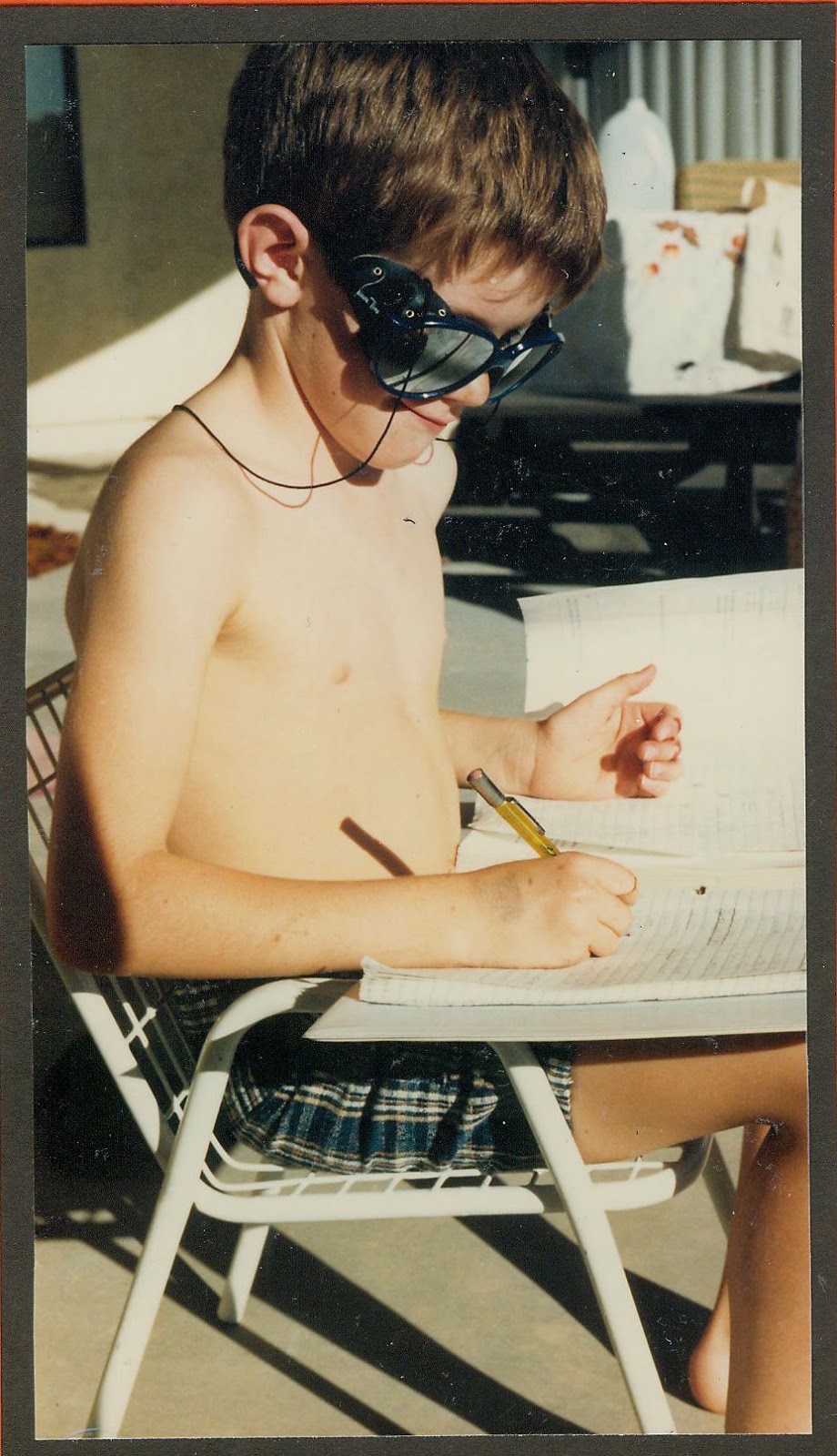
"Doing" my trigonometry homework in
our backyard on a warm, sunny,
Arizona afternoon.
One of my most beloved childhood practices was to borrow my brothers' textbooks to look through and then copy out of—pretending I was doing the same advanced high school homework they were.  As such, I became acquainted (at least in name) to calculus, chemistry, physics, English and American literature, trigonometry, economics, theology, etc.

One of the most satisfying single moments of my entire boyhood occurred one Friday evening after returning from a high school football game to find the books Hamlet and Othello sitting on my desk in my bedroom.  I had been begging my brothers to get them for me from their high school library (which I could not personally access).  They kindly acquiesced, and forever after viewed their lending of those two books to me (which I could hardly read and not in the least bit understand as a second grade) as a precious token of brotherly love and affection.

As I matured in both age and reading ability, I began to actually study books more seriously.  As I grew into my teen years, I discovered that I especially liked books related to personal development and self-leadership.  The seeds of this passion were sunned and watered by my reading of Dale Carnegie's How to Win Friends and Influence People and Dr. David J. Schwartz's The Magic of Thinking Big—both outstanding self-help books of antiquity from deep into the last century, and both of which I found on the bookshelves in my own home.  This was followed by my introduction to the work of my uncle, Hyrum W. Smith as well as Stephen R. Covey, Anthony Robbins, Norman Vincent Peale, and others.  I was hooked!

Teaching action shot of Dr. Jordan Jensen from 2012
While serving a 2-year mission for my Church, I discovered that I loved to teach as much, if not more, than I loved to read and write and study.  This natural blend of pre-sown personal proclivities, wonderful opportunities to nurture those seeds, and my growing chance to apply what I was learning led me, in time, to choose a career in education, and more specifically in the fields of self-help and personal development.

Along the way, I devoured additional self-help books and found that my interest was always piqued when my coursework included literature that possessed literary self-help or philosophical value (for example, as an English major, I made the fortuitous acquaintance of writers like Donne, Franklin, Emerson, Thoreau, Frost, etc.).  My passion for such literature was borne not just out of the joy and satisfaction that study itself brought to me, but because I needed the wisdom and help these authors afforded in my quest to overcome my own weaknesses, build upon my strengths, and work through perplexing life challenges I was facing—like my battle with OCD.

Click HERE to read about Dr. Jordan Jensen's battle with Obsessive-Compulsive Disorder (OCD)

Click HERE to read Part II

One book in particular—The Greatest Secret in the World by Og Mandino—I used on a daily basis for 45 straight weeks in a religious effort to work through my OCD and other challenges I was facing at the time.  To this day, that book—filled with all of my notes of progression, setbacks, and insights along the way—serves as a sacred reminder to me the value of investing great time, energy, passion, effort, and the will to do whatever is necessary to overcome oneself to reach greater heights and states of being in the future.

Within a few years of my Mandino experiment, I had figured out that one of my missions in life was to write my own book that could help other people in a similar way that all of these other books I had read had helped, inspired, and lifted me in my own life's journey and helped me to transcend or manage my own life's obstacles.  Recognizing I had already amassed a great deal of knowledge and insight on the subject, I set to work.  In 2005, I published my first book—I Am Sovereign: The Power of Personal Leadership.  It was directed to a teenage and young adult audience.  It was not commercially successful, but it was a building block in my early career that bolstered my confidence and opened up doorways of additional professional opportunity.

Back cover of Dr. Jordan Jensen's book, Self-Action Leadership
Ten years and a lot of reading, studying, research, and life experience later, I published what I intend to be my seminal work on the subject of personal leadership.  I call the book Self-Action Leadership: The Key to Personal, Professional, & Global Freedom.  No matter how old I live to be, and no matter how many books I write during the course of my career, I hope that this one book remains my seminal work—and is never surpassed in its eventual commercial success.

Why?

Because this ONE book provides a synergistic accumulation and unique presentation of everything I have ever learned that has benefitted me in the field of personal development and self-help over the course of the last three decades; and because I believe that this one book will be more helpful to a broader swath of society than any other book I will ever write.  Any additional books I write in the future will merely be an appendage to this seminal text.

The past several weeks I have written about how Self-Action Leadership training (along with the book) can benefit corporate and business audiences as well as educational groups (i.e. schools and classrooms).  In weeks to come, I will write about how civic leaders, parents, and persons dealing with or treating mental illness can benefit from studying the material, as well as sharing the information and providing training for their constituents, dependents, and patients.  But in the last analysis, Self-Action Leadership is, was designed to be, and I hope always will be, used primarily as a personal manual—an all-in-one comprehensive self-help guide and workbook that can bless the lives of those who read it, study it, and do the homework assignments contained therein.

Speaking of the homework assignments contained therein, one of the unique and most beneficial features of the text is a personal leadership challenge that we at Freedom Focused call The Self-Action Leadership (or SAL) Master Challenge.

This challenge consists of 25 concrete exercises that invites YOU—the reader—to do more than just read the book.  It encourages you to study the material, learn new vocabulary words, begin a personal journal and complete other relevant writing assignments, set goals, engage in activities of self-discipline, and eventually to write your own Self-Declaration of Independence & Constitution where you will begin to identify your life and career vision, mission, values, standards, goals, etc.

Click HERE and scroll toward the bottom of article to read more about writing your own Self-Declaration of Independence & Constitution.

Click HERE to watch a video of Dr. Jordan Jensen explaining the principle of writing a Self-Declaration of Independence & Constitution.

Those who undertake and complete the SAL Master Challenge will receive a special diploma (non-accredited) and medal to commemorate their achievement.  Their names will also be recorded on the Freedom Focused website where they will remain as long as Freedom Focused stands as The Center for Self-Action Leadership.

The SAL Challenge is NOT an easy challenge.  You will not be able to complete it quickly—and that is the point!  After nearly 30 years of studying the subject of personal development and self-help, and more importantly, after nearly THREE decades of working tirelessly to improve myself in the process, I have acquired the expertise necessary to create a comprehensive guide that will provide you—in one volume—with all of the essential principles, practices, and other elements contingent in the process of human existential growth and development.  And the good news is you don't have to spend nearly 30 years figuring it all out because I've already done it for you.  All you have to do is get the book, read it, complete the SAL Challenge, and then forever benefit from the blessings that come from the acquisition of vital knowledge in concert with the dedicated pursuit of self-work, self-sacrifice, goal setting, and personal discipline.

Click HERE to buy Dr. Jordan Jensen's book — SELF-ACTION LEADERSHIP

After you have finished reading the book and have completed the SAL Master Challenge, I invite you to email me to tell me about what you are learning and share your experiences.  I look forward to hearing from you!  You can reach me personally at jordan.jensen@freedomfocused.com


Note: This article is one of SIX articles in a special series dedicated to different AUDIENCES that Freedom Focused specifically targets with Self-Action Leadership training. We invite leaders and managers of these different audiences to click on links below to read the articles pertaining to your field or constituency.

Click HERE to access article for  BUSINESS PROFESSIONALS (Leaders, Managers, & Workers)

Click HERE to access article for  EDUCATORS  (Administrators, Teachers, & Staff)

Click HERE to access article for  STUDENTS & INDIVIDUALS

Click HERE to access article for PARENTS & FAMILIES

Click HERE to access article for ELECTED OFFICIALS, LEADERS, & ROLE MODELS

Click HERE to access article for PERSONS dealing with MENTAL ILLNESS


Self-Action Leadership  ~  The Book

SELF-ACTION LEADERSHIP is the key catalyst for initiating transformational leadership that lasts in any organization. The truth of the matter really is that simple; and the transformation of organizations through the holistic development of individuals really is that difficult—yet altogether possible for anyone willing to invest the time, effort, and sacrifice required to achieve authentic, transformational results.


Unlike any training program that has ever preceded it, Self-Action Leadership provides a single vehicle wherewith individual self-leaders can discover—and then act—upon the great truth that HOLISTIC personal development and growth spanning the mental, moral, spiritual, physical, emotional, and social elements of our individual natures is within the grasp of each one of us.


Back Cover of Self-Action Leadership, the Book
NoteFreedom Focused is a non-partisan, for-profit, educational corporation.  As such, we do not endorse or embrace political figures.  We do, however, comment from time-to-time on historical or political events that provide pedagogical backdrops to illuminating principles contained in the SAL Theory & Model.

Click HERE to learn more about the SAL Theory & Model.

To receive weekly articles from Freedom Focused & Dr. Jordan R. Jensen, sign up with your e-mail address in the white box on the right side of this page where it says "Follow by E-mail."

Click HERE to buy a copy of Dr. Jordan Jensen's new book, Self-Action Leadership: The Key to Personal, Professional, & Global Freedom.

Click HERE to read more about Dr. Jensen's book, Self-Action Leadership, and to review what experts in the leadership field are saying about this groundbreaking new personal development handbook.

Click HERE to learn more about Dr. Jordan R. Jensen.  Click HERE to visit the Freedom Focused website.


Journals of Rex Buckley Jensen

Rex Buckley Jensen (1943-present) Circa mid-late 1970s In this week's article, it is an honor and privilege for me to pay homage to my d...