Showing posts with label Read. Show all posts

Wednesday, June 18, 2025

SAL MASTER Challenge #22


SAL Master Challenge

EXERCISE  #22

Self-action leaders are SELF-DISCIPLINED


Complete at least TWO (2) of the following four (4) exercises:


1. For a full month (30 consecutive days), discipline yourself to wake up at 6:30 a.m. (or earlier) and spend one full hour reading, writing, pondering, meditating, memorizing, praying, walking, or a combination of these activities before you go to school, work, or do any other activities. Do NOT use any technology during this time unless you are using an electronic device for reading or writing (typing) purposes. 


Day 1:_____     Day 2:_____     Day 3:_____     Day 4:_____     Day 5:_____     Day 6:_____ 


Day 7:_____     Day 8:_____     Day 9:_____     Day 10:_____     Day 11:_____     Day 12:_____ 


Day 13:_____     Day 14:_____     Day 15:_____     Day 16:_____     Day 17:_____     Day 18:_____ 


Day 19:_____     Day 20:_____     Day 12:_____     Day 22:_____     Day 23:_____     Day 24:_____ 


Day 25:_____     Day 26:_____     Day 27:_____     Day 28:_____     Day 29:_____     Day 30:_____ 


2.  Fast from food for two consecutive meals (20 hours minimum) once a week for FIVE (5) consecutive weeks (minimum requirement).  If you are feeling extra ambitious, abstain from food and water for 24 hours once a week for five consecutive weeks.  


Week 1 Fast:_____    Week 2 Fast:_____    Week 3 Fast:_____    Week 4 Fast:_____    Week 5 Fast:_____ 


3.  In a ONE month (30-day) period, physically work out for 60-minutes on 25 different days. Include elements of strength, cardio, and stretching exercises into your workout routine.


  Day 1:_____     Day 2:_____     Day 3:_____     Day 4:_____     Day 5:_____    


Day 6:_____     Day 7:_____     Day 8:_____     Day 9:_____     Day 10:_____


Day 11:_____     Day 12:_____     Day 13:_____     Day 14:_____     Day 15:_____


Day 16:_____     Day 17:_____     Day 18:_____     Day 19:_____     Day 20:_____ 


Day 21:_____     Day 22:_____     Day 23:_____     Day 24:_____     Day 25:_____ 


4.  Sign the CHASTITY Pledge below and then demonstrate integrity to your pledge for at least six (6) months in order to complete the SAL Master Challenge.  


I hereby commit to refrain from sexual activity prior to marriage.

I further commit to upholding complete sexual fidelity to my spouse after marriage. 


___________________________________________
Print Name


___________________________________________
Signature


_______________________
Date


I have completed the SAL Master Challenge EXERCISE #22


Your initials:__________         AP initials:__________


—Dr. JJ

Tuesday, June 18, 2025
Palm Beach Gardens, Florida, USA


Author's Note: This is the 464th Blog Post Published by Freedom Focused LLC since November 2013 and the 257th consecutive weekly blog published since August 31, 2020.   

Click HERE for a compete listing of the other 463 FF Blog Articles 

Click HERE for a complete listing of Freedom Focused SAL QUOTES  

Click HERE for a complete listing of Freedom Focused SAL POEMS   

Click HERE to access the FULL TEXT of Dr. JJ's Psalms of Life: A Poetry Collection

Click HERE for a complete listing of Self-Action Leadership Articles

Click HERE for a complete listing of Fitness, Heath, & Wellness Articles

Click HERE for a complete listing of Biographical & Historical Articles


Click HERE for a complete listing of Dr. JJ's Autobiographical Articles

.........................

Tune in NEXT Wednesday for another article on a Self-Action Leadership related topic.  

If you liked this blog post, please share it with your family, friends, colleagues, and students—and encourage them to bookmark this blog to access a new FREE article every Wednesday.


Click HERE to buy the SAL Textbooks

Wednesday, January 29, 2025

Planning & Preparation Stage


 Chapter 4


Planning & Preparation Stage


CONSTRUCTION  STAGE  1:  PRE-CONSTRUCTION

SAL MODEL STAGE 1:  PLANNING and PREPARATION


When a construction company sets out to build a skyscraper—or any other physical structure—a great deal of planning and preparation must precede any tangible work. This planning and preparation is part of the PRE-CONSTRUCTION stage, all of which is done behind the scenes in architectural offices and engineering meetings.

There are SEVEN (7) different steps in the Pre-Building Stage.

CONSTRUCTION  STAGE  1:  PRE-CONSTRUCTION

  • Gathering information
  • Consultations
    Ultramodern construction wonders, such as those seen in
    Dubai, UAE, require extensive pre-construction efforts
    before they become real and tangible structures.
  • Acquiring and allotting financial resources
  • Obtaining approvals and permits
  • Planning and scheduling
  • Assembling a cohesive team and crew
  • Drafting blueprints

Stage 2 of the SAL Model contains SEVEN (7) corresponding step-habits analogous to this Pre-Building Stage. We call it the PLANNING and PREPARATION Stage. 

SAL  MODEL  STAGE  1: PLANNING and PREPARATION
  • Self-education
  • Building relationships
  • Self-awareness
  • Self-organization
  • Self-recording
  • Self-oneness
  • Drafting a Self-Constitution


 Chapter 5


Self-EDUCATION


Construction Stage 1.1   Gathering Information

SAL Model Stage 1.1   Self-Education


Most people who eventually view a completed skyscraper don't see the time and effort invested in the PRE-CONSTRUCTION stages. Similarly, your visible self-improvements and/or public professional advancements and victories as a self-action leader are usually preceded by a lot of personal planning and preparation, almost all of which is done in private and without any fanfare, attention, or applause.

Just as a construction company must obtain and gather necessary information, knowledge, experience, and skills to properly build a skyscraper, EDUCATION is a key component for effective life construction.

The planning and preparation phase of Self-Action Leadership begins with SELF-EDUCATION. In the words of Habeeb Akande, Formal education makes you a living; self-education makes you a legend.


"Formal education makes you a living;
self-education makes you a legend."

—Habeeb Akande
 

For many self-action leaders, much of their education may come formally—by way of institutionalized teachers and coaches. Formal education can be very valuable. But it is not the only kind of education—and for self-action leaders, it is ultimately secondary to the primary knowledge you will proactively seek out on your own.  

This primary process of education is called Self-Education, and YOU are primarily responsible for its attainment. 

Self-action leaders don't wait for the "right" teacher to come and teach them at the right "time." They take initiative to seek out knowledge, experience, and wisdom of their own accord. Moreover, like a young Abraham Lincoln walking 20 miles to borrow a new book, self-action leaders will sometimes go to great lengths to seek out and acquire information they need to grow and progress in their life and/or career.

The acquisition of self-knowledge begins with a burning desire to obtain it. 

In the Good Book, Jesus says that: Blessed are they which do hunger and thirst after righteousness: for they shall be filled. 


"Blessed are they which do hunger and thirst after righteousness: for they shall be filled."

—Jesus Christ


Socrates
470-399 B.C.
This principle of DESIRE works for knowledge, experience, and wisdom as well; those who authentically, genuinely, and deeply want it are more likely to eventually find their fill (and sometimes more) of it. And the stronger your desire, the more fruitful your quest and search will be. 

One famous (albeit possibly apocryphal) story on the subject of self-knowledge involves the famous Greek philosopher, Socrates. As the story goes, a man approached Socrates after seeking him out for knowledge. 

Socrates supposedly took the man down into the ocean and shoved his head underwater. After several moments of perplexing struggle, the man was able to wriggle free of Socrates' grasp, resurface, and catch his breath. Gasping for air and spitting water, the man turned to Socrates and angrily demanded to know why he had apparently attempted to drown him; to which Socrates replied: "When you desire knowledge as badly as you just wanted air, come and see me again and I will show you the pathway to wisdom." 

Abraham Lincoln
1809-1865
Abraham Lincoln—16th President of the United States—is one of world history's greatest examples of self-education. "Honest Abe" was born and raised in humble, poor, and unsophisticated circumstances in the dense, rural backwoods of Kentucky and Indiana in the early nineteenth century. Lincoln was not blessed with many chances to obtain a formal education, yet he craved knowledge like he craved air—so he created his own opportunities for learning by continually demonstrating a willingness to sacrifice time and energy to attain knowledge. As previously mentioned, he would go to great lengths (literally) to access a new book he had not yet read. 

Young Abraham devoured all the educational resources he could possibly access. This homespun lawyer-turned-politician eventually educated himself right up into the White House—a place that typically houses Ivy-Leaguers who were born with a "silver spoon in their mouths" and ready access to a quality formal education. 

Forty-five (45) men have served as President of the United States since George Washington first took the first Oath of Office in 1789. (1) Of those 45 men, most of them were born into prominent and affluent families who could afford personal tutors and would send their sons to be educated at the nation's most prestigious universities. 

Frederick Douglass
1818-1895
In light of this reality, isn't it fascinating that the man who is almost universally lauded as the greatest and nobles and smartest of them all was Abraham Lincoln
—a self-taught, self-made man who never went to high school, much less college, yet whose extraordinary character and capacity as a self-educated self-action leader and skilled communicator more than compensated for whatever formal education, training, refinement, and polish he may have lacked.

Two other prominent examples of self-education from American history include Sequoyah, a Native American responsible for creating a written alphabet for his people, and Frederick Douglass, who was a leading voice in the American abolitionist movement. 

Freedom Focused strongly encourages YOU to study the lives of these three remarkable men. The following books are a good place to start: 

  • Lincoln the Unknown by Dale Carnegie
  • Narrative of the Life of Frederick Douglass, an American Slave by Frederick Douglass
  • Sequoyah by Grant Foreman

Self-action leaders spend a significant portion of their discretionary time in pursuit of SELF-EDUCATION. They read, study, ponder, reflect, ask questions, experiment, carefully observe their surroundings—including other people—and seek out information in whatever other ways they can. 

In my case, there's no way to calculate the residual benefits and overall value of self-education in my own life and career. Suffice it to say, it has been absolutely indispensable to my success and has shaped everything good that has come into my life and/or career. 

While I have been blessed with a much broader formal education than Abraham Lincoln, I am certainly no Ivy-Leaguer. Indeed, you will not find any top-tier institutions on my academic transcripts. Nor will you find anything extraordinary or remarkable about my elementary or secondary schooling. And never once did I ever benefit from a paid, professional tutor.  

Despite the relative obscurity and average nature of the schools I attended, I was able to compensate mightily for any knowledge and experience I might have missed out on by making the most of whatever opportunities I did have—and then supplementing my formal education with a broad and ambitious buffet of continual and never-ending personal study, experimentation, and tireless personal drive, effort, and energy. 

Because YOU are ultimately responsible for the quality of your own education, where you learn, or from whom, should always be secondary to what, why, and how well you learn. Whether your opportunities include attending elite private schools and prestigious universities, an obscure state or community college, or simply visiting your local library or logging on to the Internet, you can still take responsibility for your own learning. 

If Abe Lincoln didn't make any excuses about having to walk 20 miles to get a single new book to read, no one in the twenty-first century who has access to a public library and/or the Internet should be making any excuses about why they can't self-educate, either.

In other words, no matter how hard it may seem for you to acquire knowledge in your present circumstances, chances are you still have far more (and better) access to information than Abraham Lincoln, Frederick Douglass, or Sequoyah ever had—or ever dreamed of having, for that matter!

Don't let these magnificent self-educational opportunities go to waste.

Take full advantage of them and get studying today!

And take advantage of any opportunities at obtaining a formal education as well. Doing so will multiply your options and opportunities in life.  


Learning to Learn

A quality education goes way beyond just memorizing facts and storing them away for future retrieval. As such, t
here are several components of self-education that all self-action leaders would be wise to focus on. These components include understanding how YOU learn best (e.g. visual, auditory, kinesthetic), knowing where to go for needed information, how to efficiently access it, and the proper calibration of your attitude, perception, and work ethic throughout the process.  

You can discover how you learn best through self-observation of your past learning successes (and failures). Online resources also provide ready insights into what YOUR learning style is. A simple Google search, posing the question: "What is my learning style?" will yield a cornucopia of hits that will provide detailed information as well as online tests to gauge your personal style (e.g. visual, auditory, kinesthetic).

The best way to better understand where to go to access information that is desired and/or needed is to simply ASK QUESTIONS of people you know or come across who have more knowledge than you do. If no human beings are available at any given moment, the Internet is a fantastic machine to which you can turn to and pose questions relevant to your informational search. 

The advent of artificial intelligence (AI) has further enhanced the capacity of the Internet to answer a whole host of different questions in a manner that can be impressively accurate and precise.    

The proper calibration of your attitude, perception, and work ethic along your self-educational journey will ultimately be YOUR JOB. If you find you are having trouble in any of these areas, you may find benefits from searching out and studying resources in the self-help field. Better yet, just keep reading and studying the comprehensive Life Leadership textbook you currently hold in your hands! After all, it was designed, organized, and written to assist you in this ongoing calibration!


Repetition and Rote-Learning

When I was a boy, someone taught me the great truism that: Repetition is the key to reception. 


"Repetition is the key to reception."

—Anonymous


If you want to commit anything to your long-term memory, you must usually employ a measure of rote learning. Like it or not, there's simply a lot of material you must memorize to become a highly skilled and culturally literate critical thinker. 

For example, you may need to look up certain words in the dictionary several times before you truly OWN those words as part of your fluent vocabulary. 

Similarly, an electronic calculator can never replace the efficiency value of knowing your addition, subtraction, multiplication and division tables and other elementary arithmetic skills (e.g. fractions, decimals, estimation, etc.).

The purposeful memorization of important facts, quotes, poems, riddles, stories, jokes, puns, et cetera enriches your heart, mind, soul, and cultural literacy. It also empowers you personally, professionally, and socially in countless ways. Lastly, it strengthens your memory muscles and bolsters your credibility.

And this is just the beginning of the endless benefits of memorization. 

There are many others!

For example, memorized knowledge is extremely valuable in emergency or other stressful situations, such as knowing how to administer CPR (cardio pulmonary resuscitation), perform the Heimlich maneuver, and recognize signs of shock, stroke, and other medical emergencies. Memorizing frequently used information is also more efficient than continually looking it up. 

Memorization is also good for neural plasticity, increases your brain's ability to remember details, and delays the onset of age-related cognitive decline.  

Memorization takes time and effort; but it is usually worth it—and sometimes many times over.  

At Freedom Focused, we are big believers that some books are worth reading more than once. There is one book in particular that I have read cover-to-cover 24 times in my life, and I'm a smarter, wiser, and better person for having done so. Every time I've read and studied it, I've derived new insights and wisdom from its pages that I hadn't discovered or discerned during previous readings.  

Simply stated, repetition and rote learning are vital components of a quality education. Engaging these practices requires discipline, dedication, and hard work; it is one of the things that separates top tier learners and performers from average ones.  


Ongoing Self-Education and Other Training

On Christmas Eve, 2003, I received one of the most memorable phone calls of my life. 

It was Dr. Stephen R. Covey.

Earlier that year, I had sent him a letter thanking him for his life's work and telling him about its tremendous influence on my life. I also requested the opportunity to meet him personally.

My motivation for writing the letter stemmed from some good advice I received from Kieth Merrill, a successful filmmaker. I had approached Merrill after a speech he delivered at Utah Valley University, where I was attending college at the time. I was impressed to ask Merrill for advice about how to be successful. As he looked piercingly into my eyes, he told me to: "seek out a person who was already where I wanted to someday be and learn from them."

Stephen Covey was where I wanted to someday be.  

So, I sought him out in an effort to "pick his brain" and learn from him.  

Despite his very busy schedule and international travel itinerary, Dr. Covey—to his credit—kindly carved out a few minutes of his holiday to respond to my epistolary request. On that phone call, which lasted for about 10 minutes, Dr. Covey encouraged me to read for at least two hours every day. He also urged me to read deeply and widely, including outside of my own interests.

While I can't claim to have read for two hours every day of my life, I have read a lot. Doing so is one of the things that has gotten me to where I am today, plain and simple. Indeed, I'm a rich man because of the treasures I have mined from literature, refined in my intellect and conversation, incorporated and synthesized in my writing, and then permanently stored in my mind and heart for later retrieval. Reading will always play a vital role in my ongoing self-education and personal training and development as a self-action leader.  

Ongoing self-education includes education of all kinds that occurs beyond the formal classroom. Examples of this kind of education include: personal reading, studying, pondering, reflecting, online courses and workshops, mentorships, research, educational multimedia, observation, asking questions, traveling, trying new things, and doing a wide array of other, positive and productive "stuff" in general.  

Ralph Waldo Emerson
1803-1882
Wise, principle-centered experimentation and calculated risk-taking in the interplay of our lives and careers are also excellent sources of self-education. As Emerson once suggested: Don't be too squeamish about your actions; all life is an experiment.  


"Don't be too squeamish about your actions;
all life is an experiment."

—Ralph Waldo Emerson


Don't misinterpret Emerson's words as an excuse to be stupid or engage in unwise or dangerous behavior. But do allow it to inspire you to take calculated risks for your own education, growth, and maturation.  

Embracing such risks are a big part of what has gotten me to where I am in my life today.  

Self-education is a habit to cultivate throughout your life. Based on my own experience, I highly recommend Dr. Covey's advice to be an avid and voracious reader. If you can't squeeze in an average of two hours of reading per day, commit to one. If that is too hard at first, begin with a half hour. In the wonderful Age of Information in which we all live, so much information is available through the miracle of public libraries and the Internet.

Don't let these precious resources go unused!

Muhammad
570-632
One practical and highly doable way to make this commitment to self-education is to cut in half the time you currently spend on social media, watching television and YouTube, online shopping, or randomly surfing the web. You can then devote the surplus time to substantive reading, study, and taking advantage of other meaningful educational opportunities.  


"Seek education from the cradle to the grave."

—Muhammad


To help you begin—or further inspire and motivate the continuance of—your own journey of self-education, we invite you to complete the next SAL Master Challenge homework exercise.  


SAL Master Challenge

EXERCISE  #6


Self-action leaders proactively SELF-EDUCATE


Read FIVE (5) Books from the list of Titles in Appendix G.          1___  2___  3___  4___  5___

Book Titles:

1.

2. 

3. 

4.  

5.  


Memorize FIVE (5) SAL Mantras from Appendix H.         1___  2___  3___  4___  5___


Mantras:

1.

2. 

3. 

4.  

5.  


Memorize FIVE (5) Quotes from Appendix I.          1___  2___  3___  4___  5___


Quotes:

1.

2. 

3. 

4.  

5.  


Memorize FIVE (5) Poems from Appendix J.          1___  2___  3___  4___  5___


Poem Title and Author:

1.

2. 

3. 

4.  

5.  


Initials of Accountability Partner or other Recitation Witness:__________


I Have Completed SAL Master Challenge Exercise #6:__________


In Your Journal

  • In what ways—and to what extent—have you valued and utilized self-education in the past?
  • Has this Life Leadership textbook changed the value you will place upon self-education in the future? Why or why not?
  • What are three (3) specific ways you could practically and reasonably invest more time in your self-education during the next year or two?
 

—Dr. JJ

Wednesday, January 29, 2025
Palm Beach Gardens, Florida, USA


Author's Note: This is the 429th Blog Post Published by Freedom Focused LLC since November 2013 and the 237th consecutive weekly blog published since August 31, 2020.   

Click HERE for a compete listing of the other 428 FF Blog Articles 

Click HERE for a complete listing of Freedom Focused SAL QUOTES  

Click HERE for a complete listing of Freedom Focused SAL POEMS   

Click HERE to access the FULL TEXT of Dr. JJ's Psalms of Life: A Poetry Collection

Click HERE for a complete listing of Self-Action Leadership Articles

Click HERE for a complete listing of Fitness, Heath, & Wellness Articles

Click HERE for a complete listing of Biographical & Historical Articles


Click HERE for a complete listing of Dr. JJ's Autobiographical Articles

.........................

Tune in NEXT Wednesday for another article on a Self-Action Leadership related topic.  

If you liked this blog post, please share it with your family, friends, colleagues, and students—and encourage them to bookmark this blog to access a new FREE article every Wednesday.


Click HERE to buy the SAL Textbooks   


Chapter 5 Notes

1.  While there have been 47 Presidents of the United States, only 45 men have held the office of President. This is because Grover Cleveland (22nd [1885-1889] and 24th [1893-1897) and Donald Trump (45th [2017-2021] and 47th [2025-2029) both served as President twice, in non-consecutive terms.

Tuesday, March 15, 2016

Self-Action Leadership Training for Individuals


What if You Could Squeeze Nearly THREE Decades of Knowledge, Experience, Study, and Research into ONE Comprehensive Self-Help Book and Personal Leadership Guide?


Self-Action Leadership by Dr. Jordan Jensen

ANSWER: You'd have in YOUR hands a copy of SELF-ACTION LEADERSHIP, the Premier Self-Help Guide of the 21st Century.  


This week's post introduces Self-Action Leadership training for individuals.  I am extra excited about this week's article, because writing it has taken me on a pleasantly nostalgic trip down memory lane to some of the greatest joys of my childhood, adolescence, and young adulthood.

I have always loved the printed page.  I was blessed to be born into a family that valued books—especially my father.  This love was fueled no doubt by whatever children's books my parents or older siblings read to me as a little boy.

But it seemed to me to go beyond that.  It seemed to be innate—as if my love of reading and writing and studying had been developed spiritually before I was even born—and that these proclivities had naturally accompanied me on my journey into this world as well.

As such, I felt unusually drawn to books and other written material from before I could even read.  For example, I remember a childhood neighbor friend coming over to my house one day. I was in kindergarten at the time and could not yet read myself.  She, however, was a big first grader and could read.  Enamored by her special skill I had not yet accrued myself, I admiringly directed her into our little playhouse under the stairs in our home, sat her down, took out a report of some sort that looked extra important and sophisticated (which I had retrieved from my Dad's office waste basket—my office supply shop for playing "office") and admiringly asked her to read it to me.  I don't remember what she read off of whatever it was I handed her (chances are good she couldn't read much of it) but I do remember being impressed!  I could hardly wait until the day arrived when I could finally read on my own.

Later, after I had learned to read and write myself, my perspective opened up to the wonderful world of books.  This introduction and discovery opened up a veritable Heaven on Earth to me.

First, there was my own growing collection of books (by the age of 23, I had amassed a library of over 500 volumes).  Then there was the scattered collection of books throughout my home, the mother load of which was ensconced in my Dad's personal office library, which he kindly allowed me to peruse at my leisure (including permission to read his personal journals).  Beyond that, I was introduced to school and public libraries, and the expansive University library at BYU where my Mother attended school during summer terms to finish her Bachelor's degree in between the years 1988 and 1992.

The grandest private library I had access to was in my maternal Grandmother's home.  Grandma and Grandpa Smith's library dwarfed my own father's sizable collection, and I spent some of the most cherished hours of my childhood there—alone—in the midst of those thousands of books, many of which were older and emanated that pleasant "old-book smell."  Grandma kindly allowed me to search her stacks to my heart's content.  In addition, she generously allowed me to borrow those I found to be most wonderful of all.

Upon her passing, there seemed to be a lack of clarity about how the books were going to be apportioned.  Worried that this ambiguity might stretch on for some time, I wisely secured a stack of my favorites before the moving truck arrived.  In hindsight, I should have taken more than I did.  I never saw the rest of those books again.  I heard that they initially went to a storage unit.  I do not know where they are today.

Jensen Family in 1989
I am the little boy on the bottom right
I come from a large family.  Of my six siblings, I am the youngest of five boys.  My four older brothers are all at least 8 years older than me.  Because of this salient separation in our ages, my brothers were, in many way, more like uncles or surrogate fathers to me than brothers.  This was not a bad thing because they treated me kindly and with a lot of respect, especially in light of how many typical older brothers treat their kid brother.  This tender regard for me only strengthened the near-worshipful veneration I admiringly bestowed upon my brothers.  The pedestal upon which my young eyes placed them caused me to want to know and do everything they knew and did.  This translated into many different hobbies and behaviors, the foremost of which was to take interest in the sports my brothers competed in and the books they were studying at school and church.

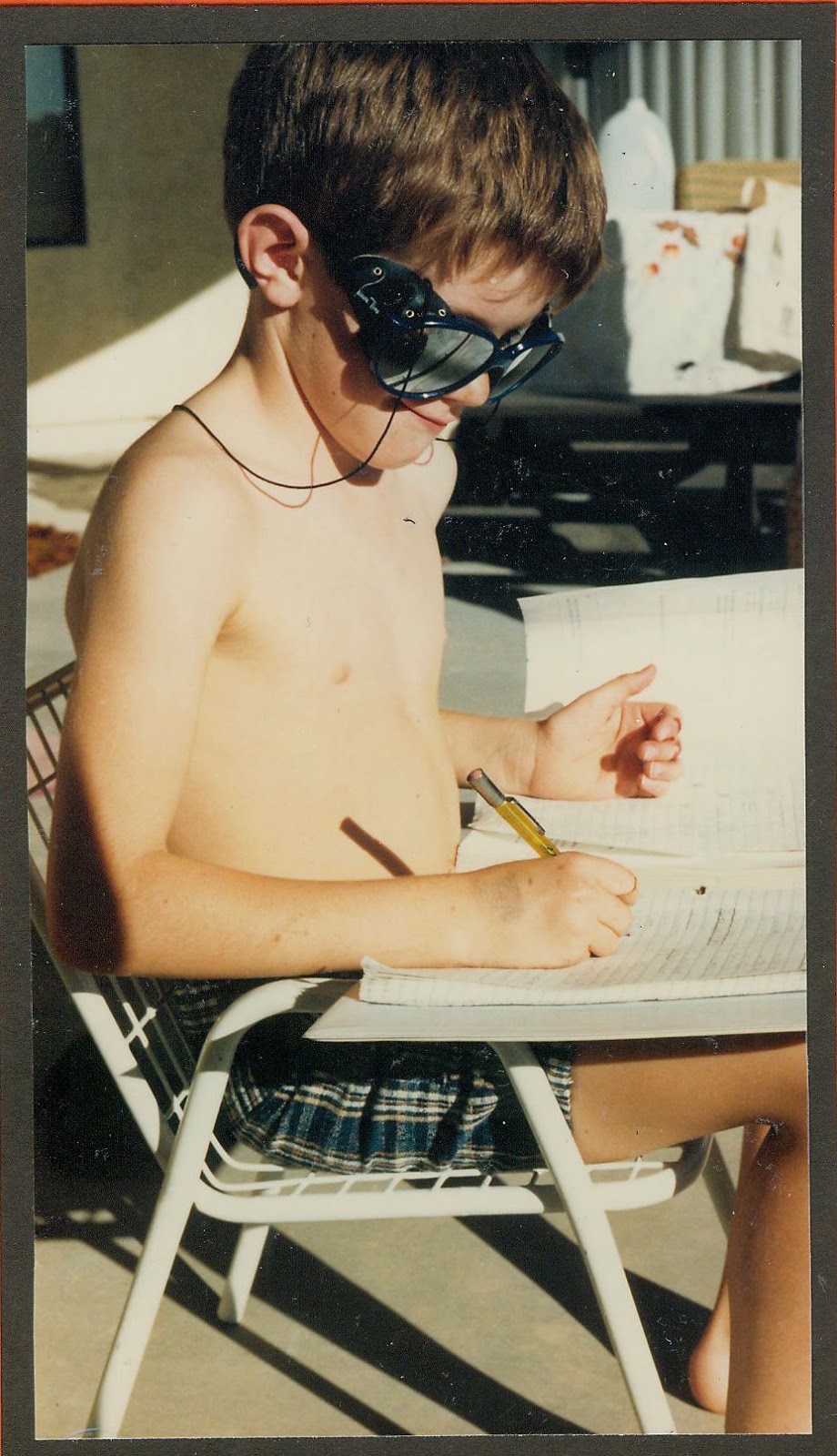
"Doing" my trigonometry homework in
our backyard on a warm, sunny,
Arizona afternoon.
One of my most beloved childhood practices was to borrow my brothers' textbooks to look through and then copy out of—pretending I was doing the same advanced high school homework they were.  As such, I became acquainted (at least in name) to calculus, chemistry, physics, English and American literature, trigonometry, economics, theology, etc.

One of the most satisfying single moments of my entire boyhood occurred one Friday evening after returning from a high school football game to find the books Hamlet and Othello sitting on my desk in my bedroom.  I had been begging my brothers to get them for me from their high school library (which I could not personally access).  They kindly acquiesced, and forever after viewed their lending of those two books to me (which I could hardly read and not in the least bit understand as a second grade) as a precious token of brotherly love and affection.

As I matured in both age and reading ability, I began to actually study books more seriously.  As I grew into my teen years, I discovered that I especially liked books related to personal development and self-leadership.  The seeds of this passion were sunned and watered by my reading of Dale Carnegie's How to Win Friends and Influence People and Dr. David J. Schwartz's The Magic of Thinking Big—both outstanding self-help books of antiquity from deep into the last century, and both of which I found on the bookshelves in my own home.  This was followed by my introduction to the work of my uncle, Hyrum W. Smith as well as Stephen R. Covey, Anthony Robbins, Norman Vincent Peale, and others.  I was hooked!

Teaching action shot of Dr. Jordan Jensen from 2012
While serving a 2-year mission for my Church, I discovered that I loved to teach as much, if not more, than I loved to read and write and study.  This natural blend of pre-sown personal proclivities, wonderful opportunities to nurture those seeds, and my growing chance to apply what I was learning led me, in time, to choose a career in education, and more specifically in the fields of self-help and personal development.

Along the way, I devoured additional self-help books and found that my interest was always piqued when my coursework included literature that possessed literary self-help or philosophical value (for example, as an English major, I made the fortuitous acquaintance of writers like Donne, Franklin, Emerson, Thoreau, Frost, etc.).  My passion for such literature was borne not just out of the joy and satisfaction that study itself brought to me, but because I needed the wisdom and help these authors afforded in my quest to overcome my own weaknesses, build upon my strengths, and work through perplexing life challenges I was facing—like my battle with OCD.

Click HERE to read about Dr. Jordan Jensen's battle with Obsessive-Compulsive Disorder (OCD)

Click HERE to read Part II

One book in particular—The Greatest Secret in the World by Og Mandino—I used on a daily basis for 45 straight weeks in a religious effort to work through my OCD and other challenges I was facing at the time.  To this day, that book—filled with all of my notes of progression, setbacks, and insights along the way—serves as a sacred reminder to me the value of investing great time, energy, passion, effort, and the will to do whatever is necessary to overcome oneself to reach greater heights and states of being in the future.

Within a few years of my Mandino experiment, I had figured out that one of my missions in life was to write my own book that could help other people in a similar way that all of these other books I had read had helped, inspired, and lifted me in my own life's journey and helped me to transcend or manage my own life's obstacles.  Recognizing I had already amassed a great deal of knowledge and insight on the subject, I set to work.  In 2005, I published my first book—I Am Sovereign: The Power of Personal Leadership.  It was directed to a teenage and young adult audience.  It was not commercially successful, but it was a building block in my early career that bolstered my confidence and opened up doorways of additional professional opportunity.

Back cover of Dr. Jordan Jensen's book, Self-Action Leadership
Ten years and a lot of reading, studying, research, and life experience later, I published what I intend to be my seminal work on the subject of personal leadership.  I call the book Self-Action Leadership: The Key to Personal, Professional, & Global Freedom.  No matter how old I live to be, and no matter how many books I write during the course of my career, I hope that this one book remains my seminal work—and is never surpassed in its eventual commercial success.

Why?

Because this ONE book provides a synergistic accumulation and unique presentation of everything I have ever learned that has benefitted me in the field of personal development and self-help over the course of the last three decades; and because I believe that this one book will be more helpful to a broader swath of society than any other book I will ever write.  Any additional books I write in the future will merely be an appendage to this seminal text.

The past several weeks I have written about how Self-Action Leadership training (along with the book) can benefit corporate and business audiences as well as educational groups (i.e. schools and classrooms).  In weeks to come, I will write about how civic leaders, parents, and persons dealing with or treating mental illness can benefit from studying the material, as well as sharing the information and providing training for their constituents, dependents, and patients.  But in the last analysis, Self-Action Leadership is, was designed to be, and I hope always will be, used primarily as a personal manual—an all-in-one comprehensive self-help guide and workbook that can bless the lives of those who read it, study it, and do the homework assignments contained therein.

Speaking of the homework assignments contained therein, one of the unique and most beneficial features of the text is a personal leadership challenge that we at Freedom Focused call The Self-Action Leadership (or SAL) Master Challenge.

This challenge consists of 25 concrete exercises that invites YOU—the reader—to do more than just read the book.  It encourages you to study the material, learn new vocabulary words, begin a personal journal and complete other relevant writing assignments, set goals, engage in activities of self-discipline, and eventually to write your own Self-Declaration of Independence & Constitution where you will begin to identify your life and career vision, mission, values, standards, goals, etc.

Click HERE and scroll toward the bottom of article to read more about writing your own Self-Declaration of Independence & Constitution.

Click HERE to watch a video of Dr. Jordan Jensen explaining the principle of writing a Self-Declaration of Independence & Constitution.

Those who undertake and complete the SAL Master Challenge will receive a special diploma (non-accredited) and medal to commemorate their achievement.  Their names will also be recorded on the Freedom Focused website where they will remain as long as Freedom Focused stands as The Center for Self-Action Leadership.

The SAL Challenge is NOT an easy challenge.  You will not be able to complete it quickly—and that is the point!  After nearly 30 years of studying the subject of personal development and self-help, and more importantly, after nearly THREE decades of working tirelessly to improve myself in the process, I have acquired the expertise necessary to create a comprehensive guide that will provide you—in one volume—with all of the essential principles, practices, and other elements contingent in the process of human existential growth and development.  And the good news is you don't have to spend nearly 30 years figuring it all out because I've already done it for you.  All you have to do is get the book, read it, complete the SAL Challenge, and then forever benefit from the blessings that come from the acquisition of vital knowledge in concert with the dedicated pursuit of self-work, self-sacrifice, goal setting, and personal discipline.

Click HERE to buy Dr. Jordan Jensen's book — SELF-ACTION LEADERSHIP

After you have finished reading the book and have completed the SAL Master Challenge, I invite you to email me to tell me about what you are learning and share your experiences.  I look forward to hearing from you!  You can reach me personally at jordan.jensen@freedomfocused.com


Note: This article is one of SIX articles in a special series dedicated to different AUDIENCES that Freedom Focused specifically targets with Self-Action Leadership training. We invite leaders and managers of these different audiences to click on links below to read the articles pertaining to your field or constituency.

Click HERE to access article for  BUSINESS PROFESSIONALS (Leaders, Managers, & Workers)

Click HERE to access article for  EDUCATORS  (Administrators, Teachers, & Staff)

Click HERE to access article for  STUDENTS & INDIVIDUALS

Click HERE to access article for PARENTS & FAMILIES

Click HERE to access article for ELECTED OFFICIALS, LEADERS, & ROLE MODELS

Click HERE to access article for PERSONS dealing with MENTAL ILLNESS


Self-Action Leadership  ~  The Book

SELF-ACTION LEADERSHIP is the key catalyst for initiating transformational leadership that lasts in any organization. The truth of the matter really is that simple; and the transformation of organizations through the holistic development of individuals really is that difficult—yet altogether possible for anyone willing to invest the time, effort, and sacrifice required to achieve authentic, transformational results.


Unlike any training program that has ever preceded it, Self-Action Leadership provides a single vehicle wherewith individual self-leaders can discover—and then act—upon the great truth that HOLISTIC personal development and growth spanning the mental, moral, spiritual, physical, emotional, and social elements of our individual natures is within the grasp of each one of us.


Back Cover of Self-Action Leadership, the Book
Note: Freedom Focused is a non-partisan, for-profit, educational corporation.  As such, we do not endorse or embrace political figures.  We do, however, comment from time-to-time on historical or political events that provide pedagogical backdrops to illuminating principles contained in the SAL Theory & Model.

Click HERE to learn more about the SAL Theory & Model.

To receive weekly articles from Freedom Focused & Dr. Jordan R. Jensen, sign up with your e-mail address in the white box on the right side of this page where it says "Follow by E-mail."

Click HERE to buy a copy of Dr. Jordan Jensen's new book, Self-Action Leadership: The Key to Personal, Professional, & Global Freedom.

Click HERE to read more about Dr. Jensen's book, Self-Action Leadership, and to review what experts in the leadership field are saying about this groundbreaking new personal development handbook.

Click HERE to learn more about Dr. Jordan R. Jensen.  Click HERE to visit the Freedom Focused website.


Wednesday, October 29, 2014

The Importance & Power of Language

CHAPTER 2:
The Importance & Power of Language


I am currently writing a series of case studies for a new college textbook that will be used in coming years by budding entrepreneurs around the country. One of the entrepreneurs I interviewed for this project was my Uncle, Hyrum W. Smith—a co-founder of FranklinCovey Company. An extraordinary entrepreneur and salesman, Hyrum Smith has left an indelible mark on the fields of time management and personal development. As one of the finest public speakers in the World, Smith commands 5-figure speaker fees when he presents professionally. A lifelong entrepreneur, he was an ideal candidate for one of my case studies.

At the end of the interview, I asked him what advice he would give to young college students interested in becoming entrepreneurs.

Thursday, October 23, 2014

Chapter 1 Starts on Monday!


A Personal Letter from the Author...


To my Dear Readers,

I want to take this opportunity to thank you for whatever time you have invested in following my blog.  I hope you have found the information I have shared so far to be relevant and meaningful.

The purpose of this post is to announce some important changes to my initial plans to publish my book serially beginning early next year on its official, hard-copy publication date.

JJ's Journal: 1983

        From the Personal Journals of My Father Rex Buckley Jensen  1983 Thursday, January 20, 1983 Annual School Picture Monticello, Utah S...