Showing posts with label Og Mandino. Show all posts

Wednesday, January 15, 2025

Seeds of Self-Help


 Chapter 2


Seeds of Self-Help 


This chapter tells the story of my introductions to and experiences with the self-help and personal development fields. It chronicles a journey that began when I was just a boy and would eventually lead to the development of the SAL Theory and Model and the creation of this Life Leadership textbook.  

I was 14 years old when Warner Books published my Uncle Hyrum's book, The 10 Natural Laws of Successful Time and Life Management, which would eventually sell over a million copies and complement the massive success Hyrum was already enjoying with the Franklin Day Planning system.

During the summer of that same year (1994), I worked as a lowly field hand on Hyrum and Gail's sprawling ranch in Gunlock, Utah, and environs. 

A ranch hand's work is physically strenuous and low-paying. I earned $4.25 per hour for my labors that summer, which was the minimum wage in 1994. Summer days in southwestern Utah were hot, dry, dusty, and long. Temperatures often exceeding 100-degrees Fahrenheit (38 degrees Celsius) and rain was rare. Our daily commute usually included a ride in the back of a white Ford pickup truck. 

One week, we were assigned to build a fence up in the mountains, many miles away from the bunkhouse where we ate and slept. Facing a long, bumpy ride to work each day that week, I decided to take along a book to read. I had brought several books from home to read and study that summer. The book I chose on this particular occasion was: The Magic of Thinking Big, by David J. Schwartz.

Once I started reading, it was hard to stop, and not just because I enjoyed reading more than digging post holes in the rocky desert soil; but because the seeds of hope, possibility, and vision that the book planted in my mind and heart. I enjoyed that book so much that I would sometimes read at lunchtime and after work was over. I kept reading until I had read, marked, and annotated the entire volume. 

As I read, studied, and pondered Schwartz's hopeful and positive message, his words sunk deep into my soul, spawning rich daydreams about my personal and professional potential. I grew increasingly motivated by the realization that I didn't have to be a ranch hand for the rest of my life. I was further inspired by the idea that I could actually design my life largely according to my own desires if I was willing to pay the price. 

When I read the words: when you believe, your mind finds ways to do, (1) I was inspired by the personal power and capacity I possessed to accomplish difficult and meaningful achievements in my life and career despite any obstacles that might stand in the way. 

This was the point in my life when a nascent conceptualization of the SAL philosophy gradually began to form in my mind and heart. 

Over the next several years—throughout my teenage and young adult life—I increasingly took advantage of opportunities to read and study books and listen to audio tapes and CDs in the self-help and personal development fields.

Hyrum W. Smith
1943-2019
The books and/or authors from whom I supped included:

  • Dale Carnegie
  • Norman Vincent Peale
  • Napoleon Hill
  • Og Mandino
  • M. Scott Peck, M.D. 
  • Hyrum W. Smith
  • Stephen R. Covey
  • Anthony Robbins
  • Brian Tracy
  • Zig Ziglar
  • Et al. 


I'll always cherish my dad's personal copy of Dale Carnegie's How to Win Friends and Influence People. He had purchased the book in England in the mid-1960s while serving as a young missionary and it had that wonderful "old book" smell. 

When I was in eighth grade, my mom started buying Gary Smalley's relationship videos. Smalley's trainings focused on family relationships, and more particularly on marital unions. Though it would be years before I would start looking seriously at exclusive dating or marriage myself, I enjoyed watching these programs with my mom and learned a great deal about personality differences, communication skills, and successfully cultivating healthy and successful relationships.  

When I was a junior in high school, my oldest brother, Paul—a successful salesman and manager who shared my passion for personal development and self-help—sent me a videotape training by Jim Rohn, a famous business philosopher of the late twentieth and early twenty-first century.

Rohn had some GREAT stuff! 

A half-decade later, as a direct salesman myself, I was reintroduced to Rohn's work. While I ultimately found little aptitude for or interest in sales and marketing, Rohn's timeless talk on CD, entitled: Building Your Network Marketing Company, was filled with general truisms about long-term success that enormously influenced my thought processes as I set out to build Freedom Focused, develop the SAL Theory and Model, and compose iterations of this Life Leadership textbook.

To this day, I hear Rohn's voice in my head more than most others because of how concise, incisive, and memorable of his personality and teaching style.    

In high school, I attended a couple of Peter Lowe-organized day-long success seminars, where I had the chance to hear an impressive collection of high-profile speakers address personal development topics related to self-improvement, health and wellness, and success.

These speakers included:

  • President Gerald Ford
  • General Colin Powell
  • Zig Ziglar
  • Karl Malone
  • Et al. 
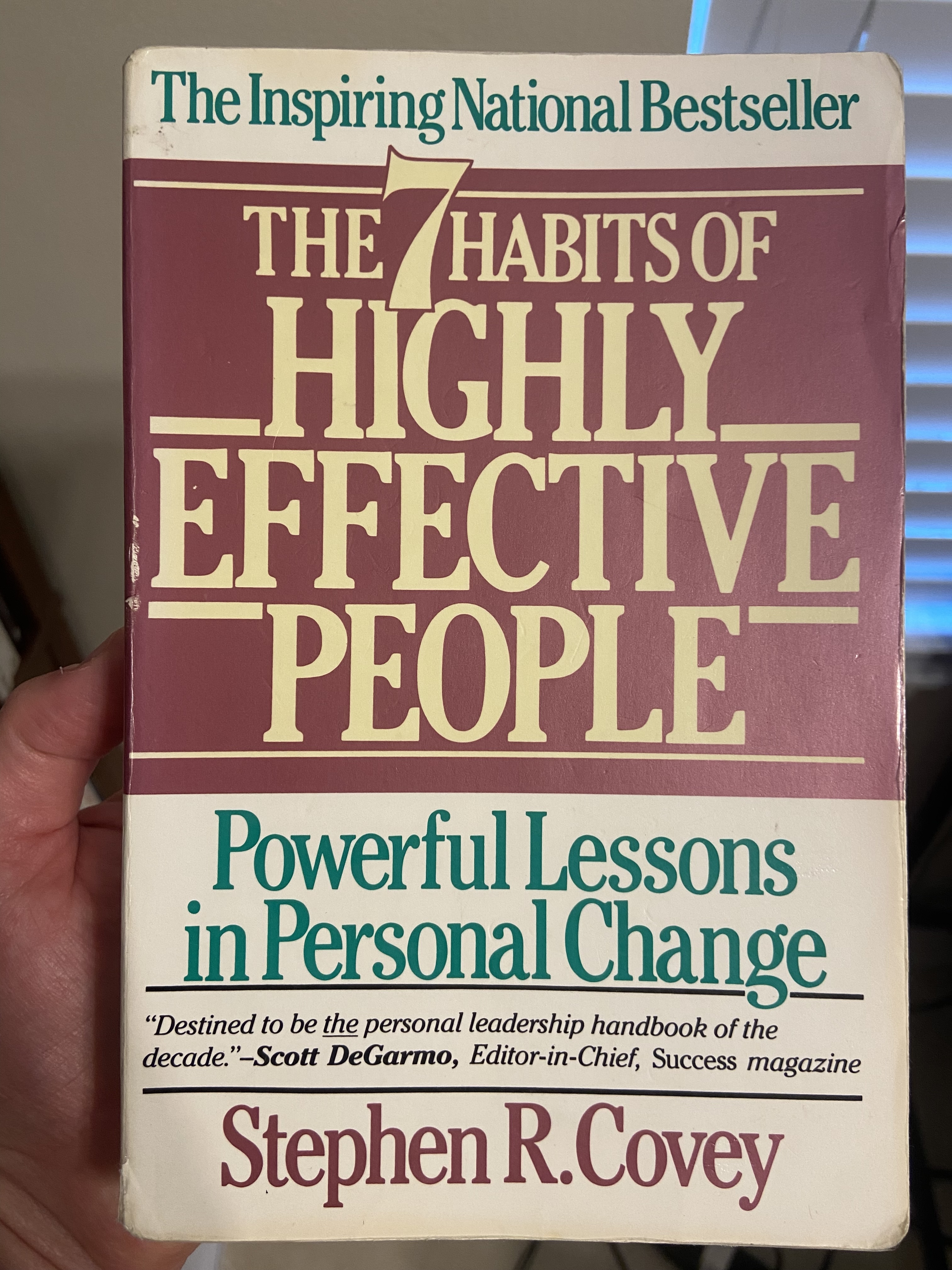
My personal copy of The 7 Habits
Annexed from my parent's home library
Shortly after graduating from high school, I read my Uncle Hyrum's book, The 10 Natural Laws of Successful Time and Life Management, wherein I made a commitment to be more conscious about planning my days moving forward. 

Later on, in college, I took a course in leadership from Brigham Young University (BYU) as a visiting student and a course in organizational behavior from Utah Valley University (UVU). 

These classes reintroduced me to Carnegie's How to Win Friends and Influence People and led me to carefully study Stephen R. Covey's bestselling book, The 7 Habits of Highly Effective People. I voraciously consumed Covey's classic work, which planted a potent and plentiful patch of additional SAL seeds in in my mind, heart, and soul. 

More than any other personal leadership-oriented or self-help book I had ever read, the 7 Habits left a deep and lasting impression on me. After reading the book, I obtained the same material on CD—taught by Covey himself—and listened intently to the entire program. The more familiar I became with the material, the more convinced I became that I didn't want to just practice what Stephen Covey had taught me; I wanted to become the Stephen R. Covey of my generation. 

My personal copy of Og Mandino's
The Greatest Secret in the World
In addition to carefully studying Covey's work during my college years, I also read books by Og Mandino. In particular, I carefully studied and completed Mandino's 45-week challenge outlined in his book: The Greatest Secret in the World, which invites a reader to not just read the Success Scrolls from his classic: The Greatest Salesman in the World, but challenges him or her to apply those scrolls in a concrete, dedicated, and systematic manner over the course of nearly a full year. 

This particular self-help exercise was, by far, the most ambitious and labor/time intensive personal development project I had ever undertaken—before or since. Og himself stated in his book that the probability of someone actually completing his ambitious challenge was about one-in-75. (2) I was absolutely determined to prove to myself—and others, including Og, even though he died nearly a decade before I undertook his challenge—that I would be one of the 1.3 percent of people who would actually finish the entire program. 

Forty-five (45) weeks after I started, I succeeded in this, my objective—an accomplishment that provides me with a residual source of personal confidence, esteem, and inner security to this day. 

William James
1842-1910
Suffice it to say, over an extended process of association, the nascent seeds of SAL were planted deeply in my mind, heart, and soul. Over time, as I continued to cultivate, fertilize, water, and otherwise nurture those seeds, they began to grow up in the form of the SAL Philosophy.  


"Sow a thought, reap an action; sow an action, reap a habit;
sow a habit, reap a character; sow a character, reap a destiny."

—William James


Thus, over a long period of time, I gradually developed and refined my own thoughts and ideas about personal leadership—notions that would, in-time, develop and evolve into the SAL Theory and Model. I recorded many of these thoughts in little black-and-white, pocket-sized "Marble Memo" notebooks.

During my early-to-mid-twenties, I filled over 20 of these books with ideas and inspiration—as it came, piecemeal, one entry at a time. My mind was exploding with ideas during this time and it was not uncommon for me to have an idea strike my brain at all times of the day, including when going to sleep at night or driving my car. At such times I was conscientious about getting out of bed, turning on the light, pulling out the little Marble Memo notebook I was filling at the time, and recording the thought—or, if I was driving, I would pull my car over to the side of the road and record the inspiration in my little notebook before proceeding on my journey.

Over a long period of time—20-plus years and counting now—I gradually developed, refined, and revised all my thoughts and ideas that would become the SAL Philosophy.

At age 25, I began constructing the SAL Theory and Model. At age 26, I self-published my first book: I Am Sovereign: The Power of Personal Leadership. It was a personal leadership guide for teenagers and contained the first version of the SAL Model, as well as early vestiges of the SAL Theory.

It was my first attempt at writing a book and contained many markings of an amateur. 

But it was a solid initial effort that would eventually go through SIX additional iterations over the course of the following two decades.

The third of these seven iterations came in the form of my doctoral research, where I further honed the SAL Model and introduced a full version of the SAL Theory for the first time. The Life Leadership textbook you now hold in your hands is four (4) iterations removed from my dissertation, published in 2013. It is the result of 40 years of informal research, 24 years of formal research, organizing, writing, editing, revising, and continually polishing. 

It is a project literally tens of thousands of hours in the making.

It is my magnum opus as a thinker, writer, organizer, and leader. 

Indeed, I do not foresee, nor do I intend, to write or create anything more important or significant in my lifetime than this single, comprehensive work. Suffice it to say, it has been an incredible adventure and an exhilarating journey—a journey that is, in many ways, still just beginning.  


In Your Journal

  • Prior to being introduced to SAL, what self-help media (books, tapes, podcasts, etc.) positively influenced your life, actions, and Existential Growth? 

  • Which of these tools did you enjoy the most?  

  • Which of these tools did you find to be the most inspiring and/or helpful?

  • Which of these tools would you most highly recommend to others?

  • Which of these tools most closely resembles the message contained in the SAL Philosophy? 


—Dr. JJ

Wednesday, January 15, 2025
Palm Beach Gardens, Florida, USA


Author's Note: This is the 427th Blog Post Published by Freedom Focused LLC since November 2013 and the 235th consecutive weekly blog published since August 31, 2020.   

Click HERE for a compete listing of the other 426 FF Blog Articles 

Click HERE for a complete listing of Freedom Focused SAL QUOTES  

Click HERE for a complete listing of Freedom Focused SAL POEMS   

Click HERE to access the FULL TEXT of Dr. JJ's Psalms of Life: A Poetry Collection

Click HERE for a complete listing of Self-Action Leadership Articles

Click HERE for a complete listing of Fitness, Heath, & Wellness Articles

Click HERE for a complete listing of Biographical & Historical Articles


Click HERE for a complete listing of Dr. JJ's Autobiographical Articles

.........................

Tune in NEXT Wednesday for another article on a Self-Action Leadership related topic.  

If you liked this blog post, please share it with your family, friends, colleagues, and students—and encourage them to bookmark this blog to access a new FREE article every Wednesday.


Click HERE to buy the SAL Textbooks  


Chapter 2 Notes

1.  Schwartz, D. J. (1995). The Magic of Thinking Big. London, UK: Pocket Books. Page 122.

2.  Mandino, O. (1972). The Greatest Secret in the World. New York, NY: Bantam Books. Page 2.

Wednesday, October 6, 2021

Finding Fun, Fruit, and Freedom in Fantasy

Daydreaming can be good or bad;
It all depends on its application.
Our world is filled with men, women, and children who spend too much time in VIRTUAL and other fantasy-lands and not enough time in the REAL world. Doing so can not only be artificial and superficial, but dangerous as well. To illustrate, consider the myriad of present-day horror stories surrounding the undisciplined use of the Internet and social media platforms.

It is a modern-day nightmare! 

One does not need technological devices to daydream or fantasize. People throughout history have engaged these activities for both good and ill. Like so many other vehicles or "TOOLS," fantasy and daydreaming are not inherently good or bad. It all depends on how you utilize them. The purpose of today's article is to help self-action leaders avoid the negative consequences of undisciplined daydreaming while capitalizing on the positive fruit that can germinate from productive fantasy.  

Og Mandino—that famous self-help guru of the 1970s—once wrote that:

"A burning desire to succeed is not enough [to win in real life]. ... There are two types of burning desire . . . and the one type is phony and hypocritical. This phony type of burning desire is found in the person who is constantly telling his [spouse], his boss, and (worst of all) himself, that he really wants to succeed. [She] reads all the self-help books published and [she] gets her "kicks" from reading about others succeeding just as there are individuals who get their "kicks" from reading pornographic books. Unfortunately for our friends who read either types of these books they never get into action. They live their lives vicariously through their imagined participation in the lives and activities of others. Tomorrow, to this type of dreamer, will be a great day. [The problem is that] tomorrow never comes."*

As he so often was, Og is right!  

Benjamin Franklin
1706-1790
Co-author and signer of the
Declaration of Independence

Mandino's words remind me of a couple of quotes from Benjamin Franklin:

"Big talkers, little doers."

         "None preaches better than the ant, and she says nothing." 

— Benjamin Franklin   


"Big talkers" and "little doers" are annoying, even anathema, to authentic self-action leaders.

For a self-ACTION leader, the essence of one's very existence involves conscious, focused, and proactive ACTION aimed at the continual betterment of oneself and others throughout the entirety of one's life and career journey.

Few things are more unattractive to self-action leaders than a day-dreamer or fantasizer who never bothers to do anything about one's hopes, dreams, and goals, or those who spend all their time creating and/or inhabiting inauthentic—or worse, divisive and dangerous—virtual worlds online and on social media platforms when they could be taking tangible action to make the REAL world a better place.  

This does not mean, however, that all daydreaming and fantasy are bad. Quite to the contrary, if properly directed, utilized, and self-disciplined, a great many mental exercises—including fantasy and daydreaming—can not only be beneficial, but vital to the construction of positive and productive outcomes in any life or career arena.     

Blueprint of building exterior
Dr. Stephen R. Covey teaches that a mental or spiritual creation always precedes the physical creation of anything.** Similarly, any serious construction project always begins with blueprints on paper.

I have discovered the truth of this mental, spiritual, or paper creation in my own life. I sometimes reflect back on the early 2000s when I was working on my first book: I Am Sovereign: The Power of Personal Leadership. Throughout the process of creating that book, I would often lie awake in bed at night—or sit awake at my desk during the day—imagining in great detail what that book would look and feel like. Later, in the spring of 2006, I enjoyed the satisfaction of seeing and holding the first REAL copy of the book I had spent so much time imagining in my mind. 

Our Engagement Photo (2008)
A TON of mental and physical
exertion went into wooing my wife.
Consider another example involving a romantic relationship...

Prior to meeting, dating, and marrying my wonderful wife, Lina, I spent countless hours envisioning the kind of woman I wanted to someday marry. But I did not stop there. I also wrote dozens of love letters to my "Future wife" and created a scrapbook with images and words that painted a mental image of what I someday desired in a best friend, intimate confidant, and romantic spouse. In addition to these mental exercises, I also went out on a lot of REAL dates with different women—100 to be exact. Lina was the magic number #101.

Click HERE to read about Dr. JJ's Rocky Road of Romance.  

All these actions served as important steps along Rascal Flatts' proverbial "broken road that led me straight to [her]." And while Lina did not always match perfectly every one of my mental creations, she is, in so many ways, even better! That's why I often refer to her as "better than the woman of my dreams."  

Click HERE to read a Special Tribute to my wife, Lina.

Athletics is another arena where positive and vivid mental imagery, working in concert with positive affirmations, helped me to accomplish significant goals in my life. As a junior in high school, I won an individual and team State Championship title by coupling focused mental strategies with disciplined and vigorous physical workouts.

Newspaper article reporting my State title victory in 1996.
My talents and skills as a writer, speaker, and communicator have additionally been aided by a great deal of mental work accompanied by tens of thousands of hours of practice.

For example, over-and-over-and-over again in a thousand different ways, I have pictured myself for many years as the "William Shakespeare of English prose"—and a decent poet to boot!

Click HERE to buy Dr. JJ's personal anthology of Poetry.  

To some, such an audacious internal supposition may come across as arrogant—and if employed out-loud in careless or undisciplined ways that tear others down, it would be arrogant. But I can both honestly and humbly say that mental exercises such as these have unquestionably aided my growth and progress as an author.

If it works and blesses my life and the lives of others, why not employ such a tactic? After all, should we not all strive to be the very best we can possibly be in every area of our lives? For self-action leaders, the answer to this question is an unyielding and never-ending "YES!"

The Immortal Bard
1566-1616
With crystalline vividness and audacious clarity
and precision, self-action leaders enthusiastically

envision exactly what they eventually want to become.
Don't get me wrong. I'm not saying I am the William Shakespeare of English prose. Other people can decide for themselves the quality (or lack thereof) of my pennings, be they prosaic or prosodic. I'm merely saying that continually picturing myself as a writer with elite natural talent and hard-won, consciously-developed skill has been a key ingredient in my long-term progress in the art and science of written composition. And diligently picturing YOURSELF where you most want to be and what you most want to accomplish will similarly aid your personal and professional initiatives, whatever they might be.          

Thus it is that day-dreaming and fantasizing is not in-and-of itself bad. After all, do not all great oak trees (meaningful accomplishments) begin as tiny acorns (ideas, hopes, daydreams, or fantasies)?

The answer to this question is self-evident and therefore rhetorical. A place does and should exist for the mental component of tangible actions and palpable achievements, for that is where all productive accomplishments have their genesis. Again in the words of Dr. Covey, a mental or spiritual creation always precedes the physical creation of anything.

As long as it is balanced with appropriate and continual ACTION, daydreaming, fantasy, and all sorts of other mental activities serve as vital components of learning and growth processes. This is why pilot trainees spend significant amounts of time in flight simulators. It is why EMT's-in-training practice CPR on dummies in preparation to save real lives. It is also why professional, corporate, and educational athletes employ various exercises in mental imagery to continually improve and hone their performances in arenas of practice and competition. 

We always see ourselves accomplishing
something before we actually achieve it.
As described above, I personally utilize positive mental imagery all the time in an on-going effort to become the best writer, speaker, teacher, leader, coach, husband, father, friend, et cetera that I can possibly be. I also spend time in specific activities and endeavors aimed at preparing me for the real stage of leadership and life. One of the most salient and prominent examples of such an exercise is my intentional and enthusiastic participation as a FANTASY baseball manager. 

For those unfamiliar with fantasy sports, it is a game played online with friends, colleagues, or competitors and allows one to manage a "Fantasy" team in an array of different sports. The purpose of the game is to simulate being a REAL manager of a professional athletic team. 

Fantasy leagues begin on a pre-determined "Draft Day" whereby you and your fellow competitors draft a team of 26 professional baseball players to play on your fantasy team prior to the start of the season. Then, once the REAL baseball season begins, real stats accrued by real players score points for those drafted (or traded) onto your fantasy roster. 

Baseball is a WONDERFUL sport. As a friend of mine once noted, baseball is boring to the uninitiated. But for those who understand the game, baseball is fascinating, multi-layered, and richly complex; in short, it is a marvelous game with endless connections to real life.

This is part of the reason I prefer fantasy baseball to other fantasy sports. I further love it because it has by far the longest season (162 games from the first of April to the beginning of October) of any other sport. Consequently, it allows me to make decisions on a daily basis throughout the entire season, as opposed to every second, third, fourth, or seventh day as would be the case with others sports such as basketball, hockey, or football. The regularity of fantasy baseball's unrelenting schedule helps keep me interested in and focused on leading my team to championships.  

I have played fantasy baseball for 11 years now as part of a league of ten managers called the Noodle Armed Knuckle Ballers. Along the way, my teams (Houston Heat and Florida Freedom) have won three (3) league championships and a number of records and other achievements.

My most recent Fantasy Baseball Title.
My team is called Florida Freedom
I do not play-for-pay. My friends and I just compete for fun. Yet along the way, I have discovered a cornucopia of positive real-life payments (benefits) from playing this game—and particularly as it relates to my lifelong desires to be an elite writer and influential leader. Consequently, the game serves a myriad of positive and productive purposes that extend well beyond the mere enjoyment of the game.  

Consider the following life lessons gleaned from playing this unique game.

Fantasy Baseball has: 

  • Enabled me to develop quality friendships.
  • Nurtured and deepened my desire for excellence and achievement. 
  • Honed my critical thinking skills as a manager and leader.
  • Helped me to create my own luck through commitment, focus, and hard work.
  • Enhanced my focus, discipline, and determination as a manager and leader.
  • Provided valuable practice at managing my emotional and social responses to losing and winning.

Let's now take these five items one-at-a-time.

1. Enabled me to develop quality friendships.

Some of my best friends play with me on our league. In most cases, we did not end up in the same league because we were best friends, but rather we become friends because we have spent a lot of time communicating with and competing with each other in our league.  

2. Nurtured and deepened my desire for excellence and achievement.

Excelling at any activity is usually FUN. When my efforts as a fantasy baseball manager bear fruit in the form of stellar stats, championship titles, and records set or broken, it motivates me to build upon my achievements to become even better in the future. Failure similarly motivates me, albeit for different emotional reasons (e.g. losing hurts). Even though my fantasy baseball team and league is something I do "just for fun," I still take pride in doing my best and rising as far and high as I can. Such desires, intentions, and goals inevitably spill-over into other, real-world endeavors.   

3. Honed my critical thinking skills as a manager and leader.

There is a lot of critical thinking involved in making decisions as a leader or manager. The same is true for a fantasy baseball manager. Success in fantasy baseball—or any other career or life undertaking—requires that I intake a lot of information and then effectively synthesize it with a host of different variables and potential variables at play. I must then analyze that synthesis in ways that empower me to make savvy decisions for both the short-term and the long-run. Fantasy baseball has provided me with an incredible opportunity to practice this input ~ synthesis ~ analysis ~ decision-making process. I can then apply the lessons I learn to REAL life situations and circumstances.  

4. Helped me to create my own luck through commitment, focus, and hard work.

With my good friend and fierce competitor,
Kent Pratt, and his beautiful family in Alberta (2019).
While a certain degree of luck is involved in just about every game or undertaking in life, the reality is that successful leaders and people find a way to create their own luck through focus, hard work, vision, discipline, commitment, and determination.

For example, the "luckiest" player in the history of our league is my good friend, Kent Pratt of Alberta, Canada. Kent has won FIVE (5) of the 11 championship titles to-date in our league—two (2) more than anybody else. I place the word "luckiest" in parentheses to emphasize a well-known fact about our league: Nobody (including me) invests more focus, hard work, vision, discipline, commitment, and determination in his team than Kent Pratt.

Is it any wonder then that he is also the "luckiest"?  

There is an old saying: "The harder you work, the luckier you get." Truer words have rarely been spoken. While fantasy baseball teams undoubtedly face days, weeks, or even months of legitimate "good luck" or "bad luck," the reality is that managers who consistently make good decisions all season long are usually the managers who end up winning the most statistical categories and championships.

In a 162-game season, there is no such thing as 162 games of all "good luck" or all "bad luck." Everyone is going to get some of both, and the managers who make the wisest decisions most consistently will usually come out on top. And it is no secret that this same principle holds true for every other endeavor in life.  

5. Enhanced my focus, discipline, and determination as a manager and leader.

I have learned a variety of different lessons as a fantasy baseball manager that translate directly to issues of focus, discipline, and determination as a manager, leader, and self-action leader in the REAL world.

Perhaps that most important of these lessons involves the value of playing hard every single day. Managers who carefully analyze their rosters every game of a 162-game season are usually the managers who finish high-up in the standings at year's end. One-hundred and sixty-two (162) games is a lot of games! If you are not careful, it can be easy to forget to check on your roster once-in-a-while. Too-oft repeated, this negligence can turn into a bad habit that extends into several days, a week, or even a month, which can prove costly to your chances of finishing strong at the end of the season. While it is possible for even the most diligent managers to have an off-season, I know of no committed and consistent manager in our league who has ever fallen into the bottom-half of the league in overall performance as measured over multiple years. To illustrate this point, I once finished as low as 7th place out of 10 managers in a single season. Yet overall, I have more championship titles and all-time records than any other player except the mighty Kent Pratt.  

By applying this same consistent, even daily effort, both Kent and I have enjoyed a lot of success, combining to win eight (8) out of the 11 league titles since we began playing in 2011. This year, I took first place and Kent took second place. And guess who had the most waiver-wire roster pickups and drops of all the managers in our league? You guessed it: Jordan and Kent. While number of roster pickups and drops does not always correspond to victory, it does shed some insight into the passion and consistency of a manager when one's waiver change-number is high.   

Learning to self-regulate and otherwise manage the emotions
surrounding both winning and losing is an essential
component of management, leadership, and SAL.
6. Provided valuable practice at managing my emotional and social responses to losing and winning.

Winning is FUN. It also brings a lot of relief after the pressure of a difficult project or lengthy season has concluded. On the other hand, losing sucks! However, losing is a part of sports, careers, and lives. As such, successful leaders, managers, and individual competitors must learn how to practice good sportsmanship (win or lose) and learn how to manage the emotional ups-and-downs of winning and losing.

I have been able to win quite a bit in my fantasy baseball league, and that has been very satisfying and fun. However, I have lost more often than I have won. Even Kent Pratt—our resident league legend (I personally refer to him as the "Nick Saban" of our league)—has lost more than he has won. Neither Kent nor I like to lose, because let's face it: losing sucks! But... it is part of the game of fantasy baseball—just like it is part of one's career and life. The better we are at gracefully handling both winning and losing, the more effective we become as managers in the future, and the more people will respect and like us.  

You typically learn more when you lose than when you win. In the words of Anthony Robbins: "When you succeed, you tend to party; but when you fail, you tend to ponder."


"When you succeed, you tend to party; but when you fail, you tend to ponder." 

— Anthony Robbins   


To date, I have done a lot more pondering than partying in my life. Doing so has blessed my personal and professional pathways immeasurably. It has also led to increasing success in both life arenas over time.

Successful managers never let a loss go to waste; they always learn from it and become more successful in the future as a result. On the other hand, winning can also be very motivating to future performances. As someone once said: "Nothing succeeds like success," and "the rich tend to get richer."

Win or lose in the present, future successes depend on how you choose to respond to both winning and losing. Positive and productive responses to losing keep you from falling into depression over your losses and generate a host of positive and productive lessons you can apply to future competition. On the other hand, positive and productive responses to winning keep you from becoming arrogant and maintain (or even expand) your motivation to build upon present wins to construct follow-up successes in the future.

Suffice it to say, there are many lessons gleaned from my experiences playing Fantasy Baseball that can easily translate and be applied to any other career or life endeavor. For this reason—and because it is so much fun—I continue to play this wonderful game with my good friends and fierce competitors year-after-year-after-year. As a result, though another 162-game season has just ended, I can hardly wait for Draft Day to arrive next March!  

What kinds of mental strategies or fantasy undertakings might you engage to help further educate and prepare you for maximum success as a self-action leader, manager, leader, friend, spouse, parent, et cetera? I invite you to ponder on this question and take advantage of appropriate opportunities as they arise in your life.   


-Dr. JJ

October 6, 2021
Palm Beach Gardens, Florida, USA

Author's Note: This is the 233rd Blog Post Published by Freedom Focused LLC since November 2013. 

Click HERE for a compete listing of the other 232 FF Blog Articles.  

.........................

Tune in NEXT Wednesday for another article on a Self-Action Leadership related topic.  

And if you liked this blog post, please share it with your family, friends, colleagues, and students—and encourage them to sign up to receive future articles for FREE every Wednesday.

To sign up, please email freedomfocused@gmail.com and say SUBSCRIBE, or just YES, and we will ensure you receive a link to each new blog article every Wednesday.  

Click HERE to learn more about Freedom Focused

Click HERE to learn more about Dr. Jordan Jensen

Click HERE to buy the SAL Textbooks

Notes:

* Mandino, O. (1972). The Greatest Secret in the World. New York, NY: Bantam Books. Pages 2-3

** Covey, S.R. (1989). The 7 Habits of Highly Effective People. New York, NY: Fireside. See pages 99-100, 129-131, 134, and 146-47.

Tuesday, March 15, 2016

Self-Action Leadership Training for Individuals


What if You Could Squeeze Nearly THREE Decades of Knowledge, Experience, Study, and Research into ONE Comprehensive Self-Help Book and Personal Leadership Guide?


Self-Action Leadership by Dr. Jordan Jensen

ANSWER: You'd have in YOUR hands a copy of SELF-ACTION LEADERSHIP, the Premier Self-Help Guide of the 21st Century.  


This week's post introduces Self-Action Leadership training for individuals.  I am extra excited about this week's article, because writing it has taken me on a pleasantly nostalgic trip down memory lane to some of the greatest joys of my childhood, adolescence, and young adulthood.

I have always loved the printed page.  I was blessed to be born into a family that valued books—especially my father.  This love was fueled no doubt by whatever children's books my parents or older siblings read to me as a little boy.

But it seemed to me to go beyond that.  It seemed to be innate—as if my love of reading and writing and studying had been developed spiritually before I was even born—and that these proclivities had naturally accompanied me on my journey into this world as well.

As such, I felt unusually drawn to books and other written material from before I could even read.  For example, I remember a childhood neighbor friend coming over to my house one day. I was in kindergarten at the time and could not yet read myself.  She, however, was a big first grader and could read.  Enamored by her special skill I had not yet accrued myself, I admiringly directed her into our little playhouse under the stairs in our home, sat her down, took out a report of some sort that looked extra important and sophisticated (which I had retrieved from my Dad's office waste basket—my office supply shop for playing "office") and admiringly asked her to read it to me.  I don't remember what she read off of whatever it was I handed her (chances are good she couldn't read much of it) but I do remember being impressed!  I could hardly wait until the day arrived when I could finally read on my own.

Later, after I had learned to read and write myself, my perspective opened up to the wonderful world of books.  This introduction and discovery opened up a veritable Heaven on Earth to me.

First, there was my own growing collection of books (by the age of 23, I had amassed a library of over 500 volumes).  Then there was the scattered collection of books throughout my home, the mother load of which was ensconced in my Dad's personal office library, which he kindly allowed me to peruse at my leisure (including permission to read his personal journals).  Beyond that, I was introduced to school and public libraries, and the expansive University library at BYU where my Mother attended school during summer terms to finish her Bachelor's degree in between the years 1988 and 1992.

The grandest private library I had access to was in my maternal Grandmother's home.  Grandma and Grandpa Smith's library dwarfed my own father's sizable collection, and I spent some of the most cherished hours of my childhood there—alone—in the midst of those thousands of books, many of which were older and emanated that pleasant "old-book smell."  Grandma kindly allowed me to search her stacks to my heart's content.  In addition, she generously allowed me to borrow those I found to be most wonderful of all.

Upon her passing, there seemed to be a lack of clarity about how the books were going to be apportioned.  Worried that this ambiguity might stretch on for some time, I wisely secured a stack of my favorites before the moving truck arrived.  In hindsight, I should have taken more than I did.  I never saw the rest of those books again.  I heard that they initially went to a storage unit.  I do not know where they are today.

Jensen Family in 1989
I am the little boy on the bottom right
I come from a large family.  Of my six siblings, I am the youngest of five boys.  My four older brothers are all at least 8 years older than me.  Because of this salient separation in our ages, my brothers were, in many way, more like uncles or surrogate fathers to me than brothers.  This was not a bad thing because they treated me kindly and with a lot of respect, especially in light of how many typical older brothers treat their kid brother.  This tender regard for me only strengthened the near-worshipful veneration I admiringly bestowed upon my brothers.  The pedestal upon which my young eyes placed them caused me to want to know and do everything they knew and did.  This translated into many different hobbies and behaviors, the foremost of which was to take interest in the sports my brothers competed in and the books they were studying at school and church.

"Doing" my trigonometry homework in
our backyard on a warm, sunny,
Arizona afternoon.
One of my most beloved childhood practices was to borrow my brothers' textbooks to look through and then copy out of—pretending I was doing the same advanced high school homework they were.  As such, I became acquainted (at least in name) to calculus, chemistry, physics, English and American literature, trigonometry, economics, theology, etc.

One of the most satisfying single moments of my entire boyhood occurred one Friday evening after returning from a high school football game to find the books Hamlet and Othello sitting on my desk in my bedroom.  I had been begging my brothers to get them for me from their high school library (which I could not personally access).  They kindly acquiesced, and forever after viewed their lending of those two books to me (which I could hardly read and not in the least bit understand as a second grade) as a precious token of brotherly love and affection.

As I matured in both age and reading ability, I began to actually study books more seriously.  As I grew into my teen years, I discovered that I especially liked books related to personal development and self-leadership.  The seeds of this passion were sunned and watered by my reading of Dale Carnegie's How to Win Friends and Influence People and Dr. David J. Schwartz's The Magic of Thinking Big—both outstanding self-help books of antiquity from deep into the last century, and both of which I found on the bookshelves in my own home.  This was followed by my introduction to the work of my uncle, Hyrum W. Smith as well as Stephen R. Covey, Anthony Robbins, Norman Vincent Peale, and others.  I was hooked!

Teaching action shot of Dr. Jordan Jensen from 2012
While serving a 2-year mission for my Church, I discovered that I loved to teach as much, if not more, than I loved to read and write and study.  This natural blend of pre-sown personal proclivities, wonderful opportunities to nurture those seeds, and my growing chance to apply what I was learning led me, in time, to choose a career in education, and more specifically in the fields of self-help and personal development.

Along the way, I devoured additional self-help books and found that my interest was always piqued when my coursework included literature that possessed literary self-help or philosophical value (for example, as an English major, I made the fortuitous acquaintance of writers like Donne, Franklin, Emerson, Thoreau, Frost, etc.).  My passion for such literature was borne not just out of the joy and satisfaction that study itself brought to me, but because I needed the wisdom and help these authors afforded in my quest to overcome my own weaknesses, build upon my strengths, and work through perplexing life challenges I was facing—like my battle with OCD.

Click HERE to read about Dr. Jordan Jensen's battle with Obsessive-Compulsive Disorder (OCD)

Click HERE to read Part II

One book in particular—The Greatest Secret in the World by Og Mandino—I used on a daily basis for 45 straight weeks in a religious effort to work through my OCD and other challenges I was facing at the time.  To this day, that book—filled with all of my notes of progression, setbacks, and insights along the way—serves as a sacred reminder to me the value of investing great time, energy, passion, effort, and the will to do whatever is necessary to overcome oneself to reach greater heights and states of being in the future.

Within a few years of my Mandino experiment, I had figured out that one of my missions in life was to write my own book that could help other people in a similar way that all of these other books I had read had helped, inspired, and lifted me in my own life's journey and helped me to transcend or manage my own life's obstacles.  Recognizing I had already amassed a great deal of knowledge and insight on the subject, I set to work.  In 2005, I published my first book—I Am Sovereign: The Power of Personal Leadership.  It was directed to a teenage and young adult audience.  It was not commercially successful, but it was a building block in my early career that bolstered my confidence and opened up doorways of additional professional opportunity.

Back cover of Dr. Jordan Jensen's book, Self-Action Leadership
Ten years and a lot of reading, studying, research, and life experience later, I published what I intend to be my seminal work on the subject of personal leadership.  I call the book Self-Action Leadership: The Key to Personal, Professional, & Global Freedom.  No matter how old I live to be, and no matter how many books I write during the course of my career, I hope that this one book remains my seminal work—and is never surpassed in its eventual commercial success.

Why?

Because this ONE book provides a synergistic accumulation and unique presentation of everything I have ever learned that has benefitted me in the field of personal development and self-help over the course of the last three decades; and because I believe that this one book will be more helpful to a broader swath of society than any other book I will ever write.  Any additional books I write in the future will merely be an appendage to this seminal text.

The past several weeks I have written about how Self-Action Leadership training (along with the book) can benefit corporate and business audiences as well as educational groups (i.e. schools and classrooms).  In weeks to come, I will write about how civic leaders, parents, and persons dealing with or treating mental illness can benefit from studying the material, as well as sharing the information and providing training for their constituents, dependents, and patients.  But in the last analysis, Self-Action Leadership is, was designed to be, and I hope always will be, used primarily as a personal manual—an all-in-one comprehensive self-help guide and workbook that can bless the lives of those who read it, study it, and do the homework assignments contained therein.

Speaking of the homework assignments contained therein, one of the unique and most beneficial features of the text is a personal leadership challenge that we at Freedom Focused call The Self-Action Leadership (or SAL) Master Challenge.

This challenge consists of 25 concrete exercises that invites YOU—the reader—to do more than just read the book.  It encourages you to study the material, learn new vocabulary words, begin a personal journal and complete other relevant writing assignments, set goals, engage in activities of self-discipline, and eventually to write your own Self-Declaration of Independence & Constitution where you will begin to identify your life and career vision, mission, values, standards, goals, etc.

Click HERE and scroll toward the bottom of article to read more about writing your own Self-Declaration of Independence & Constitution.

Click HERE to watch a video of Dr. Jordan Jensen explaining the principle of writing a Self-Declaration of Independence & Constitution.

Those who undertake and complete the SAL Master Challenge will receive a special diploma (non-accredited) and medal to commemorate their achievement.  Their names will also be recorded on the Freedom Focused website where they will remain as long as Freedom Focused stands as The Center for Self-Action Leadership.

The SAL Challenge is NOT an easy challenge.  You will not be able to complete it quickly—and that is the point!  After nearly 30 years of studying the subject of personal development and self-help, and more importantly, after nearly THREE decades of working tirelessly to improve myself in the process, I have acquired the expertise necessary to create a comprehensive guide that will provide you—in one volume—with all of the essential principles, practices, and other elements contingent in the process of human existential growth and development.  And the good news is you don't have to spend nearly 30 years figuring it all out because I've already done it for you.  All you have to do is get the book, read it, complete the SAL Challenge, and then forever benefit from the blessings that come from the acquisition of vital knowledge in concert with the dedicated pursuit of self-work, self-sacrifice, goal setting, and personal discipline.

Click HERE to buy Dr. Jordan Jensen's book — SELF-ACTION LEADERSHIP

After you have finished reading the book and have completed the SAL Master Challenge, I invite you to email me to tell me about what you are learning and share your experiences.  I look forward to hearing from you!  You can reach me personally at jordan.jensen@freedomfocused.com


Note: This article is one of SIX articles in a special series dedicated to different AUDIENCES that Freedom Focused specifically targets with Self-Action Leadership training. We invite leaders and managers of these different audiences to click on links below to read the articles pertaining to your field or constituency.

Click HERE to access article for  BUSINESS PROFESSIONALS (Leaders, Managers, & Workers)

Click HERE to access article for  EDUCATORS  (Administrators, Teachers, & Staff)

Click HERE to access article for  STUDENTS & INDIVIDUALS

Click HERE to access article for PARENTS & FAMILIES

Click HERE to access article for ELECTED OFFICIALS, LEADERS, & ROLE MODELS

Click HERE to access article for PERSONS dealing with MENTAL ILLNESS


Self-Action Leadership  ~  The Book

SELF-ACTION LEADERSHIP is the key catalyst for initiating transformational leadership that lasts in any organization. The truth of the matter really is that simple; and the transformation of organizations through the holistic development of individuals really is that difficult—yet altogether possible for anyone willing to invest the time, effort, and sacrifice required to achieve authentic, transformational results.


Unlike any training program that has ever preceded it, Self-Action Leadership provides a single vehicle wherewith individual self-leaders can discover—and then act—upon the great truth that HOLISTIC personal development and growth spanning the mental, moral, spiritual, physical, emotional, and social elements of our individual natures is within the grasp of each one of us.


Back Cover of Self-Action Leadership, the Book
Note: Freedom Focused is a non-partisan, for-profit, educational corporation.  As such, we do not endorse or embrace political figures.  We do, however, comment from time-to-time on historical or political events that provide pedagogical backdrops to illuminating principles contained in the SAL Theory & Model.

Click HERE to learn more about the SAL Theory & Model.

To receive weekly articles from Freedom Focused & Dr. Jordan R. Jensen, sign up with your e-mail address in the white box on the right side of this page where it says "Follow by E-mail."

Click HERE to buy a copy of Dr. Jordan Jensen's new book, Self-Action Leadership: The Key to Personal, Professional, & Global Freedom.

Click HERE to read more about Dr. Jensen's book, Self-Action Leadership, and to review what experts in the leadership field are saying about this groundbreaking new personal development handbook.

Click HERE to learn more about Dr. Jordan R. Jensen.  Click HERE to visit the Freedom Focused website.


JJ's Journal: February 1988

  The Personal Journals of Jordan Rex Jensen  February  1988 Monday, February 1, 1988 JJ slam dunking a mini soccer ball in the driveway of ...