 |
Joshua Lawrence Chamberlain
1828-1914 |
Today's article is about one of my favorite
heroes from
history, and a MIRACLE that occurred in the midst of his remarkable life... a miracle that, in fact,
saved his life.
You won't want to miss the story of this remarkable man and the serendipity that saved him from death, so make sure to read on to the very end of this post—even if you have to skip some details in between.
It is worth noting that this historical article just happens to be published on a very important date in history—for it was 81 years ago today that Japan attacked the U.S. Pacific Fleet at Pearl Harbor, ushering the United States into World War II and signalling the beginning of the end of the evil imperial aims of Fascist Italy, Nazi Germany, and the once-brutal Japanese Empire.
It is essential that we remember these important dates in history. As has often been said in a variety of ways: "those who fail to remember and study the past are doomed to repeat it." Variations of this quote stem from the words of George Santayana, a Spanish-American philosopher, poet, and novelist, who was born the same year the Battle of Gettysburg—featured prominently in this article—was fought. It was Santayana who originally wrote: Those who cannot remember the past are condemned to repeat it.
"Those who cannot remember the past are condemned to repeat it."
—
George Santayana (1863-1952)This week's post is about Joshua Lawrence Chamberlain, a Union Army Officer who fought in the American Civil War. Today's article highlights the remarkable Self-Action Leadership of General Chamberlain. But it also illustrates how we need more than just SAL to find safety, happiness, success, and inner peace in our lives. We also need SERENDIPITY, or "the felicitous aid of unseen forces" all along our way. By effectively combining SAL with SERENDIPITY, Chamberlain was able to live an incredible life of service and contribution and leave behind a legacy of greatness that has inspired millions, including Dr. JJ and others at Freedom Focused.
Joshua Lawrence Chamberlain was born in Brewer, Maine in 1828. An ambitious and gifted student, he graduated with honors from Bowdoin College (pronounced "bow-dun") in Brunswick, Maine, in 1852 at the age of 24.
An abolitionist, Chamberlain had been a student of Calvin Stowe's at Bowdoin. Stowe was the husband of the famous writer, Harriet Beecher Stowe—author of a wildly popular novel of the time:
Uncle Tom's Cabin.
Published in the early 1850s,
Uncle Tom's Cabin was influential in precipitating the cascading historical events of the following decade, which climaxed in the American Civil War and subsequent liberation of four million black slaves.
A very religious and studious young man, Chamberlain attended Bangor Theological Seminary after graduating from Bowdoin. He studied a variety of ancient and modern languages during the three years he spent at the Seminary. Then, in 1855, he returned to his alma mater, Bowdoin, this time as a professor.
After the Civil War broke out in 1861, Chamberlain—a fiercely principled and patriotic abolitionist—deeply desired to offer his services to the Union Army, much to the chagrin of his bosses at Bowdoin College, who greatly valued his professorial contributions and would have preferred to have kept him on campus throughout the war. It was unusual for a man of Chamberlain's education and professional station to sign up for the fight. Others in his educational stratification and social milieu tended to avoid voluntary enlistment. Later on, in 1863, when conscription became law for men aged 18-45, persons in positions of prestige like Chamberlain usually found other loopholes to avoid joining the army, such as paying a substitute to take one's place in the draft.
Joshua Lawrence Chamberlain was a different story altogether, although his station and reputation did enable him to gain an Officer's Commission as Lieutenant Colonel (2nd in Command) of the 20th Maine Infantry Regiment of Volunteers upon his entrance into the Army in 1862. He was originally offered the Colonelship, but humbly turned down the prestigious post because he felt it was his duty to learn the art and science of soldiering himself before assuming command of an entire regiment of other soldiers. Such a move was classically emblematic of Chamberlain's unusually principled character.
 |
Map of the Battle lines at Fredericksburg, December 1862, where
direct Union assaults upon Confederate forces yielded colossal losses. |
In December 1862, the 20th Maine fought in the Battle of Fredericksburg in Northern Virginia—one of the largest and bloodiest conflicts of the entire war. Like many of the early battles of the Civil War, Fredericksburg was a Confederate victory and a veritable disaster for the Union's Army of the Potomac.
After a failed charge into the Confederate position atop Marye's Heights in Fredericksburg, Chamberlain and his men spent a miserable, freezing night hunkered down amidst piles of their comrades—both
living and
dead. With their primary protection being fallen soldiers, the 20th Maine tried to stay alive while Confederate minié balls flew all around them, often sinking deep into the flesh of the dead with a supersonic zip followed by a macabre "thud." (1)
After surviving the frigid bloodletting at Fredericksburg, and within a year of enlisting in the Army, Chamberlain's outstanding military service and exemplary leadership on the battlefield prefaced his promotion to Colonel and Commander of the 20th Maine Infantry. This rise to regimental commander came just one month before the catalytic Battle of Gettysburg fought in the first three days of July 1863 in Southern Pennsylvania.
Click HERE to watch a video clip from the movie Gettysburg where Chamberlain speaks to his men about what they are fighting for.
 |
To learn more about his battle experiences, click HERE
to buy General Chamberlain's Civil War memoirs. |
In
this historian's view, the video clip above effectively captures the rare singularity of Chamberlain's unique leadership capacity and style. One of Chamberlain's fellow officers in the Union Army, General Horatio G. Sickel, once remarked to Chamberlain that he had "
the soul of the lion and the heart of the woman."
"General [Chamberlain], you have the soul of the lion and the heart of the woman." (2)
—
General Horatio G. SickelTo General Joshua Lawrence Chamberlainat the Battle of Quaker Road, Virginia
March 29, 1865Given my study of Chamberlain's life and career, I believe what General Sickel meant by this was that General Chamberlain had the rare ability as a soldier to combine fierce strength and steely resolve with kindness, gentleness, and mercy. When it was time to be resolute or fierce; there was none more determined and strong. But when it was time to be gentle and forgiving, Chamberlain was equally up to that task as well.
These are the kind of leaders that Freedom Focused seeks to train, coach, and develop. This is also the kind of leader that I have, however imperfectly, always strived to become as a man, husband, father, friend, neighbor, and business builder. And being a stay-at-home Dad for the past seven years has done wonders in helping me in this desired development!
At Gettysburg, the 20th Maine, under Chamberlain's command, was stationed at the famous "Little Round Top" during the second day of the battle (July 2nd). Positioned at the critical end of the Union line, the 20th Maine served as the Union's far left flank on the battlefield that vital day of the American Civil War's most important battle. Chamberlain's superior officer, General Strong Vincent, ordered him and his regiment to hold the line, come what may. Said Vincent to Chamberlain: "I place you here! This is the left of the Union line. You understand. You are to hold this ground at all costs!" (3)
 |
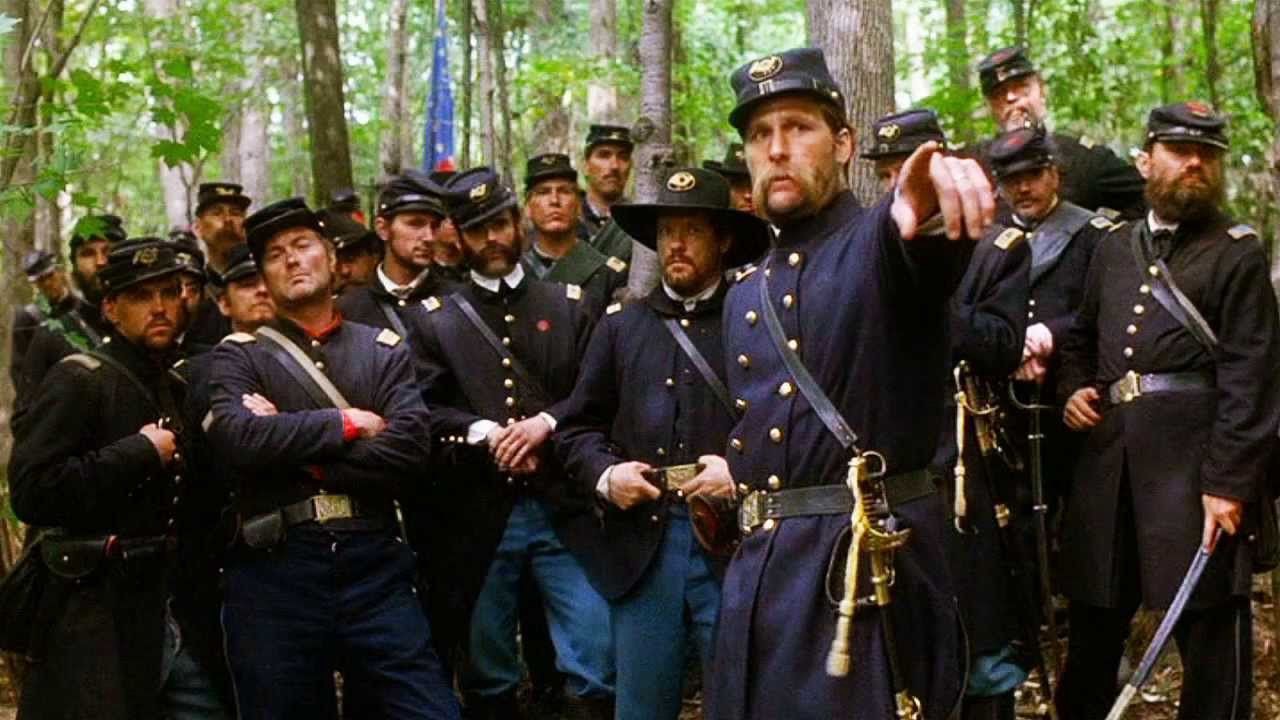
Jeff Daniels—Hollywood actor and veritable Chamberlain doppelgänger
—portraying the Colonel with his 20th Maine at Little Round Top at the
Battle of Gettysburg in the 1993 movie, Gettysburg. |
Chamberlain understood.
And at great cost, he and his comrades held the line!
The soldiers of the 20th Maine exhausted all their ammunition repelling repeated advances from the attacking Confederates, at which point Chamberlain ordered a dangerous and audacious bayonet charge in a last-ditch effort to curtail the Rebel advance.
It worked.
The 20th Maine and their supporting regiments stopped the Rebel advance.
The day was saved!
And the legendary "Hero of Little Round Top" was born. (4)
The undaunted courage of Chamberlain and his men at Little Round Top prevented the Union line from being flanked on that vital second day of fighting. This victory set up a third day of battle in which the Rebels were eventually routed in a famous frontal assault known as "Pickett's Charge," where Robert E. Lee ordered 15,000 Rebel soldiers to storm the Union's main position. The assault failed miserably and served as a mirror-image of the ill-fated Union attacks on Fredericksburg the previous December. Thus, as Pickett's men marched audaciously (but foolishly) into Union cannon, musket, and pistol fire, some of the Yankee soldiers shouted: "Remember Fredericksburg!" Just as the failed Union assaults upon Marye's Heights at Fredericksburg, Pickett's Charge was a colossal failure at Gettysburg. Few Rebels made it to the Union lines before being killed, wounded, taken prisoner, or backed into retreat, making the Union's revenge of Fredericksburg complete and decisive, thereby securing a Union victory in what proved to be a vital turning point in the war.
Click HERE to watch Chamberlain and the 20th Maine defend Little Round Top on June 2, 1863, as depicted in the movie, Gettysburg.
Click HERE to watch Chamberlain and the 20th Maine fix bayonets and charge the Rebels after exhausting their ammunition on July 2, 1863, as depicted in the movie, Gettysburg.
Click HERE to watch Pickett's Charge on July 3, 1863, as depicted in the movie, Gettysburg.
 |
Major General (2-star)
Joshua Lawrence Chamberlain |
Despite the Union victory at Gettysburg, and the retreat of Lee's Army of Northern Virginia back into the South following the bloodiest battle in American History, the Civil War would rage on for two more bloody years. And despite being wounded numerous times—and nearly fatally on a couple of occasions—Chamberlain remained in the thick of the action up until the very end of the war.
Along the way, his indomitable personal courage and patriotic passion for his country did not falter, flag, nor fail. As a leader, he continued to be promoted. By 1865, he had attained the full rank of Brigadier General (one star), a promotion he received from Ulysses S. Grant, commanding General of all Union forces. Soon thereafter, he received the brevet rank of Major General (two stars) from President Abraham Lincoln himself.
By war's end, Chamberlain had become one of the most famous and venerated officers in the entire Union Army. His star had risen so high, in fact, that he was chosen by General Grant to receive the flag of the surrendering Confederate Army at Appomattox Courthouse on April 12, 1865—three days after Lee and Grant's famous meeting that officially ended the war. The grace and respect that Chamberlain demonstrated towards his defeated enemies that day would earn him further honor and respect from all corners of the newly reunited nation. This honored and revered reputation—thoroughly earned through his noble actions and consistent character demonstrated over long periods of time—would become increasingly burnished throughout his illustrious post-war life and career.
Simply stated, Joshua Lawrence Chamberlain was a sterling example of Self-Action Leadership long before the term SAL had ever been coined.
After the war, Chamberlain entered politics and was elected to four 1-year terms as Governor of Maine. He later became President of his alma mater, Bowdoin College, where he served throughout the 1870s and early 1880s. After stepping down as college president, he moved to New York to practice law. After that he was appointed Surveyor of the Port of Portland in his home state of Maine.
 |
| An aged Chamberlain in full dress uniform |
Despite living a long and active life into his early 80s, Chamberlain never fully recovered from wounds he received during his service in the Civil War. In fact, his death in 1914 was the result of symptoms stemming from one of his lingering war wounds.
Although he suffered a great deal throughout his later life because of these wounds, they did not slow him down much. He continued to travel and speak and attend reunions with his old comrades (and enemies). He played an active and visible role in the Grand Army of the Republic, a fraternal veteran's organization consisting of soldiers who had fought for the Union in the Civil War. In 1893, the "Hero of Little Round Top" was awarded the Medal of Honor for his courageous actions at the Battle of Gettysburg.
Click HERE to see General Chamberlain's Medal of Honor page online.
Chamberlain's fame grew to be universal and widespread, including among many of his old enemies in the Confederacy. The Confederate Officer (Colonel William C. Oates, commander of the 15th Alabama Regiment) who opposed him that fateful day in early July, 1863, credited Chamberlain and his regiment with saving the Union Army at Gettysburg. According to Oates, if the Alabamians had had just one more regiment, they could have flanked the Union line, which would have theoretically led to a Confederate victory rather than a Union win in that all-important battle. Oates credited Chamberlain's leadership for making the difference in the outcome of the battle. (5)
When the Spanish American War broke out in 1898, Chamberlain—ever the patriot and forever the soldier—offered his services to his Country once again—at age 70! His offer, however, was turned down due to his advancing years and ongoing health issues from previous combat wounds. Ironically, his old foe, Colonel Oates, seven years his junior and in better physical condition, received a Brigadier General's commission in the U.S. Army from President William McKinley and did serve in that later conflict.
 |
Dead soldiers litter the field at Gettysburg.
Character and Serendipity aided Chamberlain's escape from joining them. |
The Civil War MIRACLE of Joshua Lawrence Chamberlain is that he lived to see the end of the Civil War.
Between 1862 and 1865, Chamberlain fought in 20 battles and many additional skirmishes. He had six (6) horses shot out from under him, and was wounded on six (6) different occasions, two of which nearly took his life. Despite these repeated "close calls" with death, Chamberlain managed to survive the war and live for another half century.
When you study the life and career of this unusual and singular man, it is hard not to believe in the reality of serendipity that seemingly surrounded him throughout his service in the Civil War and beyond. Some, including myself, would even chalk his miraculous survival up to direct intervention of divine Providence (the Hand of God).
Perhaps the most significant episode of this ongoing series of serendipitous events occurred at Little Round Top at the Battle of Gettysburg during the second day of that famous battle. Chamberlain himself would not learn how close he came to dying that day until years after the war when he received a letter from a soldier who had fought in the 15th Alabama—the Rebel regiment that had opposed his 20th Maine that hot, humid, and bloody afternoon of July 2nd.
After receiving and opening up the letter, Chamberlain read its contents, as follows:
Dear Sir:I want to tell you of a little passage in the battle of Round Top, Gettysburg, concerning you and me, which I am now glad of. Twice in that fight I had your life in my hands. I got a safe place between two rocks, and drew bead fair and square on you. You were standing in the open behind the center of your line, full exposed. I knew your rank by your uniform and your actions, and I thought it a mighty good thing to put you out of the way. I rested my gun on the rock and took steady aim. I started to pull the trigger but some queer notion stopped me. Then I got ashamed of my weakness and went though the same motions again. I had you, perfectly certain. But that same queer something shut right down on me. I couldn't pull the trigger, and, gave it up—that is, your life. I am glad of it now, and hope you are.
Yours Truly,
—A member of the Fifteenth Alabama (6)
...............
Call it what you want: Divine intervention, Providence, the grace & mercy of the Hand of God, serendipity, coincidence, caprice, luck, good fortune... whatever; but there it no doubt these kind of occurrences are real—and happen to all of us at various junctures over the course of our lives.
And for what purpose?
 |
SAL's aim—today, tomorrow, and forever
is focused on your personal & professional GROWTH |
The answer always relates to our
long-term advantage, and by "advantage" I mean our long term
happiness and GROWTH. I employ the phrase "long-term" because sometimes serendipity doesn't
appear or
seem to be very advantageous in the present moment. In fact, sometimes serendipity can be downright ruthless and painful in the moment; which is why Garth Brooks so ironically croons: "Some of God's greatest gifts are
unanswered prayers!"
Thus, in the end, self-action leaders are usually able to identify serendipitous events in their lives and careers because of the catalytic impact they ultimately have on producing positive, productive, and growth-inducing
end results.
And that is why we at Freedom Focused are so passionate about and grateful for SERENDIPITY, whatever its actual ontology may be—and self-action leaders are always free to decide for themselves the answers to that question.
Nevertheless, the fact remains: self-action leaders need more than just self-action leadership to be happy, successful, and experience inner peace in their lives. We also need the mysterious magic of Serendipity.
After reading this post, are you better understanding why I have always taken such a keen interest in history?
Second only to reading and writing, Freedom Focused holds that studying the past ranks among the most important secular subjects we can study as human beings. There are few better ways to successfully prepare for the future than to carefully study the past. As such, Freedom Focused advocates the teaching of history in schools and beyond, and calls for effective and engaging instructional methods that are consistently objective, balanced, fair, and non-partisan.
 |
Few things will better inform your present and future
than a careful study of your (and the) PAST. |
After reading today's posts, it will not surprise you that one of my favorite periods of American history is the Civil War era. In fact, my interest in Civil War history led, in part, to my deep fascination with the American South—a curiosity that eventually influenced a cross-country move from Utah to Georgia, where I would seek my fortunes and meet my future wife.
Click HERE to read more about Dr. JJ's love of the South.
I hope that reading this article will inspire you to learn more about history, both your own personal (and family) history, and history in a more general sense, for knowledge of the past is a great gift that we are always free to open up and learn more about, if only we will.
Will You?
-Dr. JJ
December 7, 2022
Palm Beach Gardens, Florida, USA
Author's Note: This is the 295th Blog Post Published by Freedom Focused LLC since November 2013 and the 124th consecutive weekly blog published since August 31, 2020.
Click HERE for a compete listing of the other 292 FF Blog Articles.
.........................
Tune in NEXT Wednesday for another article on a Self-Action Leadership related topic.
And if you liked this blog post, please share it with your family, friends, colleagues, and students—and encourage them to sign up to receive future articles for FREE every Wednesday.
To sign up, please email freedomfocused@gmail.com and say SUBSCRIBE, or just YES, and we will ensure you receive a link to each new blog article every Wednesday.
Notes:
1. Chamberlain, J.L. (1994). "Bayonet! Forward": My Civil War Reminiscences. Stan Clark, Jr. (Ed.). Gettysburg, PA: Stan Clark Military Books. See Chapter 1: My Story of Fredericksburg, Page 9.
2. Ibid. Page after the title page.
3. Ibid. Page 29.
4. Ibid. Page 268.
6. Chamberlain, J.L. (1994)... . page 31.


 Opportunity




%20.jpeg)