Showing posts with label Civil War. Show all posts

Wednesday, May 31, 2023

Mentoring Psalmists


Artists of all kinds grant credence to the reality of one's
MUSE in obtaining inspiration for one's best work.
 

Chapter 3


Mentoring Psalmists


No Poet is an Island (1). 

Aside from the celestial assistance of one's Muse, to Whom I gratefully acknowledge for the inspiration, organization, and perhaps most importantly—the timing—of my work, all are indebted to erstwhile bards of the mortal variety, whose genius, along with the help of their own Muses, infiltrated their souls with the rhythms and rhymes, features and forms, messages and meanings that strike living, breathing, artistic chords within and without for the benefit and blessing of others and the joy and satisfaction of oneself.   

Such literary resonances infuse many newcomers, like myself, with a penchant for poetical procreation. Some fledgling artists seek to spawn their own, unprecedented, original forms into the compositional cosmos. Others are more content with carrying on within the confines of conventionality. Star struck by the augustness of the orthodox traditionalists, I seek to build upon the firm foundations of former times in an attempt to extend the reach and power of antiquated templates into original, contemporary offerings.

This approach seems appropriate in light of the anthologist Dana's Gioia's remarks that:

"Poetry ... achieves its characteristic concision and intensity by acknowledging how words have been used before. Poems do not exist in isolation but share and exploit the history and literature of the language in which they are written. Although each new poem seeks to create a kind of temporary perfection in and of itself, it accomplishes this goal by recognizing the reader's lifelong experience with words, images, symbols, stories, sounds, and ideas outside of its own texts" (2).  

Readers of my poetry will notice certain prosodic and thematic similarities to the work of Shakespeare, Wordsworth, Longfellow, Dickinson, Poe, Frost, and other English language masters of the past 500 years. If imitation is the highest form of flattery, then flattering my mentors has been and will likely continue to be my cherished poetic pastime. 

A Contemplative Wordsworth
Some of my imitation is undoubtedly the result of my own poetically nascent voice—one that is still developing and maturing—a voice that seeks to create new art from old templates that have, in my lowly opinion, already been perfected. 

On the other hand, some of my imitation is both explicit and intentional, such as my inverse echo of Wordsworth's sonnet: The world is too much with us, where I invoke a philosophical conversation across the centuries while simultaneously conducting self-psychotherapy aimed at improving my own mental hygiene as I pontificate and versify on the counterintuitive woes of the world being not enough with me, NOW. 

In other instances, I have precisely aped the rhythm and/or rhyme of a given poem from the past with my own new language and message simply because I adore the prosodic patterns of a given piece.

It is my own way of paying homage to the grand ole masters.

The Granddaddy of them all... 
And the Master General of Sonnetry
 
I also hearken back to the Romantic Poet's pattern of apostrophically truncating words to maintain a set syllabic count per line. Finally, I adhere to Shakespeare's precise rhyming scheme—ABAB, CDCD, EFEF, GG—for virtually all of my sonnets.

In my mind, what is the use of attempting to improve upon an already perfect template? If an engine is already ideal, why not further utilize it to craft new messages with meanings for the benefit of contemporary readers?

On the pages that precede and follow, I list some of the poets who have influenced both my philosophical musings and poetical compositions. While certainly not a comprehensive list of bards who have influenced my life and career, it does provide a meaty sampling of the best-of-the-best I have been blessed to be mentored by.

Longfellow in middle-age ~
the days before his iconic white beard.
The foremost of these mentors is, of course, Henry Wadsworth Longfellow, who was born in Portland, Maine in 1807. Longfellow was educated at Bowdoin College—the same Bowdoin College that one of my historical heroes, Joshua Lawrence Chamberlain, would preside over five (5) decades after Longfellow attended there as a student. In fact, President Chamberlain would invite Longfellow back to Bowdoin as a guest speaker in 1875 as part of the 50th Anniversary of he and his colleagues 1925 graduation.  

Click HERE to read more about Joshua Lawrence Chamberlain in A Civil War Miracle.   

After Bowdoin, Longfellow spent two decades on faculty at Harvard before retiring to write full-time, although he would continue to live in Cambridge for the rest of his life. Unlike many traditional poets—then or now—Longfellow's poetry was enormously successful, bringing him unusual quantities of fame, financial remuneration, and literary acclaim.

Despite enjoying this dreamy career filled with accolades, attention, honor, and money, he faced great trials in his life, most notably of which were the deaths of both his first and second wives. The first, Mary Potter, passed away from a miscarriage after only a few years of marriage. He pursued his second wife, Frances (Fanny) Appleton for seven (7) long years before she finally agreed to marry him. They had six (6) children together. Tragically, however, Fanny would pass away 18 years later due to complications incurred from a tragic accident involving her dress accidentally catching fire. Longfellow's grew his trademark (and very famous) beard in part to cover scars he incurred himself while trying to save his wife from the flames. Both of these deaths deeply scarred Longfellow, and Fanny's tragic accidental death was particularly devastating to him.

Abraham Lincoln and his Cabinet preparing
the Emancipation Proclamation
Eighteen (18) months after Fanny's death, in 1863, President Abraham Lincoln issued the Emancipation Proclamation, ending slavery throughout the United States wherever the Union Army had control. An abolitionist, Longfellow welcomed the news. He also sought for an amicable reunion of North and South following the war.

During the war, he composed one of his most famous poems—I Heard the Bells—which was later put to music by John Baptiste Calkin (1827-1905) and has since become a popular Christmas Carol. Longfellow composed the poem on Christmas Day in 1863, shortly after his son, Charles—a Union soldier—had been wounded in combat in Northern Virginia. A full-length feature film—I Heard the Bells—was released in 2022 capturing this moving story in the life of Longfellow and his family. 

Click HERE to watch the movie trailer for I Heard the Bells about Henry Wadsworth Longfellow.

An elderly Longfellow
as he is typically remembered
In 1875, at the fiftieth reunion of his graduation from Bowdoin, he was invited to speak at the college by the famed, former General and hero of Little Round Top at the Battle of Gettysburg—Joshua Lawrence Chamberlain—who was President of Bowdoin at the time. Longfellow composed and read an original poem for the occasion: Morituri Salutamus.

Outliving his beloved Fanny by over two decades, Longfellow passed away at his home in Cambridge, Massachussetts in 1882 at age 75. He was buried next to his two wives.

Longfellow's dearth of contemporary critical acclaim is contrasted by his enormous success and popularity during his own life—and well after. In the words of Dana Gioia:

"[Longfellow] is ... not an author for ambitious [contemporary] critics to write about. Few recent books on American poetry mention Longfellow except in passing; [and] almost none discuss him at any length. ... 
"[In his own day, however] Longfellow was not merely the most popular American poet who ever lived, but he also enjoyed a type of fame almost impossible to imagine by contemporary standards. His books not only sold well enough to make him rich; they sold so consistently that he eventually became the most popular living author in any genre in nineteenth-century America. ... 
"[And his] fame was not limited to the United States. He was the first American poet to achieve an international reputation. England hailed him as the New World's first great bard. His admirers included Charles Dickens, William Gladstone, ... [and] the the British royal family and their notoriously anti-American poet laureate, Alfred Tennyson. ... In England, he eventually outsold Tennyson and Browning. ... 
"Three years after his death Longfellow's bust was unveiled in the Poet's Corner of Westminster Abbey, the first and only time an American poet has received this honor. [Moreover, his] popularity did not prevent him from receiving the esteem of literati; in his lifetime they generally regarded him as the most distinguished poet America has produced. ... 
"[To top it all off] Longfellow's fame was not merely literary. His poetry exercised a broad cultural influence that today seems more typical of movies or popular music than anything we might imagine possible for poetry" (3).

Longfellow in his study
Cambridge, Massachusetts
Circa 1870s
Regardless of his lack of contemporary critical acclaim or popularity, there are reasons why Longfellow remains one of the most oft-quoted poets in American history. It is my hope that this work will influence and promote a return not only to the reading, studying, memorizing, studying, and cherishing of Longfellow and his work, but of others like him from both yesteryear and more recent times. I reiterate here the cogent reminder of Cook: there remains a "Great need" for poetry in our "age of science" (4).

I am no Shakespeare, Wordsworth, Keats, Longfellow, or Poe. Nevertheless, it is my hope that perhaps some of the simple and heartfelt lays that have gushed from [the] heart of this humbler poet, might nonetheless find an audience seeking something similar amidst the craziness of our metamodernist era—so full-to-overflowing with chaos, cacophony, and crassness.

Click HERE to buy this BOOK

In so doing, I hope in some small way to satiate longings, soothe restless feelings, and banish the cares of readers along their own great journeys through love and life. I also hope to poetically elucidate some of the private, psychological hell I've battled—and continue to battle—throughout my career and life. Perhaps some of this verse will encourage and inspire others to noble actions, habits, dispositions, humility, and endurance along the circuitous corridors and precarious pathways of their own life's treacherous journey (5). 


—Dr. JJ

May 31, 2023
Palm Beach Gardens, Florida, USA


Author's Note: This is the 324th Blog Post Published by Freedom Focused LLC since November 2013 and the 149th consecutive weekly blog published since August 31, 2020.   

Click HERE for a compete listing of the other 323 FF Blog Articles 

Click HERE for a complete listing of Freedom Focused SAL QUOTES  

Click HERE for a complete listing of Freedom Focused SAL POEMS   

Click HERE for a complete listing of Self-Action Leadership Articles

Click HERE for a complete listing of Fitness, Heath, & Wellness Articles

Click HERE for a complete listing of Biographical & Historical Articles


Click HERE for a complete listing of Dr. JJ's Autobiographical Articles

.........................

Tune in NEXT Wednesday for another article on a Self-Action Leadership related topic.  

And if you liked this blog post, please share it with your family, friends, colleagues, and students—and encourage them to sign up to receive future articles for FREE every Wednesday.

To sign up, please email freedomfocused@gmail.com and say SUBSCRIBE, or just YES, and we will ensure you receive a link to each new blog article every Wednesday.  

Click HERE to learn more about Freedom Focused

Click HERE to learn more about Dr. Jordan Jensen

Click HERE to buy the SAL Textbooks


Notes:

1). An allusion to the poet John Donne's famous words: "No Man is an Island, entire of itself, every man is a piece of the Continent, a part of the main; if a clod be washed away from the sea, Europe is the less, as well as if a Promontory were, as well as if a Manor of thy friends, or of thine own were. Any Mans death diminishes me, because I am involved in Mankind; And therefore never send to know for whom the bell tolls; It tolls for thee."  Donn, J. (1990). Ed. Booty, J. John Donne: Selections from Divine Poems, Sermons, Devotions, and Prayers. Paulist Press.  

2. From Dana Gioia's article: The Poet in an Age of Prose. Can Poetry Matter? Essays on Poetry and American Culture. St. Paul, MN: Graywolf Press. 1992. Page 221. 

3. From Dana Gioia's article, Longfellow in the Aftermath of Modernism. Disappearing Ink: Poetry at the End of the Print Culture. (2004). St. Paul, MN: Graywolf Press. Pages 53-54, and 57. 

4. Cook, R.J. (Ed.) (1958). 101 Famous Poems: With a Prose Supplement (Revised Edition). Chicago, IL: Contemporary Books. Preface (no page number). 

5. Italicized words can be found (verbatim or paraphrased) in Longfellow's poem, The Day is Done.  

Wednesday, December 28, 2022

History & Biography Articles' INDEX


Below you will find links to every article that Freedom Focused has ever published on the subjects of HISTORY and BIOGRAPHY...


BOOK REVIEW: The Fourth Turning is Here...................................BLOG #348—September 22, 2023

Winston Churchill: A One Man Show............................................................BLOG #329—June 27, 2023

Ability is Nothing Without Opportunity..........................................................BLOG #320—May 9, 2023

The Blessings and Joys of Studying History.................................................BLOG #318—April 26, 2023

Can You Carry a Message to Garcia?.....................................................BLOG #308—February 15, 2023

Freedom Focused INDEX of POEMS.......................................................BLOG #307—February 8, 2023

Freedom Focused INDEX of QUOTES....................................................BLOG #306—February 1, 2023

A Brief Pause that Changed American History.......................................BLOG #303—January 16, 2023

History & Biography Articles' INDEX.................................................BLOG #300—December 28, 2022

A Civil War Miracle..................................................................................BLOG #295—December 7, 2022

The Magnificent Ms. Marie...................................................................BLOG #293—November 23, 2022

500th Anniversary of Magellan's Miracle............................................BLOG #284—September 21, 2022

God Save the Queen, Part 2...................................................................BLOG #283—September 14, 2022

Faith in Every Footstep: Walking in the Shadows of My Noble Ancestors.......................................................................................................BLOG #279—August 17, 2022

The Undisputed GOAT in Men's Tennis..........................................................BLOG #269—June 8, 2022


A 21st Century Winston Churchill..............................................................BLOG #257—March 23, 2022

Statement on the Russian Invasion of Ukraine............................................BLOG #255—March 9, 2022


Thomas Jefferson's 10 Rules...................................................................BLOG #227—September 1, 2021

The Wonderful World of Books...................................................................BLOG #205—March 31, 2021

Are You Worthy of Your Sufferings?......................................................BLOG #199—February 17, 2021

Life Lessons I've Learned from Gandhi...................................................BLOG #197—February 3, 2021

God Save the Queen................................................................................BLOG #191—December 23, 2020

Something Extra Special I am Thankful for in 2020...........................BLOG #187—November 25, 2020

Profiles in Courage, Part 2.....................................................................BLOG #185—November 18, 2020

Profiles in Courage, Part 1.....................................................................BLOG #184—November 11, 2020

Life Lessons in Humility, Part 2................................................................BLOG #181—October 21, 2020


Movies and Life Leadership, Part 2............................................................BLOG #179—October 7, 2020

Movies and Life Leadership, Part 1.....................................................BLOG #177—September 29, 2020

Power Tales for a New Generation.......................................................BLOG #175—September 21, 2020

Cultivating the Spirit of Exploration.............................................................BLOG #167—May 31, 2020

An American Bible and the Dangers of Presentism........................................BLOG #145—May 2, 2016

Truth, Facts, and Predictions: A Freedom Focused Vision of the Future...............................................................................................................BLOG #144—April 30, 2016


A Sacred Day of Remembrance.............................................................BLOG #124—November 10, 2015

The Land of the Free & the Home of the Brave.............................................BLOG #108—June 19 2015

The Patriotism Principle..................................................................................BLOG #106—June 11, 2015

Case Study: The Essence of Inner Greatness on Display at Graduation..........................................................................................................BLOG #105—June 4, 2015

The Role of Literature in Changing the World...............................................BLOG #104—June 2, 2015

SAL Case Study: A First Generation American Goes to West Point: The Story of Pete Frometa.............................................................................................................BLOG # 84—March 6, 2015


Creating Your World from the Inside-Out...............................................BLOG #69—February 12, 2015

SAL Case Study: The Fred & Marlene Hawryluk Story..........................BLOG #68—February 5, 2015

SAL Case Study: The Charlie & Muriel Pierson Story.............................BLOG #67—February 3, 2015

SAL Case Study: The Jason Miner Story...................................................BLOG #65—February 1, 2015

My Career Crucibles....................................................................................BLOG #64—January 29, 2015

The Power of Real-Life Stories....................................................................BLOG #60—January 14, 2015

The Last Best Hope of Earth......................................................................BLOG #45—December 4, 2014

Ask Not......................................................................................................BLOG #43—November 30, 2014

Standing on the Shoulders of Giants..........................................................BLOG #22—October 12, 2014

Nelson Mandela 1918-2013: Lessons in Inner Change............................BLOG #12—December 9, 2013

Reflecting on Two REALLY BIG Anniversaries ~ Kennedy & Lincoln.......................................................................................................BLOG #10—November 21, 2013


SAL in Real Life: Success from Chicago's South Side............................BLOG #8—November 11, 2013


—Dr. JJ

December 28, 2022
Palm Beach Gardens, Florida, USA


Author's Note: This is the 300th Blog Post Published by Freedom Focused LLC since November 2013 and the 127th consecutive weekly blog published since August 31, 2020.   

Click HERE for a compete listing of the other 299 FF Blog Articles

Click HERE for a complete listing of Freedom Focused SAL QUOTES

Click HERE for a complete listing of Freedom Focused SAL POEMS   

Click HERE for a complete listing of Self-Action Leadership Articles

Click HERE for a complete listing of Fitness, Heath, & Wellness Articles

Click HERE for a complete listing of Biographical & Historical Articles


Click HERE for a complete listing of Dr. JJ's Autobiographical Articles

.........................

Tune in NEXT Wednesday for another article on a Self-Action Leadership related topic.  

And if you liked this blog post, please share it with your family, friends, colleagues, and students—and encourage them to sign up to receive future articles for FREE every Wednesday.

To sign up, please email freedomfocused@gmail.com and say SUBSCRIBE, or just YES, and we will ensure you receive a link to each new blog article every Wednesday.  

Click HERE to learn more about Freedom Focused

Click HERE to learn more about Dr. Jordan Jensen

Click HERE to buy the SAL Textbooks

Wednesday, December 7, 2022

A Civil War Miracle

Joshua Lawrence Chamberlain
1828-1914
Today's article is about one of my favorite heroes from history, and a MIRACLE that occurred in the midst of his remarkable life... a miracle that, in fact, saved his life.  

You won't want to miss the story of this remarkable man and the serendipity that saved him from death, so make sure to read on to the very end of this post—even if you have to skip some details in between.  

It is worth noting that this historical article just happens to be published on a very important date in history—for it was 81 years ago today that Japan attacked the U.S. Pacific Fleet at Pearl Harbor, ushering the United States into World War II and signalling the beginning of the end of the evil imperial aims of Fascist Italy, Nazi Germany, and the once-brutal Japanese Empire.

It is essential that we remember these important dates in history. As has often been said in a variety of ways: "those who fail to remember and study the past are doomed to repeat it." Variations of this quote stem from the words of George Santayana, a Spanish-American philosopher, poet, and novelist, who was born the same year the Battle of Gettysburg—featured prominently in this article—was fought. It was Santayana who originally wrote: Those who cannot remember the past are condemned to repeat it.  

"Those who cannot remember the past are condemned to repeat it."

—George Santayana
             (1863-1952)

This week's post is about Joshua Lawrence Chamberlain, a Union Army Officer who fought in the American Civil War. Today's article highlights the remarkable Self-Action Leadership of General Chamberlain. But it also illustrates how we need more than just SAL to find safety, happiness, success, and inner peace in our lives. We also need SERENDIPITY, or "the felicitous aid of unseen forces" all along our way. By effectively combining SAL with SERENDIPITY, Chamberlain was able to live an incredible life of service and contribution and leave behind a legacy of greatness that has inspired millions, including Dr. JJ and others at Freedom Focused.  

Joshua Lawrence Chamberlain was born in Brewer, Maine in 1828. An ambitious and gifted student, he graduated with honors from Bowdoin College (pronounced "bow-dun") in Brunswick, Maine, in 1852 at the age of 24.

An abolitionist, Chamberlain had been a student of Calvin Stowe's at Bowdoin. Stowe was the husband of the famous writer, Harriet Beecher Stowe—author of a wildly popular novel of the time: Uncle Tom's Cabin.

Published in the early 1850s, Uncle Tom's Cabin was influential in precipitating the cascading historical events of the following decade, which climaxed in the American Civil War and subsequent liberation of four million black slaves.

A very religious and studious young man, Chamberlain attended Bangor Theological Seminary after graduating from Bowdoin. He studied a variety of ancient and modern languages during the three years he spent at the Seminary. Then, in 1855, he returned to his alma mater, Bowdoin, this time as a professor.

After the Civil War broke out in 1861, Chamberlain—a fiercely principled and patriotic abolitionist—deeply desired to offer his services to the Union Army, much to the chagrin of his bosses at Bowdoin College, who greatly valued his professorial contributions and would have preferred to have kept him on campus throughout the war. It was unusual for a man of Chamberlain's education and professional station to sign up for the fight. Others in his educational stratification and social milieu tended to avoid voluntary enlistment. Later on, in 1863, when conscription became law for men aged 18-45, persons in positions of prestige like Chamberlain usually found other loopholes to avoid joining the army, such as paying a substitute to take one's place in the draft. 

Joshua Lawrence Chamberlain was a different story altogether, although his station and reputation did enable him to gain an Officer's Commission as Lieutenant Colonel (2nd in Command) of the 20th Maine Infantry Regiment of Volunteers upon his entrance into the Army in 1862. He was originally offered the Colonelship, but humbly turned down the prestigious post because he felt it was his duty to learn the art and science of soldiering himself before assuming command of an entire regiment of other soldiers. Such a move was classically emblematic of Chamberlain's unusually principled character.   

Map of the Battle lines at Fredericksburg, December 1862, where
direct Union assaults upon Confederate forces yielded colossal losses.
In December 1862, the 20th Maine fought in the Battle of Fredericksburg in Northern Virginia—one of the largest and bloodiest conflicts of the entire war. Like many of the early battles of the Civil War, Fredericksburg was a Confederate victory and a veritable disaster for the Union's Army of the Potomac.

Click HERE to watch scenes from the Battle of Fredericksburg as depicted in the 2003 movie, Gods and Generals. 

After a failed charge into the Confederate position atop Marye's Heights in Fredericksburg, Chamberlain and his men spent a miserable, freezing night hunkered down amidst piles of their comrades—both living and dead. With their primary protection being fallen soldiers, the 20th Maine tried to stay alive while Confederate minié balls flew all around them, often sinking deep into the flesh of the dead with a supersonic zip followed by a macabre "thud." (1)    

After surviving the frigid bloodletting at Fredericksburg, and within a year of enlisting in the Army, Chamberlain's outstanding military service and exemplary leadership on the battlefield prefaced his promotion to Colonel and Commander of the 20th Maine Infantry. This rise to regimental commander came just one month before the catalytic Battle of Gettysburg fought in the first three days of July 1863 in Southern Pennsylvania.

Click HERE to watch a video clip from the movie Gettysburg where Chamberlain speaks to his men about what they are fighting for.

To learn more about his battle experiences, click HERE
to buy General Chamberlain's Civil War memoirs.
In this historian's view, the video clip above effectively captures the rare singularity of Chamberlain's unique leadership capacity and style. One of Chamberlain's fellow officers in the Union Army, General Horatio G. Sickel, once remarked to Chamberlain that he had "the soul of the lion and the heart of the woman."

"General [Chamberlain], you have the soul of the lion and the heart of the woman." (2)

—General Horatio G. Sickel
To General Joshua Lawrence Chamberlain
at the Battle of Quaker Road, Virginia
March 29, 1865

Given my study of Chamberlain's life and career, I believe what General Sickel meant by this was that General Chamberlain had the rare ability as a soldier to combine fierce strength and steely resolve with kindness, gentleness, and mercy. When it was time to be resolute or fierce; there was none more determined and strong. But when it was time to be gentle and forgiving, Chamberlain was equally up to that task as well.

These are the kind of leaders that Freedom Focused seeks to train, coach, and develop. This is also the kind of leader that I have, however imperfectly, always strived to become as a man, husband, father, friend, neighbor, and business builder. And being a stay-at-home Dad for the past seven years has done wonders in helping me in this desired development!

At Gettysburg, the 20th Maine, under Chamberlain's command, was stationed at the famous "Little Round Top" during the second day of the battle (July 2nd). Positioned at the critical end of the Union line, the 20th Maine served as the Union's far left flank on the battlefield that vital day of the American Civil War's most important battle. Chamberlain's superior officer, General Strong Vincent, ordered him and his regiment to hold the line, come what may. Said Vincent to Chamberlain: "I place you here!  This is the left of the Union line.  You understand.  You are to hold this ground at all costs!" (3) 

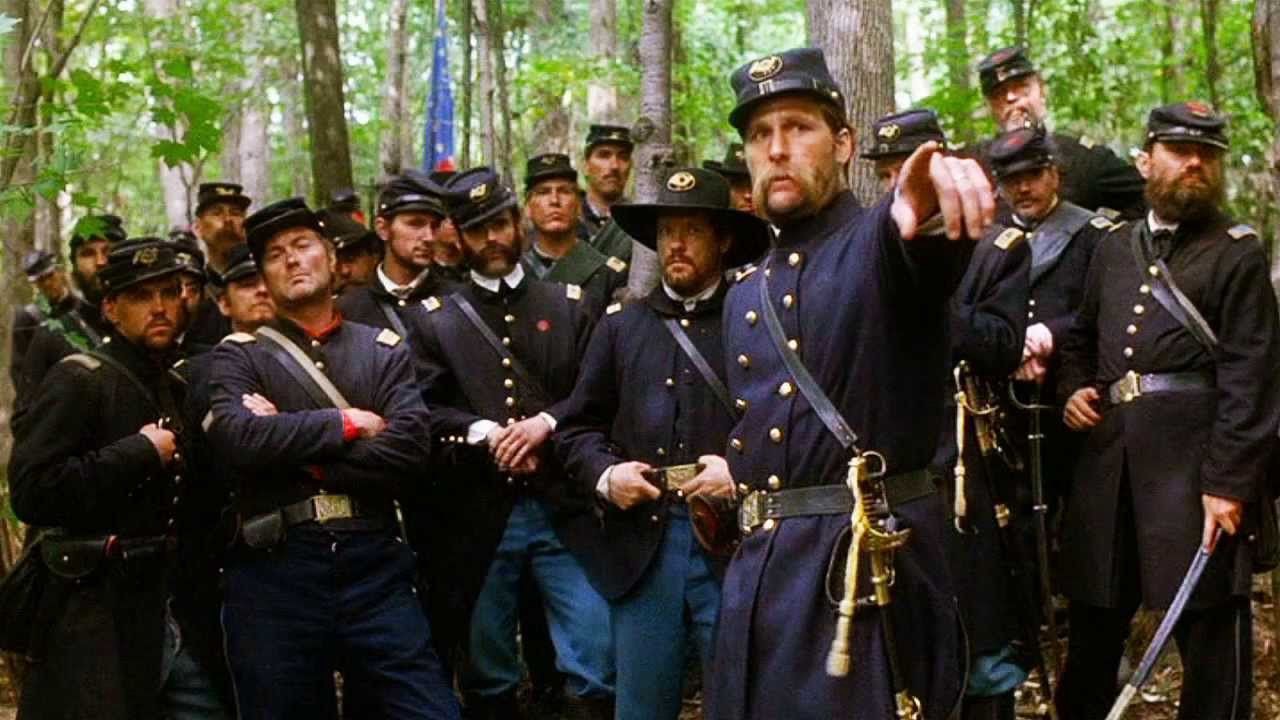
Jeff Daniels—Hollywood actor and veritable Chamberlain doppelgänger
—portraying the Colonel with his 20th Maine at Little Round Top at the
Battle of Gettysburg in the 1993 movie, Gettysburg.

Chamberlain understood.

And at great cost, he and his comrades held the line!  

The soldiers of the 20th Maine exhausted all their ammunition repelling repeated advances from the attacking Confederates, at which point Chamberlain ordered a dangerous and audacious bayonet charge in a last-ditch effort to curtail the Rebel advance.

It worked. 

The 20th Maine and their supporting regiments stopped the Rebel advance.

The day was saved!

     And the legendary "Hero of Little Round Top" was born. (4)  

The undaunted courage of Chamberlain and his men at Little Round Top prevented the Union line from being flanked on that vital second day of fighting. This victory set up a third day of battle in which the Rebels were eventually routed in a famous frontal assault known as "Pickett's Charge," where Robert E. Lee ordered 15,000 Rebel soldiers to storm the Union's main position. The assault failed miserably and served as a mirror-image of the ill-fated Union attacks on Fredericksburg the previous December. Thus, as Pickett's men marched audaciously (but foolishly) into Union cannon, musket, and pistol fire, some of the Yankee soldiers shouted: "Remember Fredericksburg!" Just as the failed Union assaults upon Marye's Heights at Fredericksburg, Pickett's Charge was a colossal failure at Gettysburg. Few Rebels made it to the Union lines before being killed, wounded, taken prisoner, or backed into retreat, making the Union's revenge of Fredericksburg complete and decisive, thereby securing a Union victory in what proved to be a vital turning point in the war.   

Click HERE to watch Chamberlain and the 20th Maine defend Little Round Top on June 2, 1863, as depicted in the movie, Gettysburg.  

Click HERE to watch Chamberlain and the 20th Maine fix bayonets and charge the Rebels after exhausting their ammunition on July 2, 1863, as depicted in the movie, Gettysburg.  

Click HERE to watch Pickett's Charge on July 3, 1863, as depicted in the movie, Gettysburg.  

Major General (2-star)
Joshua Lawrence Chamberlain
Despite the Union victory at Gettysburg, and the retreat of Lee's Army of Northern Virginia back into the South following the bloodiest battle in American History, the Civil War would rage on for two more bloody years. And despite being wounded numerous times—and nearly fatally on a couple of occasions—Chamberlain remained in the thick of the action up until the very end of the war.

Along the way, his indomitable personal courage and patriotic passion for his country did not falter, flag, nor fail. As a leader, he continued to be promoted. By 1865, he had attained the full rank of Brigadier General (one star), a promotion he received from Ulysses S. Grant, commanding General of all Union forces. Soon thereafter, he received the brevet rank of Major General (two stars) from President Abraham Lincoln himself.  

By war's end, Chamberlain had become one of the most famous and venerated officers in the entire Union Army. His star had risen so high, in fact, that he was chosen by General Grant to receive the flag of the surrendering Confederate Army at Appomattox Courthouse on April 12, 1865—three days after Lee and Grant's famous meeting that officially ended the war. The grace and respect that Chamberlain demonstrated towards his defeated enemies that day would earn him further honor and respect from all corners of the newly reunited nation. This honored and revered reputation—thoroughly earned through his noble actions and consistent character demonstrated over long periods of time—would become increasingly burnished throughout his illustrious post-war life and career.

Simply stated, Joshua Lawrence Chamberlain was a sterling example of Self-Action Leadership long before the term SAL had ever been coined.  

After the war, Chamberlain entered politics and was elected to four 1-year terms as Governor of Maine. He later became President of his alma mater, Bowdoin College, where he served throughout the 1870s and early 1880s. After stepping down as college president, he moved to New York to practice law. After that he was appointed Surveyor of the Port of Portland in his home state of Maine.  

An aged Chamberlain in full dress uniform
Despite living a long and active life into his early 80s, Chamberlain never fully recovered from wounds he received during his service in the Civil War. In fact, his death in 1914 was the result of symptoms stemming from one of his lingering war wounds. 

Although he suffered a great deal throughout his later life because of these wounds, they did not slow him down much. He continued to travel and speak and attend reunions with his old comrades (and enemies). He played an active and visible role in the Grand Army of the Republic, a fraternal veteran's organization consisting of soldiers who had fought for the Union in the Civil War. In 1893, the "Hero of Little Round Top" was awarded the Medal of Honor for his courageous actions at the Battle of Gettysburg.

Click HERE to see General Chamberlain's Medal of Honor page online.  

Chamberlain's fame grew to be universal and widespread, including among many of his old enemies in the Confederacy. The Confederate Officer (Colonel William C. Oates, commander of the 15th Alabama Regiment) who opposed him that fateful day in early July, 1863, credited Chamberlain and his regiment with saving the Union Army at Gettysburg. According to Oates, if the Alabamians had had just one more regiment, they could have flanked the Union line, which would have theoretically led to a Confederate victory rather than a Union win in that all-important battle. Oates credited Chamberlain's leadership for making the difference in the outcome of the battle. (5)

When the Spanish American War broke out in 1898, Chamberlain—ever the patriot and forever the soldier—offered his services to his Country once again—at age 70! His offer, however, was turned down due to his advancing years and ongoing health issues from previous combat wounds. Ironically, his old foe, Colonel Oates, seven years his junior and in better physical condition, received a Brigadier General's commission in the U.S. Army from President William McKinley and did serve in that later conflict.  

Dead soldiers litter the field at Gettysburg.
Character and Serendipity aided Chamberlain's escape from joining them.
The Civil War MIRACLE of Joshua Lawrence Chamberlain is that he lived to see the end of the Civil War. 

Between 1862 and 1865, Chamberlain fought in 20 battles and many additional skirmishes. He had six (6) horses shot out from under him, and was wounded on six (6) different occasions, two of which nearly took his life. Despite these repeated "close calls" with death, Chamberlain managed to survive the war and live for another half century. 

When you study the life and career of this unusual and singular man, it is hard not to believe in the reality of serendipity that seemingly surrounded him throughout his service in the Civil War and beyond. Some, including myself, would even chalk his miraculous survival up to direct intervention of divine Providence (the Hand of God).

Perhaps the most significant episode of this ongoing series of serendipitous events occurred at Little Round Top at the Battle of Gettysburg during the second day of that famous battle. Chamberlain himself would not learn how close he came to dying that day until years after the war when he received a letter from a soldier who had fought in the 15th Alabama—the Rebel regiment that had opposed his 20th Maine that hot, humid, and bloody afternoon of July 2nd.

After receiving and opening up the letter, Chamberlain read its contents, as follows:  

Dear Sir:

I want to tell you of a little passage in the battle of Round Top, Gettysburg, concerning you and me, which I am now glad of.  Twice in that fight I had your life in my hands.  I got a safe place between two rocks, and drew bead fair and square on you.  You were standing in the open behind the center of your line, full exposed.  I knew your rank by your uniform and your actions, and I thought it a mighty good thing to put you out of the way.  I rested my gun on the rock and took steady aim.  I started to pull the trigger but some queer notion stopped me. Then I got ashamed of my weakness and went though the same motions again.  I had you, perfectly certain.  But that same queer something shut right down on me.  I couldn't pull the trigger, and, gave it up—that is, your life.  I am glad of it now, and hope you are.

Yours Truly,  

—A member of the Fifteenth Alabama (6)

...............

Call it what you want: Divine intervention, Providence, the grace & mercy of the Hand of God, serendipity, coincidence, caprice, luck, good fortune... whatever; but there it no doubt these kind of occurrences are real—and happen to all of us at various junctures over the course of our lives. 

And for what purpose? 

SAL's aim—today, tomorrow, and forever
is focused on your personal & professional GROWTH
The answer always relates to our long-term advantage, and by "advantage" I mean our long term happiness and GROWTH. I employ the phrase "long-term" because sometimes serendipity doesn't appear or seem to be very advantageous in the present moment. In fact, sometimes serendipity can be downright ruthless and painful in the moment; which is why Garth Brooks so ironically croons: "Some of God's greatest gifts are unanswered prayers!"

Thus, in the end, self-action leaders are usually able to identify serendipitous events in their lives and careers because of the catalytic impact they ultimately have on producing positive, productive, and growth-inducing end results. 

And that is why we at Freedom Focused are so passionate about and grateful for SERENDIPITY, whatever its actual ontology may be—and self-action leaders are always free to decide for themselves the answers to that question.

Nevertheless, the fact remains: self-action leaders need more than just self-action leadership to be happy, successful, and experience inner peace in their lives. We also need the mysterious magic of Serendipity.

After reading this post, are you better understanding why I have always taken such a keen interest in history?

Second only to reading and writing, Freedom Focused holds that studying the past ranks among the most important secular subjects we can study as human beings. There are few better ways to successfully prepare for the future than to carefully study the past. As such, Freedom Focused advocates the teaching of history in schools and beyond, and calls for effective and engaging instructional methods that are consistently objective, balanced, fair, and non-partisan.  

Few things will better inform your present and future
than a careful study of your (and the) PAST.
After reading today's posts, it will not surprise you that one of my favorite periods of American history is the Civil War era. In fact, my interest in Civil War history led, in part, to my deep fascination with the American South—a curiosity that eventually influenced a cross-country move from Utah to Georgia, where I would seek my fortunes and meet my future wife.

Click HERE to read more about Dr. JJ's love of the South.

I hope that reading this article will inspire you to learn more about history, both your own personal (and family) history, and history in a more general sense, for knowledge of the past is a great gift that we are always free to open up and learn more about, if only we will.  

Will You?  


-Dr. JJ

December 7, 2022
Palm Beach Gardens, Florida, USA

Author's Note: This is the 295th Blog Post Published by Freedom Focused LLC since November 2013 and the 124th consecutive weekly blog published since August 31, 2020.   

Click HERE for a compete listing of the other 292 FF Blog Articles.  


.........................

Tune in NEXT Wednesday for another article on a Self-Action Leadership related topic.  

And if you liked this blog post, please share it with your family, friends, colleagues, and students—and encourage them to sign up to receive future articles for FREE every Wednesday.

To sign up, please email freedomfocused@gmail.com and say SUBSCRIBE, or just YES, and we will ensure you receive a link to each new blog article every Wednesday.  

Click HERE to learn more about Freedom Focused

Click HERE to learn more about Dr. Jordan Jensen

Click HERE to buy the SAL Textbooks

Notes:

1. Chamberlain, J.L. (1994). "Bayonet! Forward": My Civil War Reminiscences. Stan Clark, Jr. (Ed.). Gettysburg, PA: Stan Clark Military Books. See Chapter 1: My Story of Fredericksburg, Page 9.   

2. Ibid. Page after the title page. 

3. Ibid. Page 29.  

4. Ibid. Page 268.


6. Chamberlain, J.L. (1994)... . page 31.   

Thursday, August 18, 2016

A Portrait of a Fully Flourished Age of Authenticism

When the Age of Authenticism has fully flourished—sometime in between the years 2035 and 2045, what will America and the world look like?

The purpose of this article is to answer this question with specifics.

First of all, it should be noted that an Age of Authenticism in this world will not translate into human perfection or a global utopia.  In the margins, vestiges of pre-structuralism and postmodernism will always persist to perpetuate predictable problems.  Just as corruption, greed, and inequality created and tarnished the gilded age following the Civil War and profound racial prejudice persisted during the prosperous years following World War II, the authentic era following Strauss and Howe's "Crisis of 2020" will not be without its problems. [1]

Click HERE, HERE or HERE to learn more about the "Crisis of 2020"

At Freedom Focused, we foresee a day when the status quo of the collective populace is markedly different—meaning greatly improved—from where we presently stand.  This shift will not begin in society at large; it will begin in the minds, hearts, and spirits of individuals who choose to become self-action leaders by patterning their thoughts, speech, and actions after the ideals of Self-Action Leadership.

The result of this authentic flourishing will bring about monumentally positive and creative impacts on the culture-at-large in the Western World and beyond.

Education will drive the Age of Authenticism
Driven by the principle of Existential Growth (holistic personal and professional character and skill development) championed in the Self-Action Leadership Theory and Model, the Age of Authenticism will forge a dramatic shift in American culture in coming decades.  Spurred by the "Crisis of 2020" and illuminated by hope spawned by an education in Self-Action Leadership and a desire to prevent a World War 4 from ever occurring, the cultural malaise of the postmodern period—marked by narcissism, hedonism, nihilism and secular godlessness—will give way to a new era highlighted by selflessness, sacrifice, existential meaning, and religious faith.

An Authentic Age
will produce a Rich Age
Such a dramatic shift will be bad news for academic, political, commercial, artistic, and other cultural icons and their minions who grew rich and powerful during the materialistic postmodern period.  This shift will be good news for authentic educators and citizens who recognize and affirm the existence of absolute Truths with a capital "T."

Driven by a shifts in education, the world will begin to rebound both culturally and economically.  While poverty will never be diminished entirely, it will begin to give way to a large degree to a worldwide expansion of the middle class.  In addition, the upper classes will grow larger and more diverse than ever before in human history.  Income inequality will still exist, but it will simultaneously become less salient—and ironically, less demonized.

Old age will be venerated in the
Age of Authenticism
The narcissistic worship of youth in the West will give way to an Eastern-esque veneration of the elder class.  The cultural respect and attention gap that presently exists between grown adults (and even senior citizens) who are educated, successful, and good—and snobbish, narcissistic teenagers and yuppies who are talented singers, dancers, artists, business persons, pundits, or athletes—will begin to narrow.  While the number of YouTube "clicks" any ignoramus can generate will always exert some cultural sway, purveyors of flotsam and jetsam (virtual or otherwise) will become increasingly marginalized.


Education will be driven by the newly sacrosanct (even if secular) notion that truth with a capital "T" is a real phenomenon to be carefully accessed and abided by if you desire positive and constructive consequences in the long run.  Academicians who peddled the rubbish of relativity with regards to truth—who were widely venerated during the postmodern period—will appear as self-absorbed buffoons in kinder corners of the Age of Authenticism, and as devilish pariahs to be forever castigated among the authentic balance of society.

America's Greatness lies in
her adherence toTrue Principles of
Liberty, Freedom, Morality
& Self-Government
With a focus on Truth, teachers and students alike will seek not so much to earn (or learn) something from their studies, but rather to become something better than they were before in an effort to become worthy citizens who are a genuine asset to whatever collective populace they represent.  As a result, multitudes of individuals will enter the work force with a collective character and integrity unseen since the World War II generation went to work in the late 1940s.  The result will be an economic and cultural boom that in many ways parallels, but that ultimately exceeds, that which took place in 1950s and 1990s America.
 
Business will thrive as never before because executives will be less corrupt and more philanthropic.  Moreover, these same officers will hire and train a workforce and leadership team that is impressive not only in intellect, but in integrity.

Government & Politics will, for a period of time, be greatly transformed.  The questions of competence and/or character that plagued the Bill Clinton, George W. Bush, and Barack Obama administrations will be replaced by the leadership and results of the Roosevelt (Theodore & Franklin), Kennedy, and Reagan years.  Congress will manage to restore its approval rating to an unimagined 50% or better.  The Supreme Court will legislate less and judge more.  

Law Enforcement will be more respected than it has in a cycle of generations.  At the same time, peace officers will have more respect for those they serve than ever in the history of the nation.  Many inner city areas will be transformed into prosperous, bustling urban neighborhoods.  Suburban areas will become increasingly diverse, not because government has legislated that it must be so, but because more minorities will have risen in life by virtue of improved public education which will further magnify their impressive talents, and abilities in proportion to the efforts they invest.  More suburbanites and rural dwellers will be open minded to living side-by-side a wider range of races and ethnicities.  

Personal finance will be transformed.  Individual debt will be minimized to an extent that many in the previous generation believed possible.  Most people will free themselves from debt and many will have a growing savings.  Frugality and balance will replace fiscal profligacy and excess at individual, familial, community, corporate, state, and national levels.

Transportation will achieve a quality never before seen in world history.  Airlines will be more efficient and more comfortable while maintaining middle class affordability.  Bullet trains and futuristic hyperloops will effectively compete with air transporters.  Ground transportation will be safer and more affordable than ever.  Less and less oil will be needed to power all of the above.

Religion will proliferate as it has rarely done in American History.  Many different dominations will benefit from an influx of church goers, and most will unite in a sincere embrace of faith-based collectivity aimed at the greater good of the nation and world—aside from any specific doctrinal differences.  

Environmental Issues will be front and center and progressive, but less extreme and divisive as they were in the latter-half of the postmodern period.  I do not presume to predict what will occur with global warming trends, although I feel confident that developed nations will continue to make environmental progress while successfully applying pressure by degrees to developing nations who still have a long ways to go.


The traditional family as
the root of society in the Age of Authenticism
The family, having grown more diverse than ever before in human history, will maintain its diversity and rights in both the mainstream and the fringes.  Different families will respect each other and practice greater tolerance even as the notion of the traditional family—consisting of a mother and father (who are legally wed and conjugally faithful) and their children—receives greater approbation than it ever did in the second half of the postmodern period.  This will come as a result of a collective return to faith as well as an overwhelming body of social science research that corroborates the nomologically self-evident and scientifically indisputable individual and societal benefits arising from nuclear families thusly arranged.

America is destined to
continue world leader
In short, during the Age of Authenticism (2025-2045) the United States and world will, in many regards, be better, safer, and more pleasant and prosperous places to live than they ever have been in the history of the world.  Having successfully met and overcome the dire challenges posed by the "Crisis of 2020," the United States will retain its position as the lone world superpower.  Having built its military into the largest and most powerful fighting force the world has ever seen (even to surpass the U.S. force extant in 1945) and been victorious in the mighty struggle, the postwar "Powers-that-be" will once again embrace the paradigm of Hadrian, Washington, Kennedy, and Reagan, which affirms that, "only when our arms are sufficient beyond doubt can we be certain beyond doubt that they will never be employed."  [2]


As goes America, so goes the world
Despite the rise of China, India, Brazil, and other nations, the 21st Century will turn out to be a new American Century led by a United States that embraces the economic, political, social, and cultural rise of all other nations.  The United States will never seek to dominate by force or coercion; but she will always embrace her calling to lead by the veracity of her collective principles and the moral force of her kind and compassionate leadership.  As such, every other nation willing to embrace constitutional principles of free government, the rule of law, and the liberty of the individual, will likewise rise and eventually prosper.

It will be, in short, an age for the ages — the greatest age the world has ever seen.

Unfortunately, the Age of Authenticism will not last forever.  As the cycles of history continue their march into the future, dire times will circle round once again in decades beyond the 2040s.  I do not presume to predict past the point of progress and authenticity described in this article beyond my personal conviction that at some unknown point in the future, He who created this world in the first place, and He whom I believe has atoned it from an otherwise inevitable ruin, will, with the scepter of righteousness and the crown of eternal glory and godhood, eventually return again in an unprecedented display of both majesty and ubiquity—to take His rightful place on the Earth as King of Kings and Lord of Lords.  I do not presume to know a period or date when such a glorious event will occur, nor do I believe any man save God Himself has any specific knowledge of such things.  Nevertheless, I am a man firmly rooted in the faith and cause of the Christians (generally speaking).  As such, I firmly believe that it will occur.  As for what will occur from this point in time on until the end of the world, I can only point you to the prophecies of the Holy Prophets in the Old and New Testaments and other Sacred Writ.

Whether you are a believer or not, and whether you are a Christian or not, I invite men and women everywhere to invest the study, effort, and time required to become the principle-centered self-action leaders who will both lead and prosper during this period of authenticity.  You can begin by buying my new book — a secular TEXTBOOK  FOR  LIVING —which I wrote in an effort to unite all liberty loving, freedom seeking, and law abiding citizens who are determined to do their part to make the world a better place by virtue of their presence therein.


God Bless the United States of America—a blessed land of promise—now, and always.

Click HERE to buy a copy of Dr. Jordan Jensen's new book, Self-Action Leadership: The Key to Personal, Professional, & Global Freedom.


SELF-ACTION LEADERSHIP is the key catalyst for initiating transformational leadership that lasts in any organization. The truth of the matter really is that simple; and the transformation of organizations through the holistic development of individuals really is that difficult—yet altogether possible for anyone willing to invest the time, effort, and sacrifice required to achieve authentic, transformational results.

Unlike any training program that has ever preceded it, Self-Action Leadership provides a single vehicle wherewith individual self-leaders can discover—and then act—upon the great truth that HOLISTIC personal development and growth spanning the mental, moral, spiritual, physical, emotional, and social elements of our individual natures is within the grasp of each one of us.

Note: Freedom Focused is a non-partisan, for-profit, educational corporation. As such, we do not endorse or embrace political figures. We do, however, comment from time-to-time on historical or political events that provide pedagogical backdrops to illuminating principles contained in the SAL Theory & Model.


Click HERE to learn more about the SAL Theory & Model.


To receive weekly articles from Freedom Focused & Dr. Jordan R. Jensen, sign up with your e-mail address in the white box on the right side of this page where it says "Follow by E-mail."


Click HERE to read more about Dr. Jensen's book, Self-Action Leadership, and to review what experts in the leadership field are saying about this groundbreaking new personal development handbook.


Click HERE to learn more about Dr. Jordan R. Jensen.

Click HERE to visit the Freedom Focused website.


Notes:

1.  Strauss, W. & Howe, N. (1991). Generations: The History of America's Future, 1584-2069.   Quill: New York, NY. Page 382. (p. 382).
2. John F. Kennedy.  1960 inaugural address.  

JJ's Journal: 1983

        From the Personal Journals of My Father Rex Buckley Jensen  1983 Thursday, January 20, 1983 Annual School Picture Monticello, Utah S...