Showing posts with label Dale Carnegie. Show all posts

Wednesday, January 15, 2025

Seeds of Self-Help


 Chapter 2


Seeds of Self-Help 


This chapter tells the story of my introductions to and experiences with the self-help and personal development fields. It chronicles a journey that began when I was just a boy and would eventually lead to the development of the SAL Theory and Model and the creation of this Life Leadership textbook.  

I was 14 years old when Warner Books published my Uncle Hyrum's book, The 10 Natural Laws of Successful Time and Life Management, which would eventually sell over a million copies and complement the massive success Hyrum was already enjoying with the Franklin Day Planning system.

During the summer of that same year (1994), I worked as a lowly field hand on Hyrum and Gail's sprawling ranch in Gunlock, Utah, and environs. 

A ranch hand's work is physically strenuous and low-paying. I earned $4.25 per hour for my labors that summer, which was the minimum wage in 1994. Summer days in southwestern Utah were hot, dry, dusty, and long. Temperatures often exceeding 100-degrees Fahrenheit (38 degrees Celsius) and rain was rare. Our daily commute usually included a ride in the back of a white Ford pickup truck. 

One week, we were assigned to build a fence up in the mountains, many miles away from the bunkhouse where we ate and slept. Facing a long, bumpy ride to work each day that week, I decided to take along a book to read. I had brought several books from home to read and study that summer. The book I chose on this particular occasion was: The Magic of Thinking Big, by David J. Schwartz.

Once I started reading, it was hard to stop, and not just because I enjoyed reading more than digging post holes in the rocky desert soil; but because the seeds of hope, possibility, and vision that the book planted in my mind and heart. I enjoyed that book so much that I would sometimes read at lunchtime and after work was over. I kept reading until I had read, marked, and annotated the entire volume. 

As I read, studied, and pondered Schwartz's hopeful and positive message, his words sunk deep into my soul, spawning rich daydreams about my personal and professional potential. I grew increasingly motivated by the realization that I didn't have to be a ranch hand for the rest of my life. I was further inspired by the idea that I could actually design my life largely according to my own desires if I was willing to pay the price. 

When I read the words: when you believe, your mind finds ways to do, (1) I was inspired by the personal power and capacity I possessed to accomplish difficult and meaningful achievements in my life and career despite any obstacles that might stand in the way. 

This was the point in my life when a nascent conceptualization of the SAL philosophy gradually began to form in my mind and heart. 

Over the next several years—throughout my teenage and young adult life—I increasingly took advantage of opportunities to read and study books and listen to audio tapes and CDs in the self-help and personal development fields.

Hyrum W. Smith
1943-2019
The books and/or authors from whom I supped included:

  • Dale Carnegie
  • Norman Vincent Peale
  • Napoleon Hill
  • Og Mandino
  • M. Scott Peck, M.D. 
  • Hyrum W. Smith
  • Stephen R. Covey
  • Anthony Robbins
  • Brian Tracy
  • Zig Ziglar
  • Et al. 


I'll always cherish my dad's personal copy of Dale Carnegie's How to Win Friends and Influence People. He had purchased the book in England in the mid-1960s while serving as a young missionary and it had that wonderful "old book" smell. 

When I was in eighth grade, my mom started buying Gary Smalley's relationship videos. Smalley's trainings focused on family relationships, and more particularly on marital unions. Though it would be years before I would start looking seriously at exclusive dating or marriage myself, I enjoyed watching these programs with my mom and learned a great deal about personality differences, communication skills, and successfully cultivating healthy and successful relationships.  

When I was a junior in high school, my oldest brother, Paul—a successful salesman and manager who shared my passion for personal development and self-help—sent me a videotape training by Jim Rohn, a famous business philosopher of the late twentieth and early twenty-first century.

Rohn had some GREAT stuff! 

A half-decade later, as a direct salesman myself, I was reintroduced to Rohn's work. While I ultimately found little aptitude for or interest in sales and marketing, Rohn's timeless talk on CD, entitled: Building Your Network Marketing Company, was filled with general truisms about long-term success that enormously influenced my thought processes as I set out to build Freedom Focused, develop the SAL Theory and Model, and compose iterations of this Life Leadership textbook.

To this day, I hear Rohn's voice in my head more than most others because of how concise, incisive, and memorable of his personality and teaching style.    

In high school, I attended a couple of Peter Lowe-organized day-long success seminars, where I had the chance to hear an impressive collection of high-profile speakers address personal development topics related to self-improvement, health and wellness, and success.

These speakers included:

  • President Gerald Ford
  • General Colin Powell
  • Zig Ziglar
  • Karl Malone
  • Et al. 
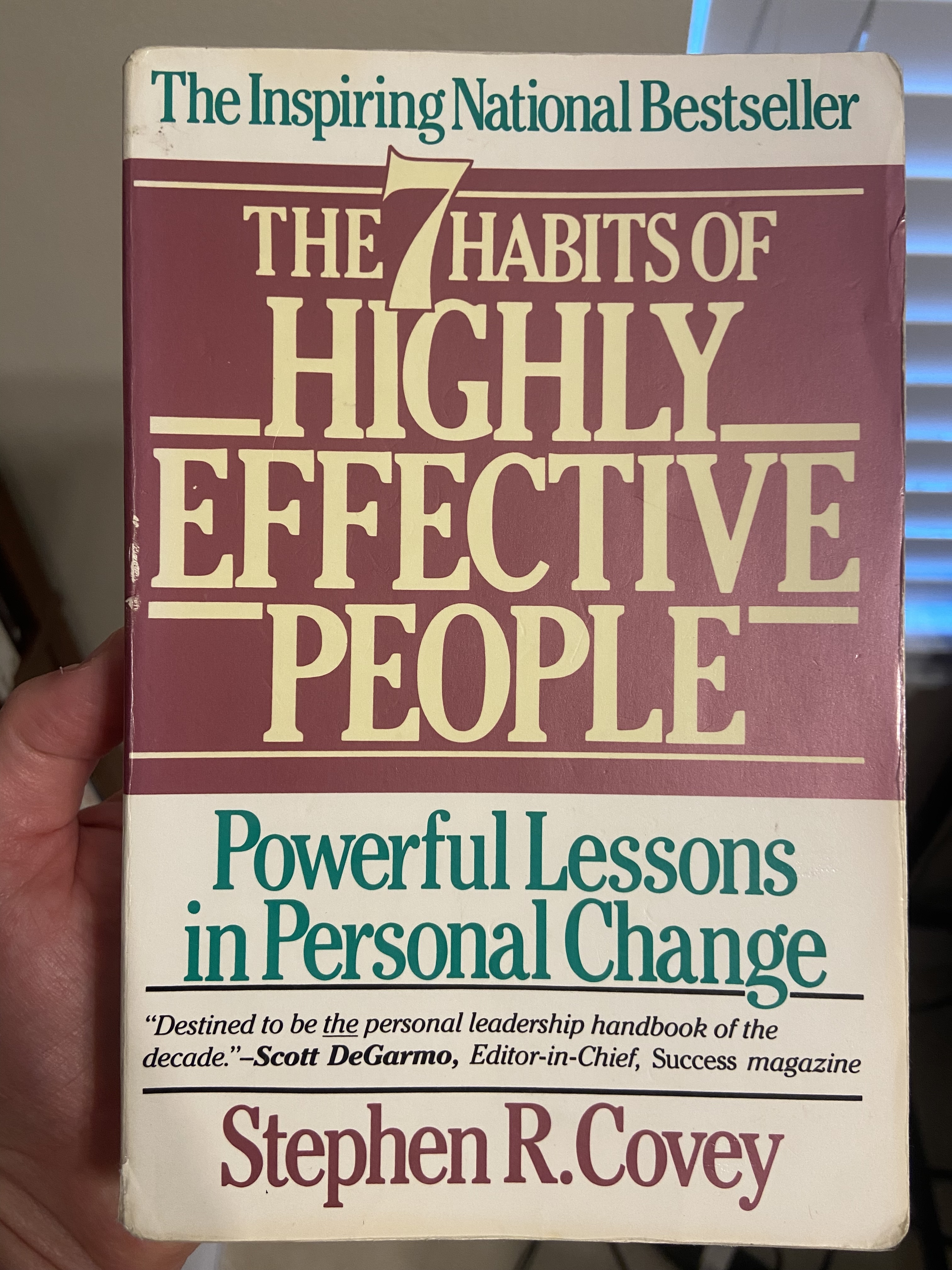
My personal copy of The 7 Habits
Annexed from my parent's home library
Shortly after graduating from high school, I read my Uncle Hyrum's book, The 10 Natural Laws of Successful Time and Life Management, wherein I made a commitment to be more conscious about planning my days moving forward. 

Later on, in college, I took a course in leadership from Brigham Young University (BYU) as a visiting student and a course in organizational behavior from Utah Valley University (UVU). 

These classes reintroduced me to Carnegie's How to Win Friends and Influence People and led me to carefully study Stephen R. Covey's bestselling book, The 7 Habits of Highly Effective People. I voraciously consumed Covey's classic work, which planted a potent and plentiful patch of additional SAL seeds in in my mind, heart, and soul. 

More than any other personal leadership-oriented or self-help book I had ever read, the 7 Habits left a deep and lasting impression on me. After reading the book, I obtained the same material on CD—taught by Covey himself—and listened intently to the entire program. The more familiar I became with the material, the more convinced I became that I didn't want to just practice what Stephen Covey had taught me; I wanted to become the Stephen R. Covey of my generation. 

My personal copy of Og Mandino's
The Greatest Secret in the World
In addition to carefully studying Covey's work during my college years, I also read books by Og Mandino. In particular, I carefully studied and completed Mandino's 45-week challenge outlined in his book: The Greatest Secret in the World, which invites a reader to not just read the Success Scrolls from his classic: The Greatest Salesman in the World, but challenges him or her to apply those scrolls in a concrete, dedicated, and systematic manner over the course of nearly a full year. 

This particular self-help exercise was, by far, the most ambitious and labor/time intensive personal development project I had ever undertaken—before or since. Og himself stated in his book that the probability of someone actually completing his ambitious challenge was about one-in-75. (2) I was absolutely determined to prove to myself—and others, including Og, even though he died nearly a decade before I undertook his challenge—that I would be one of the 1.3 percent of people who would actually finish the entire program. 

Forty-five (45) weeks after I started, I succeeded in this, my objective—an accomplishment that provides me with a residual source of personal confidence, esteem, and inner security to this day. 

William James
1842-1910
Suffice it to say, over an extended process of association, the nascent seeds of SAL were planted deeply in my mind, heart, and soul. Over time, as I continued to cultivate, fertilize, water, and otherwise nurture those seeds, they began to grow up in the form of the SAL Philosophy.  


"Sow a thought, reap an action; sow an action, reap a habit;
sow a habit, reap a character; sow a character, reap a destiny."

—William James


Thus, over a long period of time, I gradually developed and refined my own thoughts and ideas about personal leadership—notions that would, in-time, develop and evolve into the SAL Theory and Model. I recorded many of these thoughts in little black-and-white, pocket-sized "Marble Memo" notebooks.

During my early-to-mid-twenties, I filled over 20 of these books with ideas and inspiration—as it came, piecemeal, one entry at a time. My mind was exploding with ideas during this time and it was not uncommon for me to have an idea strike my brain at all times of the day, including when going to sleep at night or driving my car. At such times I was conscientious about getting out of bed, turning on the light, pulling out the little Marble Memo notebook I was filling at the time, and recording the thought—or, if I was driving, I would pull my car over to the side of the road and record the inspiration in my little notebook before proceeding on my journey.

Over a long period of time—20-plus years and counting now—I gradually developed, refined, and revised all my thoughts and ideas that would become the SAL Philosophy.

At age 25, I began constructing the SAL Theory and Model. At age 26, I self-published my first book: I Am Sovereign: The Power of Personal Leadership. It was a personal leadership guide for teenagers and contained the first version of the SAL Model, as well as early vestiges of the SAL Theory.

It was my first attempt at writing a book and contained many markings of an amateur. 

But it was a solid initial effort that would eventually go through SIX additional iterations over the course of the following two decades.

The third of these seven iterations came in the form of my doctoral research, where I further honed the SAL Model and introduced a full version of the SAL Theory for the first time. The Life Leadership textbook you now hold in your hands is four (4) iterations removed from my dissertation, published in 2013. It is the result of 40 years of informal research, 24 years of formal research, organizing, writing, editing, revising, and continually polishing. 

It is a project literally tens of thousands of hours in the making.

It is my magnum opus as a thinker, writer, organizer, and leader. 

Indeed, I do not foresee, nor do I intend, to write or create anything more important or significant in my lifetime than this single, comprehensive work. Suffice it to say, it has been an incredible adventure and an exhilarating journey—a journey that is, in many ways, still just beginning.  


In Your Journal

  • Prior to being introduced to SAL, what self-help media (books, tapes, podcasts, etc.) positively influenced your life, actions, and Existential Growth? 

  • Which of these tools did you enjoy the most?  

  • Which of these tools did you find to be the most inspiring and/or helpful?

  • Which of these tools would you most highly recommend to others?

  • Which of these tools most closely resembles the message contained in the SAL Philosophy? 


—Dr. JJ

Wednesday, January 15, 2025
Palm Beach Gardens, Florida, USA


Author's Note: This is the 427th Blog Post Published by Freedom Focused LLC since November 2013 and the 235th consecutive weekly blog published since August 31, 2020.   

Click HERE for a compete listing of the other 426 FF Blog Articles 

Click HERE for a complete listing of Freedom Focused SAL QUOTES  

Click HERE for a complete listing of Freedom Focused SAL POEMS   

Click HERE to access the FULL TEXT of Dr. JJ's Psalms of Life: A Poetry Collection

Click HERE for a complete listing of Self-Action Leadership Articles

Click HERE for a complete listing of Fitness, Heath, & Wellness Articles

Click HERE for a complete listing of Biographical & Historical Articles


Click HERE for a complete listing of Dr. JJ's Autobiographical Articles

.........................

Tune in NEXT Wednesday for another article on a Self-Action Leadership related topic.  

If you liked this blog post, please share it with your family, friends, colleagues, and students—and encourage them to bookmark this blog to access a new FREE article every Wednesday.


Click HERE to buy the SAL Textbooks  


Chapter 2 Notes

1.  Schwartz, D. J. (1995). The Magic of Thinking Big. London, UK: Pocket Books. Page 122.

2.  Mandino, O. (1972). The Greatest Secret in the World. New York, NY: Bantam Books. Page 2.

Wednesday, August 11, 2021

Fighting and Surrendering vs. YIELDING

Nearly everywhere you look in our
contemporary world, people are FIGHTING
Our contemporary world is filled with fighting—both verbally and physically.

It is really SAD!

Sadder still, the existence of Social Media has made things much worse in recent years and decades, thus leading us into an awful cycle of collective vitriol and violence that seems to get worse with each passing day.

Fighting feeds on itself, thereby engendering more and more fighting while weakening all parties engaged in its self-destructive patterns. It is an endless negative cycle that will not—nay, cannot—be broken by merely more fighting. Yet, ironically, it is the "more fighting" route that seemingly everyone chooses to take amidst an ever-enlarging morass made up of myriad conflicts around the globe.

If we are ever going to make significant headway into solving the significant challenges of our time, we need less fighting and more focused, strategic, and wise yielding.


What exactly do I mean by "YIELDING?"

GOOD QUESTION!

First of all, I must emphasize what I do not mean when I employ the term "YIELD." In encouraging my readers to yield, I DO NOT mean to imply surrender. 

There are always those who, wishing to eschew fighting, simply give up—or give in—in the face of pressure, stress, or worse—deceit, intentional unfairness, or tyranny. Surrender is the opposite extreme of fighting, and in the long-run, can be just as dangerous and foolhardy as fighting.

With this said, it is important to note that there are usually exceptions to every rule in the realms of moral behavior. As such, there are times when it is both good and right to fight. For example: it made both moral and practical sense for the Allies to wage war against the evil and tyrannical aims of Adolf Hitler and his axis comrades in World War 2.

There are also times when it is both good and right to surrender. For example, if someone has a gun pointed to your head and demands your wallet, it is almost certainly wiser to give him or her your wallet than to risk an avoidable catastrophe.  

Aristotle's Golden Mean Inspires us to seek
Balance in our Lives and Careers
Nevertheless, most of the time, fighting and surrendering represent extremes that can and should be avoided. In the face of these two extremes (fighting and surrendering), YIELDING is meant to serve as a productive, balanced alternative—emblematic of Aristotle's "Golden Mean." 

Click HERE to learn more about Aristotle's GOLDEN MEAN.

One of the most interesting quotes I ever came across was spoken by the esteemed author, Dale Carnegie, who famously wrote the best-selling book, How to Win Friends and Influence People.   

Said Carnegie:

"When you fight, you can never get enough; but when you yield, you get more than expected."

— Dale Carnegie

I think that is one of the wisest things that has ever been spoken.  

Do you ever find yourself arguing or fighting (virtually or in-person) about politics, religion, culture, science, history, or some other controversial topic? If so, have you ever gotten enough? Or do you believe that you will, at some point in the future, get enough... you know, after you have fought over it long enough? And in the midst of these back-and-forths, how many times has your adversary exclaimed in humble and sincere gratitude: "Oh, thank you for showing me where I was wrong; I completely agree with you now; now we can be best friends forever!"

Self-Action Leaders are good at laughing...
Especially at themselves!
If you are laughing right now, that is a good thing.  

I'm chuckling myself because I've done my share of verbal bickering with friends, associates, and others over the years.

And you know where it has gotten me?

          Usually nowhere.

Consequently, I've learned—bit-by-bit by degrees over long periods of time—that yielding is usually much more satisfying, endearing, and productive than fighting or surrendering could ever hope to be.

In other words—or, more accurately, in Dale Carnegie's words—When you fight, you can never get enough; but when you yield, you get more than expected."  

Why is this?

     How can yielding yield better results than fighting or surrendering?

Another GOOD QUESTION!

The rest of this article aims to answer this question.      

There are times in life when it is important to be right.
But most of the time, it is better to be easy to live/work with.
I once heard a wise man give a speech. In his remarks, he said something that has since been burned into my soul. His advice: "There are times in life when it is important to be right. But most of the time, it is better to be easy to live with."

"There are times in life when it is important to be right. But most of the time, it is better to be easy to live with."

— Christoffel Golden 

If you are laughing again, then that is, once again, a good thing!

Obviously there are isolated occasions when "being right" really is a matter of life or death—or some other point of unusual importance. But I've discovered that about 99.9% of the time, that is not the case. Consequently, we human beings have the tendency to get unduly worked up about all sorts of issues that are either not as important as we think they are, or are matters over which we have virtually zero influence or control. Yet, despite these factual realities, we will continue to fight with others over said issues as if our lives really did depend on it—and usually to the detriment of a myriad of relationships. We humans are funny that way—and in so many other ways! In the words of the famed comedian, Brian Regan, "Human Beings, man!"

"Human beings, man!"

— Brian Regan 

What is your natural proclivity?
Surrender, Fight, or YIELD?
Whether in a marriage or fraternal relationship, a friendship, or a professional working arrangement, you really are more likely to win friends and influence people by being easy to work with than you are by being persistently belligerent or bellicose over issues of relative unimportance. This includes that overladen minefield of matters over which, however inherently important, you and those with whom you are bickering have little (if any) authority to directly impact.

This has been a hard—but oh, so, important—lesson for me to learn (and I am still learning it!).

Why has it been so hard for me to learn?

I suppose the difficulty for me comes from my natural outspokenness. In addition, I really do CARE—a lot... about a lot of different issues. Consequently, I tend to have strong feelings and opinions about a myriad of matters.

It is good to feel strongly about people and things, but passion can quickly go awry if we are not cautious and disciplined in our thoughts, speech, and actions. I know this is true because my own unbridled passion has gotten me entangled in a variety of avoidable predicaments and problems over the years.

Fortunately, I've come a long ways—long enough to be able to write this article with what I hope will be an air of authenticity, experience, credibility, and value to others who may similarly struggle—which I suppose is all of us to one extent or another.   

Many human beings fall into the categories of extremes when it comes to this issue. In other words, many are prone to fight or surrender in situations where they are challenged by others. The fighters are usually high-spirited and unhappy people. And the "white-flag" surrender-prone are usually listless personalities who struggle with low self-esteem. It is the relatively rare (probably 20% or less) who either dispositionally intuit—or, more commonly, discover through diligent education and experience—the magical balance of YIELDING.

So how exactly does one YIELD when confronted? And how does it differ from fighting and surrendering? 

Or refrain from the argument entirely!
Yielding involves much more effort than surrendering and higher levels of maturity, communication skills, and logic than fighting. To yield to someone does not mean you give up—or give-in—to it or them. Nor does it involve acquiescing to or accepting another's viewpoints.

When you yield to someone, you give them complete freedom to speak their mind with impunity. You actively listen, which involves restating points and probing further with follow-up questions as necessary (or as desired).

Next, you resist the urge to become angry—no matter how angry you might feel inside. That skill is what Emotional Intelligence (EQ) is all about, and as most wise persons will tell you, EQ is usually even more important and valuable in the real world than IQ.

With your emotions in check, you then state your own frame of reference with confidence and, insofar as possible, supporting data. Lastly, you do not try to change the other person; you simply grant them complete freedom to make up their own mind based on the conversation. Sometimes you might influence a positive change in others. Many (and perhaps most) times, you will not. But either way, it is okay because you cannot change other people—nor would a self-action leader ever want to try. You can only influence other people to CHANGE themselves.

There is a great deal of power inherent in our ability and opportunity to influence outcomes. As such, authentic self-action leaders should seek continually to positively influence others by virtue of wise, balanced, and mature YIELDING strategies; but control is simply out of the question. Even if you could control another person (as in the case of brute force [e.g. a loaded gun]), anyone with any sense knows that that approach only brings about short-term results; it never changes hearts or minds in the long-run—not to mention the utter immorality involved in denying another person's one's freedom to choose (agency).   

SAL is about Invitation and Influence,
not coercion and control
It is true that self-action leaders are interested in changing minds and hearts in the direction of the SAL Philosophy of living. But we have zero interest in coercion. Kind communication and persuasive pedagogy?

YES!

But never should anyone for any reason seek to force the human mind against its independent and completely volitional will.

While the word "YIELDING" may initially connote weakness or submission, it is, in fact, neither. It is merely a kind, considerate, and ultimately courageous form of communication that builds bridges to other people, rather than wreaking a wide swath of relational divisiveness and destruction along your ongoing path through life.

So what exactly does Yielding look like in a real conversation?

To answer that question, consider the following scenario:

Imagine someone states or asserts "X" and you disagree, preferring the "Y" or "Z" option in the matter. Yielding would involve affirming their own belief and then respectfully stating that you see it differently, how/why you see it differently, and providing relevant information to back up your position. Then, if the other person tries to escalate the conversation into "fight mode" you might respectfully state that you "aren't going there"—and perhaps adding that you respect their right to view it as they choose, and that you reserve that same right for yourself. In some situations, you might choose to continue the debate with a determination to maintain your cool. However, if the other person persists in further escalation towards fight mode, then JUST... WALK... AWAY. 

Fighting = Greater DIVISION
Yielding = Greater UNITY
In other instances, another alternative is to either not say anything at all—with accurate foreknowledge of the consequences—or else provide a blanket disclaimer, such as: "For personal, professional, or positional reasons, I simply don't (or can't) discuss my politics (etc.)."

As you might expect, I am NOT the surrendering type, so my constant challenge is to try and YIELD instead of fighting. I have found in numerous instances throughout my life that I do, in fact, GAIN more from YIELDING than I ever could by fighting or surrendering. When I succeed in yielding, I find that while I miss the opportunity to "scratch the itch" that comes from a good fight, the only way to eliminate that pesky itch is to choose to consistently YIELD instead of fighting.

I have discovered that with practice, this negative itch eventually dissipates over time. Better yet, my relationships with other people are immensely improved compared to how they would have been had I persisted in fighting.

Are you more prone to fighting or surrendering?

What might you do beginning TODAY to begin a new life full of relationships guided by wise, respectful, and strategic YIELDING?            

-Dr. JJ

August 11, 2021
Palm Beach Gardens, Florida, USA

Author's Note: This is the 224th Blog Post Published by Freedom Focused LLC since November 2013. 

Click HERE for a compete listing of the other 223 FF Blog Articles.  

.........................

Tune in NEXT Wednesday for another article on a Self-Action Leadership related topic.  

And if you liked this blog post, please share it with your family, friends, colleagues, and students—and encourage them to sign up to receive future articles for FREE every Wednesday.

To sign up, please email freedomfocused@gmail.com and say SUBSCRIBE, or just YES, and we will ensure you receive a link to each new blog article every Wednesday.  

Click HERE to learn more about Freedom Focused

Click HERE to learn more about Dr. Jordan Jensen

Click HERE to buy the SAL Textbooks


Thursday, August 13, 2015

How I Came to Develop Self-Action Leadership

The Seeds of Self-Help


This chapter tells the story of my background with self-help literature and chronicles the journey that led to the development of the SAL Theory & Model.

Hyrum W. Smith,  FranklinCovey Co-founder
In 1994, Warner Books published my Uncle Hyrum’s, The 10 Natural Laws of Successful Time and Life Management, which eventually sold over a million copies. The summer of that year, I worked on Hyrum’s ranch in Southwestern Utah. I was 14 years old.

JJ's Journal: 1983

        From the Personal Journals of My Father Rex Buckley Jensen  1983 Thursday, January 20, 1983 Annual School Picture Monticello, Utah S...